
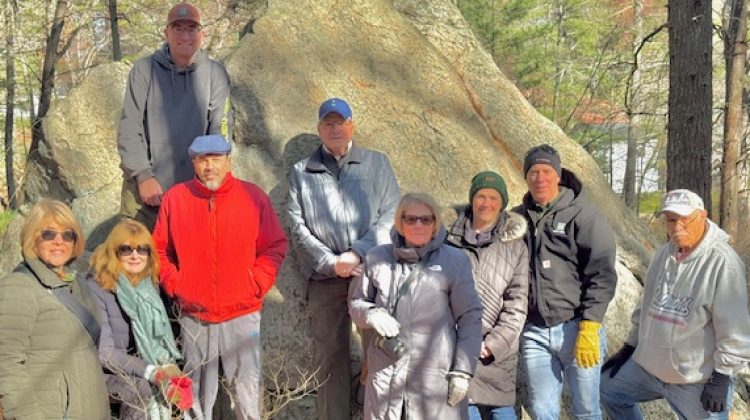
LYNNFIELD — The Open Space and Recreation Working Group hosted a hike through Willis Woods to a glacial erratic, one of many large boulders deposited across North America by retreating glaciers at the end of the last ice age.
The erratic was identified late last year as OSRWG were scouting through the Willis Woods: a section of more than 600 acres of contiguous, undeveloped, forested land at the intersection of Lynnfield, Peabody, North Reading, and Middleton along the Ipswitch River.
Geologist Nick Federico, Lynnfield resident and OSRWG member, discussed the discovery earlier this year.
“These rocks are usually by themselves and in random locations,” he said. “The geology of the erratics are usually not native to the area… For example, this one in Willis Woods could have come from Canada.”
The walk’s event page noted the significance of glacial erratics, calling them “a testament to the immense power of glaciers, which can pick up and move enormous blocks of rock over great distances.” Geologists can identify an erratic when a rock’s composition is different from the local bedrock but is similar to bedrock in another area.
Describing the route taken on this past weekend’s walk through Willis Woods, Federico said, “While walking through Willis Woods, toward the glacial erratic, most of the paths are similar to the surficial geology on the maps. Small hills, swamps, streams, and sporadic rocks are scattered throughout the woods. All these findings are an indicator that the area was shaped by glaciers. The last glaciers to pass this area of New England was about 10,000 years ago and transformed most of the northeastern United States.”
New England is home to the largest glacial erratic in the North Atlantic, the Madison Boulder in Madison, NH. According to the walk’s event page, the Madison Boulder is “a granite boulder measuring approximately 83 feet long, 37 feet wide, and 23 feet high.” Many other erratics are strewn about the region, such those in Lynn Woods, Harold Parker State Forest in Andover, and a pair called “The Monoliths” in Manchester-by-the-Sea.
The OSRWG was formed in 2022 by the Select Board to implement the Open Space and Recreation Plan with goals including managing, maintaining, and improving the town’s open spaces to provide recreational opportunities and to protect important wildlife habitats.
Among those open spaces is Willis Woods, the object of a “collaborative effort to plan for the protection of a large area of open space along the Ipswich River,” according to the Conservation Committee’s Willis Woods project page. That page states the plans for a network of recreational hiking paths and emphasizes how it will protect drinking water resources.
The Willis Woods project was “bolstered” by a Metropolitan Area Planning Council technical assistance grant in 2021.
The Conservation Committee page detailing the Willis Woods plan states that while some of Willis Woods is already protected, other parts of it are vulnerable to development: “Some of the area is owned by the Lynnfield Center Water District, some is owned by other towns in Essex County but not yet permanently protected, and other areas are unprotected privately-owned land.”