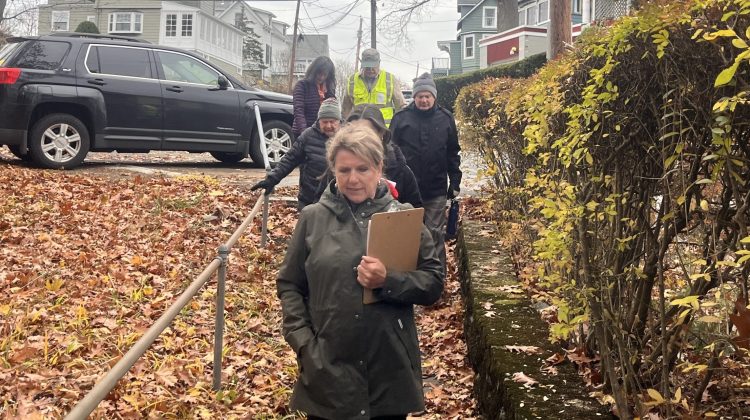
SWAMPSCOTT — Community Development staff and volunteers from the Tree Committee, Historical Society, Historical Commission, and Open Space and Recreation Committee conducted a walk through of various public trails to confirm their conditions, location, and ensure future use by residents.
It was part of the Town’s perambulation walk, which refers to the periodic inspection of municipal boundaries and certain public rights of way. While perambulations are historically focused on town boundary markers, numerous communities, Swampscott included, also carry out routine inspections of unaccepted or unbuilt streets, which are commonly known as paper streets, along with historic paths and legacy access corridors, according to Senior Planner Christa McGaha.
By walking those areas, it allows the Town to document the conditions, understand levels of accessibility, identify maintenance needs, and collect data to inform future decisions regarding the use of the paper streets.
Each right of way was observed for surface conditions, accessibility, public use, vegetation encroachment, and any opportunities for clarifying boundaries or maintenance responsibilities. There were 13 different areas covered throughout the course of the walk.
- Jessie Street to Roy Street
- Roy Street to Melvin Avenue
- Longwood Drive
- Longwood Drive to Morningside Drive
- Forty Steps (Ingalls Terrace to Rockland Street)
- End of Claremont Terrace to Humphrey Street (no public access found)
- Elmwood Road to Hadley School/Redington Street
- Pinehill/Sargent Road to Walnut Road
- Walnut/Sargent Road to Walnut Road
- Forest Ave Extension
- Galloupes Point
- White Court/Blythswood Easement
- Hawthorne property along Cliffside Street
“I think it’s important that the Town does this to try and preserve public access to areas that everyone in the community can enjoy,” Open Space and Recreation Plan Committee member Paula Claridge said. “It’s heartening to know that they are paying attention to this and making sure the areas are maintained and accessible.”
Community and Economic Development Director Marzie Galazka shared those feelings, saying that it’s important to take inventory of public ways in order to preserve pedestrian access to the different trails in town.
“We definitely want to encourage walkability within the town — which is only about 3 square miles — so I want to make sure that our residents have the best and easiest paths to travel,” Galazka said. “In order to preserve them, we have to document them.”
McGaha said she was pleased to see residents already using some of the paths.
Historical Commission Vice Chair Jonathan Leamon also shared his thoughts on the efforts to preserve the different trails around Swampscott. And why he felt it was an important endeavor.
“I feel that there are a lot of opportunities for walking and exploring in Swampscott; the reason the areas were left open was to enable residents to enjoy the beautiful spots around town… It’s important to me to preserve the walking paths that were made available many, many years ago,” Leamon said.
He continued, saying he feels strongly about continuing that tradition to preserve the paths for future generations.
“I think one of the most important things is that people enjoy the outside, and that they join us in future walks to familiarize themselves with the paper streets so that we can continue to enjoy the many paths,” he said.