

Born and raised in West Lynn, in the “shade of the General Electric plant,” Alan I. Saltman grew up in a working-class household shaped by loss and perseverance.
When Saltman was 4, his father, who worked for GE, passed away. This left his mother to support the household through a small neighborhood grocery store she ran.
Saltman said, when talking with some friends that he had grown up with, they all shared the same sentiment: They had a great upbringing, but money was scarce — a reality shared by most families in Lynn at the time.
Saltman recalled a time when a friend of his told him they had visited a “fabulous” house with a finished basement. They had commented, “Oh, I can never have anybody come to my house after seeing this.”
Saltman also recalled that when he was a child, “nicer things” were scarce. The rare purchase of a new car, for example, was considered a big deal.
Life presents you with opportunities.
Alan I. Saltman
You just have to recognize them
and be willing to take them.
Saltman, an academic standout, attended Connery Elementary and Breed Junior High before graduating from Lynn Classical. During his time in high school, he excelled, including winning the math and science fair, as he initially planned to pursue a career as an engineer.
After graduating from Classical, Saltman continued his education at Northeastern University, pursuing a long-held ambition to study electrical engineering. After two years, Saltman found himself no longer interested in studying engineering and was no longer thrilled with the prospect of it. He proceeded to graduate with a degree in economics. Although, his education did not stop there.
“I had read an article that said that the heads of a lot of corporations were lawyers… and that intrigued me,” Saltman said. “That’s when I started to think about becoming a lawyer.”
A new plan was on Saltman’s mind, and that was to pursue law, change the environment, and broaden his horizons. There were 10 schools that Saltman was considering attending, and he wound up on the waitlist at University of Pennsylvania. Ultimately, Saltman stayed in Massachusetts after being admitted to Boston College Law School, and he later served as an adjunct professor for several years. He went on to earn his JD, the professional doctorate necessary for practicing law in the U.S. This launched a legal career that spanned more than four decades. During his time in law school, Saltman’s personal life also reached a milestone when he married the daughter of a local doctor.
Saltman’s legal career began on a historic day in 1973. He recalled starting his practice on the day of the Roe v. Wade decision and the death of Lyndon B. Johnson — all falling on the eve of his 25th birthday. He began working in Washington D.C., where he joined what is currently known as the Government Accountability Office. He was originally hired to work on the team that was investigating then-President Richard Nixon for impounding funds, which is something that intrigued Saltman.
Following a series of rotations, Saltman wound up doing government contracts. He enjoyed the work so much that it became the cornerstone of his 50-year career. His career came down to holding the government responsible for doing the right thing. From computer software and rockets to paper clips, he managed all types of government contracts. He is also poised to be the foremost practitioner in the Northwest timber industry.
“I was from West Lynn. I knew all about timber. People would sort of laugh. I’m the least likely person in the world to do that,” Saltman said. “Your life takes various paths… and I got that opportunity and made a career largely on that. I try to tell this to my kids and grandkids: Life will present you with opportunities, and you have to be smart enough to decide to take them.”
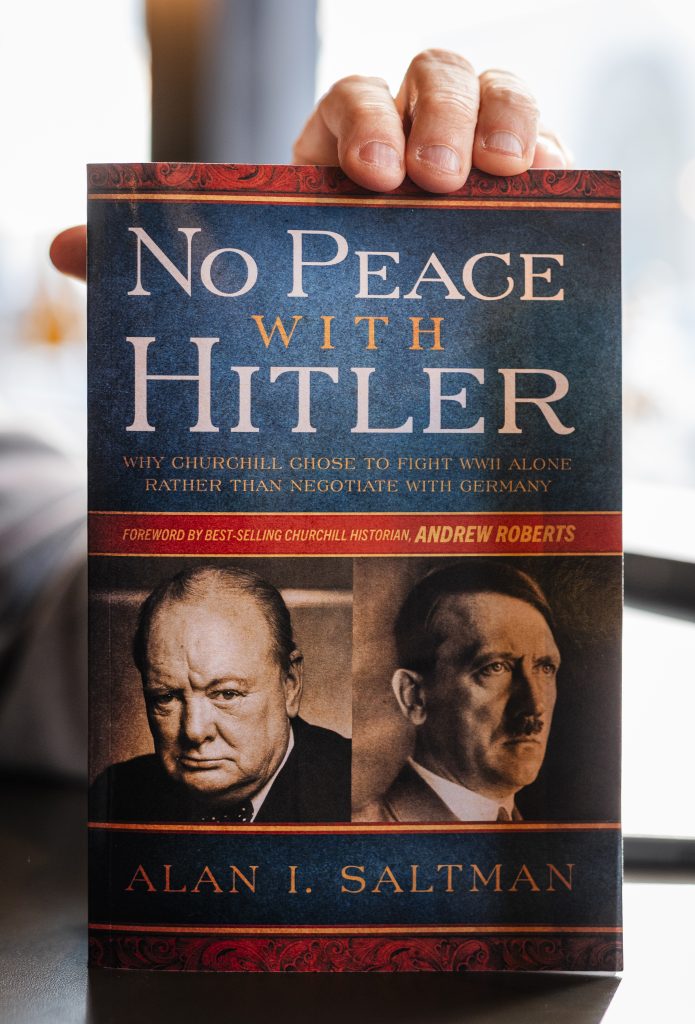


intricacies of publishing a book.

Saltman gradually transitioned into semi-retirement after decades in private practice. He started his own firm that eventually merged with a bigger firm based in Seattle. That firm later absolved, and he wound up back at his own firm before becoming a sole practitioner. He now works out of his home with just one remaining client, which is more than enough for him.
Now that Saltman is semi-retired, a new, unexpected path came into his life: becoming an author. Inspiration struck in 2017 with the release of the war/thriller film “The Darkest Hour.” Directed by Joe Wright, the movie chronicles Winston Churchill’s critical early weeks as British Prime Minister in May 1940. It focuses on the monumental decision he faced: to negotiate peace with Nazi Germany or to continue fighting as Hitler’s forces invaded Western Europe, with the very survival of the nation at stake. Prior to this, there had been no initial interest in or motivation to start writing. He went into the movie not knowing much more about Winston Churchill than the average person and left with the question: Why did Churchill reject peace negotiations with Adolf Hitler?
“How could he not cut a deal? He was, I thought, condemning half a million of his people to death,” Saltman said. “Hitler would bomb England… They would invade England, so I started doing research.”
This question sent Saltman on a journey, as he embarked on years of research alongside a psychiatrist to better understand Churchill’s mindset and why he made what seemed like a reckless decision. After three years of research and learning about Churchill, Saltman would publish his first book in 2022 titled “No Peace with Hitler: Why Churchill Chose to Fight WWII Alone Rather than Negotiate with Germany,” foreworded by best-selling Churchill historian Andrew Roberts. This 700-page book argued that Churchill’s decision was neither irrational nor reckless, but a calculated act that ultimately preserved democracy. Saltman also traced back to Churchill’s troubled childhood, which created a lifelong drive to prove himself, particularly to a distant and critical father. The book also challenges several long-standing myths about Churchill, one of which are the accusations against Churchill relating to the famine in India during World War II, which remains highly controversial.
Earlier this year, Saltman released his second book titled “Chamberlain and Churchill The Antagonists Who Saved Democracy.” This time around, Saltman focused on the complex relationship between Churchill and Neville Chamberlain, who served as Prime Minister from 1937 until his resignation in 1940, when Churchill took over.
Saltman argued that Chamberlain played a critical role in Britain’s refusal to appease Hitler, casting a decisive vote that allowed Churchill’s leadership to prevail. In the book, Saltman draws striking parallels between Churchill and Chamberlain, including childhood trauma and a shared desire to prove themselves, despite arriving at very different conclusions about how to confront Nazi Germany. Many viewed the pair as opposites, yet they were complementary and couldn’t fulfill their roles without each other.

Saltman now resides in Maryland with no immediate plans to write another book. Although Saltman does not rule out the possibility of releasing another in the future. He continues to speak publicly about history, leadership, and accountability, and with his time growing up in West Lynn, to having a decades-long law career, and becoming a late-life author, he reflects on a simple lesson.
“Life presents you with opportunities,” Saltman said. “You just have to recognize them and be willing to take them.”