
SWAMPSCOTT — At a quarter past 4 on a cold January morning, Henry Palmer Ingalls entered the world, 7 pounds, 13 ounces, and carrying with him nearly four centuries of Swampscott history.
Born on Jan. 31, Henry represents the 13th generation of the Ingalls family to call Swampscott home, a lineage that stretches back to the town’s earliest beginnings. While most newborns arrive with a blank slate, Henry’s story began long before his first breath, woven into the streets, shorelines, and landmarks of the coastal town his family has never left.
“It’s pretty amazing when you think about it,” his grandfather, John Ingalls, said. “Four hundred years. And we’re still here.”
The Ingalls family arrived in New England from Lincolnshire, England, in 1628, enduring an arduous 11-week journey across the Atlantic. A year later, Francis Ingalls established the first tannery in the Massachusetts Bay Colony along what is now Hawthorne — or Stony — Brook, near the corner of New Ocean Street and Burrill Street. The tannery became one of the earliest businesses in the region and helped anchor the settlement that would become Swampscott.
That same ground remains part of daily life today.
“To know they were walking where I walk, looking at the same ocean — it really gets you,” John Ingalls said. “You don’t always think about it, but when you do, it blows you away.”
As Swampscott grew, so did the Ingalls family’s presence. Along Humphrey Street once stood “Ingalls Row,” where five brothers lived side by side. The five later fought in the Revolutionary War, cementing the family’s role not just in local history, but in the founding of the nation itself.
One brother, Joseph Ingalls, owned what is now the Swampscott Club, famously selling the property in the 1700s for two cows. Today, members jokingly say his spirit still haunts the building’s second floor.
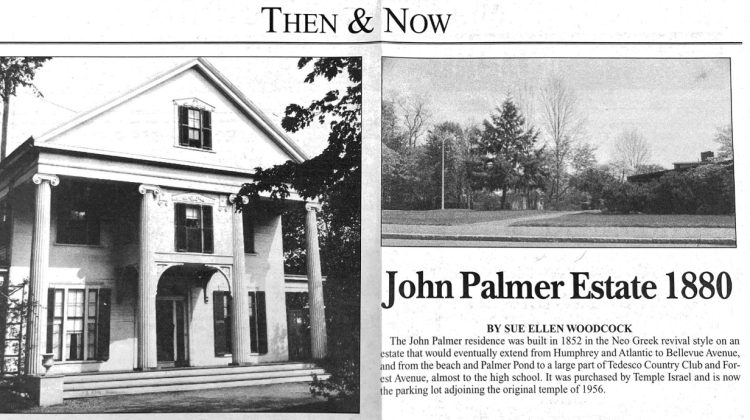
Elsewhere in town, the family name appears in stained glass at the former Unitarian Universalist church and through the Palmer family line, after a marriage connected the Ingallses to one of Swampscott’s largest landowning families. Palmer Pond, the former Palmer School, and much of the surrounding land trace back to that branch of the family.
“I always say I’ve got two sides of Swampscott history in me,” John Ingalls said. “And that’s pretty special.”
The family’s history also includes darker chapters. Martha Ingalls Carrier, a descendant of Edmund Ingalls, was executed during the Salem witch trials in August 1692. Her story, preserved in historical records, remains a sobering reminder of the dangers and fears of early colonial life.
“It’s not something you forget,” John Ingalls said. “But it’s part of who we are.”
Generations later, the family remains rooted in Swampscott. Henry’s grandfather spent 38 years in the restaurant business, operating Palmer’s Restaurant locally before retiring and turning to commercial fishing — a trade that keeps him on the same waters his ancestors once relied upon.
Looking toward shore from the boat, he often finds himself thinking about those who came before him.
“I’ll look over at the Swampscott Club and think, ‘One of my family (members) lived there back in the 1700s.’ That kind of connection never really leaves you,” John Ingalls said.
Henry’s father, Aaron Ingalls, was adopted as a newborn and raised in Swampscott — a fact his family speaks of with pride.
“Family is family,” John Ingalls said. “That’s what matters.”
As towns like Salem and Lynn prepare to commemorate 400 years of history, he hopes Swampscott will also pause to reflect, not just on dates and buildings, but on the families who have quietly carried its story forward.
For baby Henry Palmer Ingalls, the future is unwritten. But his roots run deep, and his place in Swampscott’s long story is already secured.