
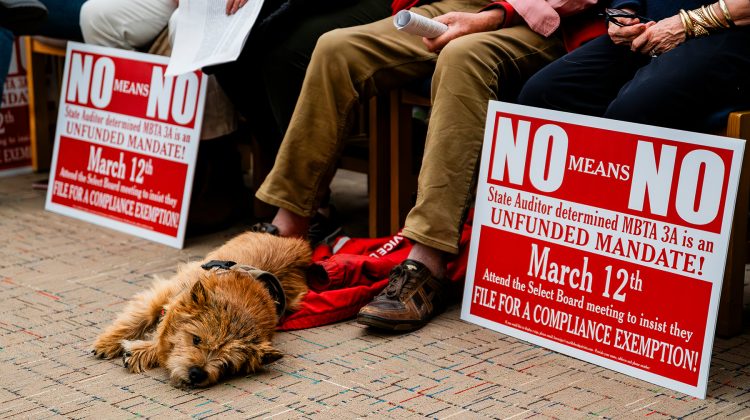
MARBLEHEAD — The Massachusetts Attorney General, Andrea Joy Campbell, has filed suit on Jan. 29 against Marblehead over its continued noncompliance with the state’s MBTA Communities zoning law, escalating a dispute that has already begun to carry tangible financial consequences for the town. On Thursday, Marblehead has now taken its first formal step toward restoring compliance.
The lawsuit, filed in Suffolk Superior Court this week, seeks to compel Marblehead and eight other municipalities, including Dracut, East Bridgewater, Halifax, Holden, Middleton, Tewksbury, Wilmington, and Winthrop, to comply with Section 3A of the state zoning law, which requires MBTA-served communities to allow multifamily housing by right in at least one zoning district.
The filing comes as Marblehead officials are already grappling with the loss of grant funding tied directly to the town’s noncompliance. However, new information confirms that the town has recently received pre-adoption feedback from the Executive Office of Housing and Livable Communities (EOHLC), indicating that its latest proposed 3A zoning plan does not conflict with state regulations, marking what local officials describe as a significant turning point.
Even before the lawsuit, Marblehead had begun to feel the effects of its 3A status. Town officials have confirmed that Marblehead is no longer eligible for several discretionary state grants, including the Community Transit Grant Program, which helps fund the Council on Aging’s senior transportation services.
Town Administrator Thatcher Kezer has warned that without restored eligibility, the town may be forced to absorb high new costs to maintain the COA shuttle program. The grant has historically provided both operating funds and an 80% state match for vehicle replacement, supplying three of the town’s four vans. Any future vehicle replacements would need to be funded entirely through local dollars.
Select Board members have expressed growing concern as additional funding impacts continue to surface.
“We’re losing money we don’t have,” Select Board member Erin Noonan said at a recent Select Board meeting. “Every meeting we’ve had, something else has come up that we’ve lost.”
State Rep. Jenny Armini has cautioned that Marblehead’s noncompliance could jeopardize a broad range of discretionary state and federal grants, particularly those tied to infrastructure, climate resilience, and community development. While formula-based aid, such as Chapter 70 education funding and Chapter 90 road funding, is not affected, competitive grants increasingly require or heavily weigh 3A compliance.
Among the programs at risk is the Municipal Vulnerability Preparedness (MVP) Program, which previously funded planning work that led to a $2 million grant for improvements at Parker’s Boatyard. Continued noncompliance could also weaken Marblehead’s ability to compete for matching funds for major infrastructure projects, including repairs or replacement of the structurally deficient Village Street Bridge.
Despite the lawsuit, Marblehead officials say meaningful progress toward compliance is now underway.
In a Feb. 5 letter to Planning Director Brendan Callahan, EOHLC confirmed that it “did not identify any items that conflict with the requirements of the regulations” in Marblehead’s most recent pre-adoption submission for a 3A multifamily overlay district. While the letter does not constitute final certification, it states that adoption of the district would place Marblehead “in a good position for compliance.”
Select Board Chair Dan Fox described the determination as the town’s first clear breakthrough.
“They reviewed our plan, and we addressed all five comments from the previous submission,” Fox said. “This is pre-compliance approval. Once the Town Meeting passes it, it goes back to EOHLC and then to the Attorney General for final approval. At that point, we would no longer be in noncompliance with 3A.”
Under the current proposal, the town’s 3A compliance would be achieved through a multifamily overlay district, rather than a rezoning that mandates construction. The two primary areas identified are the Tedesco Country Club property and Broughton Road, including land associated with the Marblehead Housing Authority.
“The word ‘development’ is what gets people concerned,” Fox said. “This is not a building mandate. It’s an overlay that allows multifamily housing by right. It doesn’t mean anything has to be built.”
Fox noted that the Marblehead Housing Authority is already working on a separate housing proposal on Broughton Road, and that the overlay zoning would support that effort. In contrast, he said the Tedesco property is expected to remain largely unchanged.
“In all likelihood, Tedesco will stay the same,” he said.
Marblehead has already brought two 3A zoning proposals to Town Meeting. One failed outright, and a second passed before being overturned by referendum, highlighting deep divisions within the community.
The current proposal reflects revisions based on resident feedback, particularly concerns related to traffic impacts, density, and neighborhood character.
The Planning Department and Planning Board are continuing technical modeling and feasibility analysis with state-funded consultants, adopting a more internally driven, data-focused approach intended to rebuild public trust.
While the Attorney General’s lawsuit adds urgency, town officials continue to emphasize that local adoption of a compliant zoning plan remains Marblehead’s best option, allowing the town to retain control over where and how multifamily housing is permitted — and to restore eligibility for critical funding — rather than risk a court-ordered solution.