
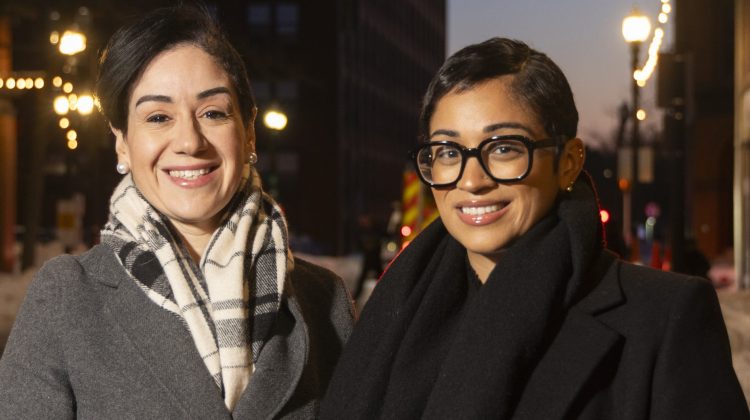
LYNN — Ivanna Solano has been speaking for those who can’t since she was 7 years old.
Growing up in an immigrant community in Lynn and often expected to be her mother’s translator, Solano witnessed firsthand how women in vulnerable communities often go unheard.
“Growing up an immigrant kid, I became an advocate before I even knew what the word meant,” said Solano, one of two commissioners representing Lynn, along with Brenda Ortiz McGrath, on the Essex County Commission on the Status of Women (ECCSW).
“I would see how folks would treat immigrants. I would see how people would speak to women. Seeing so much of that growing up and having to be the translator in my household really pushed me to want to advocate for their voices to be at the center of it all — for the voices of people and women that look like me to be taken into account and acknowledged.”
The ECCSW, a regional division of the Massachusetts Commission on the Status of Women, is an advocacy group that focuses on listening to women in vulnerable communities, identifying their needs, and advocating for their support.
“Women have always been the overlooked pillars of our society,” said Solano, who is also the founder and executive director of Love Your Magic, which supports the positive identity development of Black and Brown girls. “We (ECCSW) implement programs, advocate for policies, and try to really think about innovative ways to address their concerns. That lets folks know that their experiences matter, that they matter, and that their voices matter.”
In addition to community surveys (current survey https://masscsw.org/about/regional-commissions/essex-county/), the ECCSW hosts occasional Listening Circles for vulnerable women of all ages, including the elderly, and is planning another for April. Listening Circles have been held in Lynn, Haverhill, Methuen, and Wenham.
Issues that have been raised by the community include the high costs of childcare, increased rates of domestic violence, and housing costs. The last two Listening Circles have focused on senior women.
“It seemed to us that senior women are sort of falling through the cracks a little bit. We’ve been trying to find those pockets of people who might be underrepresented and getting their voices heard,” said ECCSW Vice Chair Brianna Sullivan.
She added, “We’ve heard that from the senior women we’ve been speaking to, that the cost to have a safe place to live is becoming almost impossible to reckon with.”
Record-high data released this week by Harvard University’s Joint Studies for Housing Studies shows that 43.5 million U.S. households (30%) were cost-burdened in 2024 (spending more than 30% of their income on housing costs) and 21.6 million (16%) were severely burdened (spending more than half of their income on housing).
In Massachusetts, 36% of households were housing cost-burdened in 2024.
“There are so many issues in Lynn that affect our families. And gender pay gaps and economic hardships affect women across the Commonwealth,” said McGrath, who is also a Lynn School Committee member and on the Board of Directors of the National Association of Commissions for Women.
“Some of the challenges include lower-than-average earnings, career interruptions due to caregiving responsibilities, and higher poverty rates that exist for single mothers who struggle with housing and child care costs. Women statistically default as the caregiver, so that means missed work opportunities, part-time jobs, and career pauses: less income, less stability, more stress.”
According to the Institute for Women’s Policy Research, women are 35% to 38% more likely to live in poverty than men. Almost 15 million women in the U.S. live below the poverty line, and it is estimated that number would be cut in half if women received equal pay.
In Massachusetts, where one in nine women and girls live below the poverty line, closing the gender pay gap would reduce poverty among working women by 68.7%.
“Gender bias can result in unequal pay where women with the same responsibilities as men are often paid less,” said ECCSW Chair Geetha Ramani.
“While women may spend as much time in a role, their lower lifetime earnings hinder their ability to build their own assets and wealth at the same pace as men. Similarly, women carry the burden of caretaking, whether caring for their children or caring for their elderly parents. And often this type of caretaking takes significant time and is nearly always unpaid,” she added.
The ECCSW is currently pushing for legislation that would help Essex County women, including Parity on Boards, which seeks equal representation in respect to race and gender on public boards; The I Am Bill, which would provide free menstrual products in schools, shelters, and prisons; and CommonStart legislation which would increase access to affordable childcare and more financial support for educators to increase early childhood care options.
“Women need to maintain their ground in decision-making circles. History demonstrates how women’s voices have been left out of political, business, and societal spheres,” said Ramani. “… By providing these outlets, we ensure that women are not just bystanders but active participants.”
Upcoming ECCSW events include a Massachusetts Commission on the Status of Women’s Public Hearing in Brockton on March 24 https://masscsw.org/, the Empowerment Leadership Initiative (GELI) Summit in Amherst on April 23 https://masscsw.org/event/girls-empowerment-leadership-initiative-summit-2026/, and the promotion of North Shore Juneteenth Association’s Opening Night of Black Excellence on Feb. 10. https://itemlive.com/event/opening-night-of-black-excellence-2026/