
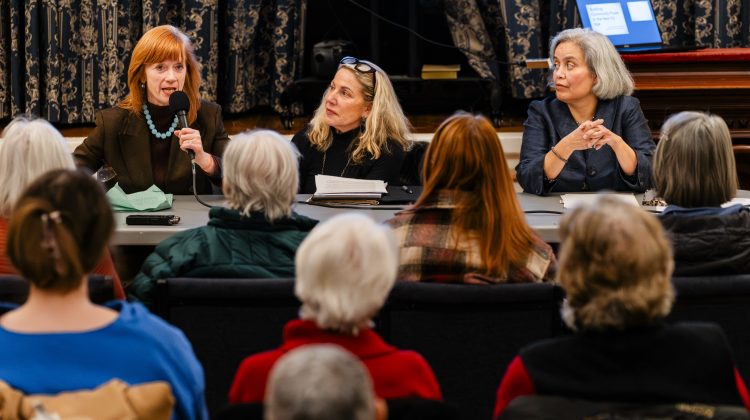
MARBLEHEAD — A standing-room crowd filled Old North Church for a community forum on immigration enforcement, legal pathways, and the concrete ways local residents can support immigrant families.
The panel brought together two veteran Marblehead immigration attorneys, Nancy Norman of Horrigan & Norman and Diann Slavit, alongside Dr. Alexandra Piñeros-Shields, a Brandeis University professor and longtime Essex County community organizer.
Senior Minister the Rev. Lindsay Popperson opened the evening by naming what many attendees were feeling: worry, uncertainty, and isolation.
“There are times when we can feel really alone and like we’re the only ones who feel the way that we feel,” she told the audience.
The turnout, of approximately 80 people, she said, was a reminder that concern is shared, and that community conversations like this are necessary.
The discussion focused on two intertwined questions: what has changed in immigration enforcement, and what ordinary people can do – locally and practically – to help immigrant neighbors stay safe, stable, and connected.
Attorney Diann Slavit, who represents asylum seekers, families, and work-permit applicants, began with a blunt assessment of what she described as a shifting enforcement climate, one in which people with pending applications and no criminal history can still become targets.
Slavit’s practice includes pro bono advocacy for unaccompanied children as well as service through the Essex County Probate Court’s “Lawyer of the Day” program. She told the audience her work now feels like it has expanded beyond guiding clients through procedures.
“As an immigration attorney, my role has always been just to get my clients through the immigration process,” she said. “But now I feel like I have a second role … to defend my clients.”
In her remarks, Slavit described the fear created when rules appear to shift mid-process, especially for people pursuing lawful avenues such as asylum or humanitarian relief. She also focused on the growing pressures faced by unaccompanied minors, including obstacles that can discourage sponsors from stepping forward to care for children in federal custody.
Slavit’s background extends beyond immigration law. She is also a longtime civic activist with Moms Demand Action and the Massachusetts Coalition to Prevent Gun Violence, a former Deputy Campaign Director for the Massachusetts Democratic Party, and in 2024 served as a delegate for Massachusetts’ 6th Congressional District to the Democratic National Convention – experience, she suggested, reinforces how policy decisions translate into lived consequences.
Attorney Nancy Norman, of Horrigan & Norman, followed with a practical roadmap of how immigration lawyers evaluate cases and identify available options, especially in an increasingly restrictive environment.
Norman has dedicated her career exclusively to immigration law, with nearly 40 years of experience, and is widely regarded as one of Massachusetts’ most seasoned removal defense experts. Other attorneys, she noted, regularly refer their most complex cases to her, particularly those involving deportation defense matters that unfold in U.S. Immigration Court.
Norman emphasized that immigration law is highly individualized: the details of a person’s entry history, family ties, work history, victimization, and any previous interaction with the immigration system can completely change what relief is possible.
Her process, she said, begins with “tons of questions” so she can determine the best legal outcome, whether that means stopping deportation, reopening a case, or identifying a path toward lawful permanent residence or citizenship.
She then offered a clear overview of the system’s building blocks: temporary visas versus immigrant visas (green cards), family-based versus employment-based pathways, and the complicated role of waivers and lawful entry. She also addressed protections and pathways that may apply in some cases, including relief for survivors of abuse, victims of certain crimes, and trafficking survivors – while stressing that legal help is essential because small facts can determine eligibility.
After hearing the earlier enforcement updates, Norman acknowledged what many in the room were likely thinking: What do we do now?
Her answer was straightforward: attorneys keep fighting case by case, nonprofit networks collaborate, and federal court strategies can sometimes be used to challenge unlawful detention. But, she said, the law alone can’t carry the burden. Community support is part of what makes legal defense possible in practice.
Dr. Alexandra Piñeros-Shields widened the frame, connecting today’s enforcement climate to longer historical trends and to the civic choices communities make.
Piñeros-Shields is an Associate Professor and Director of the Master of Public Policy Program at the Heller School for Social Policy and Management at Brandeis University. Her work focuses on immigration policy, economic justice, and community-based research. She previously served as Executive Director of the Essex County Community Organization (ECCO), an interfaith network involved in racial and economic justice efforts.
She has also advised former Governor Deval Patrick’s New Americans Agenda, and currently serves as President of the Massachusetts Budget and Policy Center board, as well as a board member of the ACLU of Massachusetts and Philanthropy Massachusetts, roles that bridge research, advocacy, and institutional policy.
Piñeros-Shields began with a personal story about her family’s experience immigrating through a U.S. embassy, a pathway that felt strikingly different, she said, from what immigrant families face today. Then she offered a historical snapshot: across the 20th and 21st centuries, federal immigration responsibilities shifted from being housed within agencies focused on labor to justice, and eventually to homeland security. The bureaucratic arc, she argued, reflects how immigrants have increasingly been framed as threats rather than contributors.
Her central message: the “logics of expulsion” must be met with “logics of belonging.”
In practice, she said, that means building local networks of support and acting at multiple levels – direct service, municipal policy, and the civic stories communities tell about who belongs.
A major theme of the night was that people often want to help, but don’t know where to start. The panel answered that meaningful action doesn’t require expertise – just commitment, coordination, and attention to what’s happening locally.
Among the strategies discussed is supporting legal defense funds and nonprofit legal organizations, especially because immigrants in civil immigration proceedings do not have a guaranteed right to counsel.
As well as contribute to mutual aid funds that help families cover essentials when work authorization is delayed, or legal options are limited, and participate in court accompaniment programs, where trained volunteers attend hearings to provide support and observe interactions when immigration enforcement is reported near courthouses.
Another strategy is neighborhood-level solidarity, including phone trees and rapid communication networks, so families aren’t isolated if enforcement activity is reported.
Throughout the evening, the panel returned to one underlying point: immigration issues may be debated nationally, but their impacts are felt street by street, at workplaces, schools, court buildings, and family dinner tables.
And the response, the speakers insisted, can also be local: organized, persistent, and rooted in community.
The forum did not offer easy answers. What it offered instead was a clearer picture of what immigrant families are facing, and a set of practical entry points for residents who want to help.
If the goal is to counter fear with stability, the panelists suggested, then “belonging” isn’t a slogan; it’s something communities build through legal defense, mutual aid, and policies that keep neighbors connected rather than exposed.
As Popperson said in her welcome, the gathering itself was proof that people are not alone. The panel’s message went one step further: concern is important, but it becomes protective only when it turns into organized action.