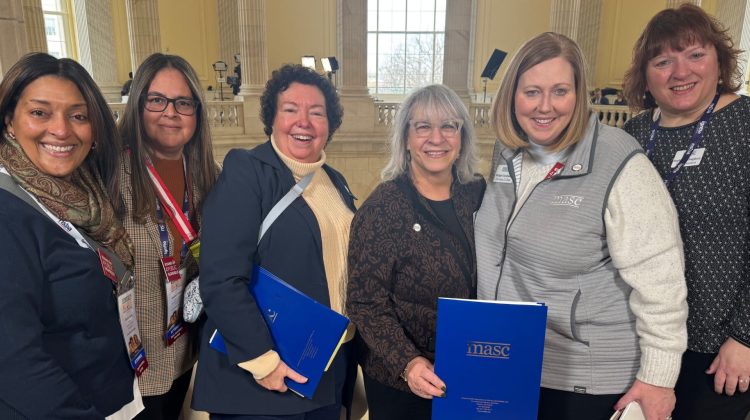
PEABODY — Earlier this month, longtime School Committee member Beverley Griffin Dunne, who is also the president-elect for the Massachusetts Association of School Committees, attended a convention in Washington, D.C., where priorities were set for the year for school committees, often also called school boards in other states, across the country.
This was her eighth year attending the National School Board Association’s Advocacy Institute, which she said approximately 500 people attended.
“We all come with state priorities as well, but they do work into the federal priorities of the NSBA because they are working for all of the states that are members,” Dunne said. “Much of it is funding because you’re going to be dealing with Congress, but a lot of it is about the policies and the actual face of public education going forward. You’re setting all of the parameters that you’re going to work for during the year, and we have courses, or seminars, on all of those topics.”
Dunne noted that, after two days of “hearing from wonderful speakers, people who are experts in their field of education,” everyone got a chance to spend a day on Capitol Hill. Attendees made appointments and visited with their Congressional delegates, meeting with the staff of the Congressmen and women, and the senators as well.
“It’s really great to sit down and talk with those staff members, to be able to give them information, to let them know what the actual impact of federal action is in the districts back here in Massachusetts, so we will give them concrete examples of the impact of losing Title 1 funding, for example, or trying to explain why we need to continue the IDEA (Individuals with Disabilities Education Act) funding and laws to protect special education students,” she said.
One of her biggest takeaways from her time on Capitol Hill was that there really is great work being done in Washington, D.C., despite government shutdowns.
“They continue working. They are all still working and doing the work for the people back here in the district, and they are very in tune with the worries that we have here about the federal funding and about the federal government’s impact on education,” Dunne said. “They are really skilled with dealing with the constant pull of politics in Washington and with the needs of the people back home. That was really, really nice to see, and very, very reassuring.”
She also excitedly shared that, during her day on Capitol Hill, she was able to get gallery passes to watch the funding vote. Dunne said she had a very nice experience with a young intern from a Texas Congressional office, who, rather than just giving directions, actually escorted Dunne’s group through the tunnel herself.
As a member of the state’s first Student Advisory Board at Peabody Veterans Memorial High School in 1973, Dunne has always been supportive of student leadership. So when Devin Sheehan, NSBA president, asked for her expertise and experience to be shared, Dunne jumped to help a friend.
“A little while later (after saying hello to Sheehan), I’m out in the hallway, and he came up to me, and he said, ‘Beverley, they have just come to me and want me to do a presentation tomorrow. Would you be available to speak on the role of student school committee members.’ I said, ‘Absolutely, no problem,’” Dunne said.
As part of the presentation, which drew in a crowd of approximately 70 people, two students joined remotely to share their concerns with the education system, notably regarding artificial intelligence, graduation requirements, the need for CTE education, student attendance in light of ICE agents in their states, funding for school supplies, and the overall future of public education.
“The best part was: When you listen to the students — and I always listen to our students because — you will hear some of the best, honest questions and discussions about education because these are the very people that are consuming that education,” Dunne said. “They’re right there. They’re on the ground. They’re seeing things happen. They’re concerned, and they want to make sure things go well.”
Dunne added that it felt like a “full circle moment” and a “great opportunity to meet people and talk about how to help students to represent their classmates, basically, and speak for them.”
With the rare down time she had, Dunne was able to tour the American Dream Experience, which she said was a “fascinating” museum.
“One of the key things we all picked up on was: The key to the American dream was education,” Dunne said.