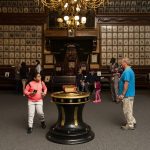
LYNN– As the Lynn Grand Army of The Republic Hall and Museum (GAR) prepares to unveil its long-awaited elevator with a ribbon-cutting next week, curator Wendy Joseph is focused on far more than just accessibility; she’s orchestrating a full reimagining of how visitors experience the historic space.
“Making the building handicap accessible is the first step in the revelation of this historic building,” said the GAR board chair, Patti Pendexter, who noted that two exhibits created by Joseph will be on display.
The new elevator, installed to meet ADA compliance, has reshaped the building both physically and conceptually. “We lost some exhibit space to the elevator,” Joseph explained during a recent walkthrough, “so we’re rethinking how everything fits together.” The result is a series of refreshed and expanded exhibits that blend historical storytelling with modern accessibility standards.
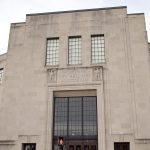
There will be a ribbon-cutting ceremony for the elevator on March 24 at 10 a.m. at the GAR, 58 Andrew St.
In addition to the elevator, there are other improvements in the building, including accessible bathrooms. The city invested $2.2 million in ARPA (American Rescue Plan Act) funding for the project. The GAR received a $400,000 Community Development Block Grant, and they also raised additional funds, including a $50,000 gift from the Friends of GAR.
“We are proud to have the GAR in Lynn, and we appreciate the value it adds to the community,” Mayor Jared Nicholson said. “This is one of the many uses of ARPA funds that have had a meaningful impact in the city.”
Two exhibits in particular highlight this transformation: Civil War Medicine in the GAR Years and The Lincoln and Grant Library. Both are being carefully reinstalled and reinterpreted ahead of the opening.
In the Civil War medicine room, Joseph has assembled a striking collection that illustrates the realities faced by soldiers long after the battlefield. Among the most unusual artifacts is a rare electrotherapy device, a hand-cranked machine once used as a form of “patent medicine.”
“You would hold both handles and generate an electric current,” she said. “It was supposed to treat various ailments. It’s extremely rare, especially with a GAR connection.”
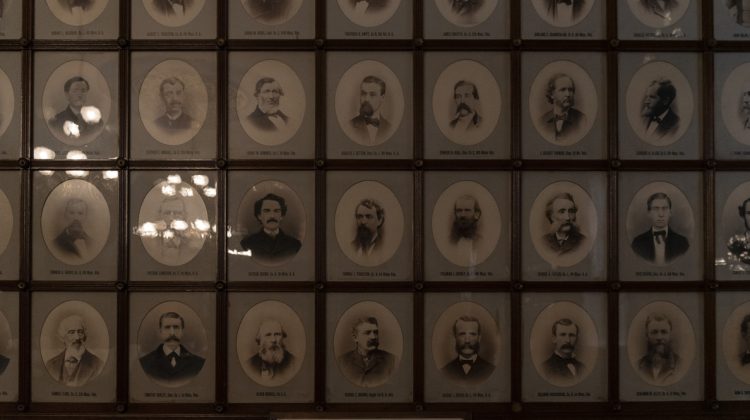
The exhibit also tells deeply human stories. Photographs made from glass negatives show veterans whose lives took drastically different paths after the war. One soldier returned home but struggled with lasting trauma and instability, while another—despite losing an arm—went on to serve his community for decades.
“You’ve got some people who could function very well,” Joseph noted, “and others whose lives were completely derailed.”
Artifacts discovered in the building’s attic add another layer of authenticity. A wooden brace and an adaptive viewing device, which was once used so disabled veterans could still participate in events in the grand hall, demonstrates how the GAR community supported its members.
“It didn’t matter if you couldn’t walk,” Joseph said. “They made sure you could still be part of what was going on.”
Next door, the Lincoln and Grant Library is still coming together, with empty spaces awaiting heavy, historic pieces that require specialized installation. Financial constraints have delayed their return, but the museum is actively seeking funding to complete the process.
“Some of these items take three people to move,” Joseph said. “They’re fragile, and putting them back isn’t covered under our current funding.”
During their ribbon-cutting, there will be signs encouraging donations to the GAR through their website or with a check.
Joseph also mentioned the possibility of bringing back a bean supper that was a fundraiser for the museum.
“Like 22 years ago, they still used to have bean suppers. And that’s another time that they would, we always get duplicate books donated to us.” Joseph explained. “So we would sell (them)…for crazy low prices to get rid of books,”
The gallery also reflects a broader shift in the museum’s mission. Trustees are working toward expanding the narrative beyond the Civil War to include veterans from all eras. This has meant new research and entirely new interpretive materials.
“These are not just updated exhibits,” Joseph emphasized. “They’re greatly expanded, with more context and deeper stories.”
Accessibility has influenced every decision. Joseph has been testing layouts herself, ensuring enough space for wheelchair movement and rethinking traditional setups. “We can’t put chairs around tables the way we used to,” she said. “A lot is changing, and it will continue to change.”
Despite the challenges, Joseph sees the upcoming ribbon-cutting as a turning point. “This is the end of one chapter and the beginning of another,” she said. Her hope is that residents will see the museum not just as a historical site, but as a living community resource, one that welcomes veterans groups, historians, and the public alike.
Next week’s event may celebrate an elevator and improvements, but it ultimately marks something much larger: a renewed commitment to preserving history while making it accessible to all.