
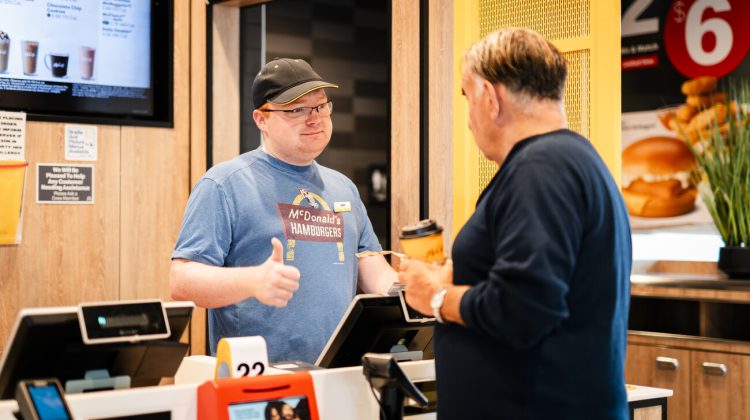
SAUGUS — When Bitty and Beau’s Coffee in Melrose, which specifically employs people with disabilities, closed, McDonald’s franchisee Lindsay Wallin called to ask whether any of the employees would be a good fit. Conor Farrell, who has autism, has now worked at the restaurant at 738 Broadway for 2.5 years.
With March being Disabilities Awareness Month and April being Autism Awareness Month, Wallin wanted to highlight the incredible work Conor Farrell has done since he was hired at the location, and to emphasize the importance of employing and making visible those with disabilities in the workforce.
Conor Farrell has enjoyed his time working at the restaurant, and his favorite part has been “Taking customers’ orders and delivering their food. It makes me feel so proud.”
He continued that he’s proud of what he’d done there.
“I’m proud of all the hard work I do, and I’m proud that I get to earn my own money,” he said.
His mother, Terri Farrell, echoed this sentiment, noting that her son has become more confident as he earns his own money, pays taxes, and lives in his own apartment.
“It allows him to feel confident (and say) ‘Oh, I can do more things on my own because I’m a valued member of the community,'” she said.
Conor Farrell also noted how his coworkers are always there to help him out when things get overwhelming.
“Sometimes when things get busy, my coworkers switch jobs with me. Sometimes they ask me, and sometimes I ask them. Sometimes I’ll start at the register and switch to the drive-through,” he said.
Terri Farrell said that oftentimes people with disabilities are seen for what they can’t do, not for what they can do and what they can achieve.
“Lindsay and the ownership group, and the management team here, value Conor for what he can do, and so they meet him where he is. And because of that, it allows him to shine and feel confident about himself. It just makes me so happy for him to be seen for what he can do,” she said.
Terri Farrell noted the importance of such a supportive work environment, stating that it doesn’t just benefit Conor but also other team members.
“It’s a symbiotic relationship where they can see someone else achieve it. I think it helps remove bias sometimes from how people perceive someone should act and how they should engage. I think it’s a value back and forth. He’s also a really funny, very outgoing person, and he sees the glass as half full. I think that rubs off on other people. It’s not just what they can do for him, but also what he brings to them,” she said.
She continued that the management team at the location has embraced Conor and created a positive work environment.
“It’s not just giving someone a chance; it’s giving someone an opportunity. And that’s a big difference,” she said.
Wallin said that when she lived in Melrose, she would go into Bitty and Beau’s, which was owned by a friend, and immediately felt “such a great energy” when she went inside.
She continued that the minute she heard it was closing, she had reached out to her friend, remembering the great attitudes of the staff at the shop and how hardworking and friendly they all were.
“Conor was at the top of the list, and he’s been here ever since,” she said.
Rachel Kaprielan, CEO of Triangle Inc., which helps people with disabilities connect with jobs, noted that Triangle relies on employers like Wallin to be willing to work with them.
“The data is uncontroverted. If they are suited for a job that they can do, not only do they do it well, but they almost never miss a day of work. They’re not looking at their phones for what’s next. And they bring up the whole culture. Everyone at this McDonald’s works with Conor, sees Conor’s contribution, and appreciates what he’s doing,” Kaprielan said.
Wallin continued, saying that having Conor on the team has been awesome and that he has raised everyone’s awareness and understanding.
“It brings everybody together as far as lifting him up and supporting him if he needs it, but he really holds his own, and he does a great job. I think the customers adore him, and it’s just fun to be able to provide these opportunities. And I don’t feel like we’re doing Conor any favors,” she said. “He’s really helping us a lot, and it’s a symbiotic relationship. We’re really thrilled to have him here.”
Kaprielan explained that there is a fundamental human desire to contribute and that it’s important to look at everyone as someone who can contribute.
Terri Farrell said that recently Conor brought up how he was learning Spanish while working at the restaurant, and even learned how to tell Spanish-speaking customers that he doesn’t know Spanish before going to get a coworker who can.
But it’s not just Conor showing care for the customers. Terri Farrell said that she recently saw a squishy gummy bear fidget on Conor’s dresser, and when asked where he got it, Conor said one of his regulars had given it to him.
“I think that’s really invaluable, because there obviously was an identification of ‘Oh, this might be something that could be helpful,’ because they might have a contact with somebody that’s autistic… It just made me feel so touched, and it made him feel so valued,” she said.
Wallin also noted that, as an owner of nine restaurants, she would love to hire others with disabilities.
“We are always looking for great young adults or kids… It’s not just how it helps us or how it helps the individual, but there’s also the customer’s… We have some customers that can be difficult, but for some reason, they are sort of calmed by Conor and the understanding that he might need a little extra time, and most of the time they’re perfectly happy giving him that… He’s really a gem here,” she said.