
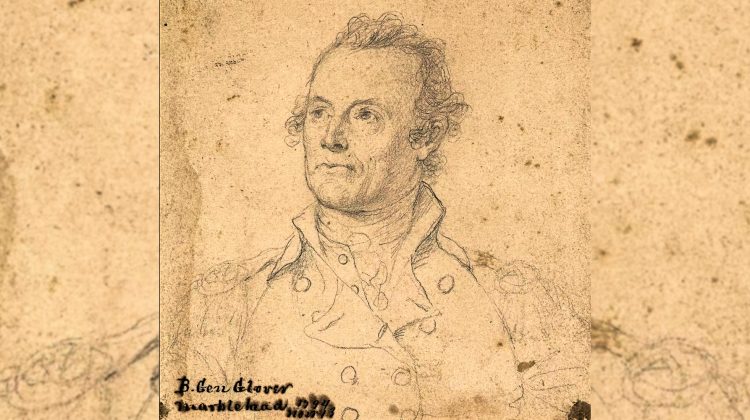
SWAMPSCOTT — As fundraising efforts ramp up and the clock on a demolition delay continues to tick down, local historians and preservation advocates are making a renewed push to save the Glover Farmhouse, arguing that the effort is about more than a building — it is about preserving a piece of history that cannot be replaced.
The Save the Glover campaign is leading that effort. They have raised over $500,000 across donations, pledges, and grants toward their $1 million goal needed by July to stay on track with the property’s redevelopment timeline.
“We’ve raised a lot of money so far,” said Nancy Lusignan Schultz, chair of the Swampscott Historical Commission. “I think if people are sitting on the fence and saying, ‘can they do it?’ now is the time … we can show that we have the money.”
The farmhouse, believed to be dated before 1750, is tied to Gen. John Glover, a Marblehead native whose role in the American Revolution has gained renewed attention as the country approaches its 250th anniversary.
Schultz said the urgency is real. A demolition delay on the property is set to expire on July 20. It’s the second demolition delay in the past few years that the Historical Commission has put on the property since the redevelopment plans began.
“This is the first time in the 300-year history of the house that somebody is actually trying to tear it down,” Schultz said. “There seems to be this idea out there like it’s falling down, but people need to understand we haven’t just been sitting on our heels.”
Part of the campaign’s work has included confirming the historical integrity of the structure itself. Schultz said that engineers found a significant portion of the original framing, about 75-80%, remains intact — even as later additions have deteriorated.
Support for the project has extended beyond the Commission. The Swampscott Historical Society, which is headquartered in the Humphrey House — one of the oldest standing homes in America — has contributed both financially and in sentiment. Leaders of the Historical Society have emphasized the importance of preserving a tangible link to the past.
“We’ve been helping the Historical Commission and Nancy’s efforts from the beginning, in any way we can,” said Molly Conner, president of the Swampscott Historical Society. “It’s really a shared effort to make sure this history isn’t lost.”
The society recently donated $1,000 to the campaign, part of what Conner described as a broader commitment to highlighting Glover’s legacy, including recent projects based on Revolutionary War history in the area.
Connie Carman, the society’s vice president, said the case for preservation is straightforward.
“We can’t replicate history,” Carman said. “Once it’s gone, it’s gone.”
The push to save the farmhouse has also brought renewed attention to Glover himself, a figure local historians describe as essential to the nation’s founding.
Glover, a merchant and fisherman-turned-military leader, commanded a regiment of Marblehead mariners whose skills proved critical during the Revolutionary War. His troops are best known for rowing George Washington and the Continental Army across the Delaware River on Christmas night in 1776, a moment later immortalized in one of the country’s most recognizable paintings.
But Schultz said that moment, famous as it is, is only one of several instances where Glover’s leadership helped preserve the American cause.
“He saved Washington’s army on three occasions,” she said. “Each time, had we lost, we wouldn’t have been the country. Glover is responsible for us even being able to succeed in the Revolution.”
Schultz said that Glover had long plans of returning home to the North Shore, but remained serving the young nation for as long as he was needed.
“He served a long time under Washington and sacrificed a lot,” she said. “All he wanted to do was buy a farm and retire to it, but Washington asked him to keep on, and he stayed.”
That legacy will be the focus of an upcoming public event, “General John Glover: Unsung Hero of the Revolution,” hosted by Essex Heritage, which is partnering with local organizers to highlight Glover’s role in the Revolutionary War.
The event will take place at the Salem Armory Visitors Center on April 29 from 6:30-7:45 p.m. Glover’s Marblehead Regiment, a local reenactment group, will perform, and local historians will speak about Glover’s North Shore legacy, from his birth in Salem to his fitting of “The Hannah,” the country’s first warship, in Beverly, to his retirement in Marblehead and what is now Swampscott.
Schultz hopes that the event will help build broader regional support for preservation efforts, emphasizing that Glover’s story extends beyond Swampscott and Marblehead.
“People in Salem should understand that John Glover was born there, and that this is a Salem story as much as well as a Marblehead, Swampscott, and Lynn story,” she said. “We need the full support of Essex County.”
Back in the present, supporters say the campaign has reached a pivotal moment. With roughly half of the needed funds raised and a deadline approaching, organizers are hoping the latest push will bring in the remaining support needed to move forward.
“A lot of people have expressed doubt that we would be able to raise this amount of money quickly enough,” Schultz said. “I hope people see what we’ve already done and understand that this is possible — but only if they step in now.”
For those involved, the effort is not just about saving a structure, but about preserving a story that continues to resonate within the historical fabric of Swampscott, Marblehead, and the Essex region.
“You can’t recreate something like this once it’s gone,” Carman said. “This is part of who we are.”