
PEABODY — To celebrate the grand reopening of the 54,000-square-foot Peabody Recycling Center, located at 109 Newbury St., Republic Services marked the occasion with a ribbon-cutting before showing off the facility’s new upgrades on Tuesday.
The facility was built in 2015, and in 2023, when Republic acknowledged the need to better its systems, Machinex Technologies was contracted to take on the project. It was then closed from April to December of last year for the improvements to be made.
Despite its name, the Peabody Recycling Center is not recycling anything on-site; rather, it is sorting and collecting recyclable materials so they can be reused in the future.
The new Material Recoveries Facility — the approximately 40-foot structure of new equipment needed for daily operations — features ballistic sorters, a sophisticated conveyor system, eddy current separators, and enhanced safety systems, including a new Fire Rover system. Additionally, the various improvements increase the facility’s output to 35-40 tons per hour.
“Peabody Recycling Center is a state-of-the-art facility designed to make precise recycling processing much better,” said Brian Skehan, Republic Services general manager. “This 54,000-square-foot facility is home to new equipment, much empowered by AI technologies.”
This new infrastructure utilizes AI to separate the materials brought to the facility more effectively, ultimately creating a cleaner product.
“Sustainability is in our DNA at Republic Services,” Skehan said. “We are fully committed to providing sustainable solutions for our customers throughout the Greater Boston area.”
Kathi Mirza, branch chief for the Massachusetts Department of Environmental Protection’s Municipal Waste Reduction Program, said she was “quite impressed” with the new facility and that she appreciated how it will assist with waste reduction.
“We have very ambitious goals for the state: to reduce waste by 30% by 2030. And we know that recycling and the capacity to recycle more are very important parts of that equation,” Mirza said.
Machinex Technologies Inc. Senior Project Manager Chris Hayes explained that there are cameras throughout the facility, and within the necessary equipment, that monitor the entire conveyor belt system. Via those cameras, AI is used to identify objects based on their shape and composition.
“Imagine taking 100 million pictures of an aluminum can crushed every way possible, and then it loads into the neural network, and it’s able to identify it based on its two-dimensional shape on the belt,” Hayes said.
The database then tells the AI which objects are meant to go where throughout the system. Republic Services Operations Manager Joe Ganno added that the AI learns along the way, and Machinex is able to make “tweaks and adjustments as we give them information as well.” So if there is waste found where it shouldn’t be, Republic can fix the problem by updating the AI software.
Ganno emphasized that the AI isn’t taking away from human jobs, though, as people are needed to double check the machine’s work throughout the sorting process.
“This is our optical sorter,” Ganno said, approaching one of the many machines within the new structure. “This is using AI technology to sort paper. This right here is making sure that anything that’s paper is dropping down and going into this room here. The AI does the work (and) sends it into this room. Our manual sorters look and say, ‘Yup, OK, AI did what it’s supposed to do. (Or) AI missed that; I’m going to grab that out.’”
Pointing around the facility, Ganno added, “We do that here with the paper. Up there is some cardboard, and these two back ones here, one is for PET (polyethylene terephthalate) and then one is for mixed plastic. Pretty much, there’s an AI component to everything that we’re sorting, but then there’s a human face behind there that’s the last chance line.”
What stood out to Ganno about the new facility was that the grand improvements in equipment — like the “infinitely bigger” end feeder, where the material goes — can equally translate into grand impacts made for the approximately 35 staff members, as they now have heat and air conditioning available in their sorting cabins, and for the environment.
“This is so great for Republic Services because it’s allowing us to use technology and to use people to get the best commodity, the best sort separation, that we can,” Ganno said. “It’s allowing us to take in more tons per hour, which is allowing us to increase our sustainable footprint by soliciting more customers to bring us more recycle(able materials). So we’re extremely excited to be here and to be able to take in more recycling.”
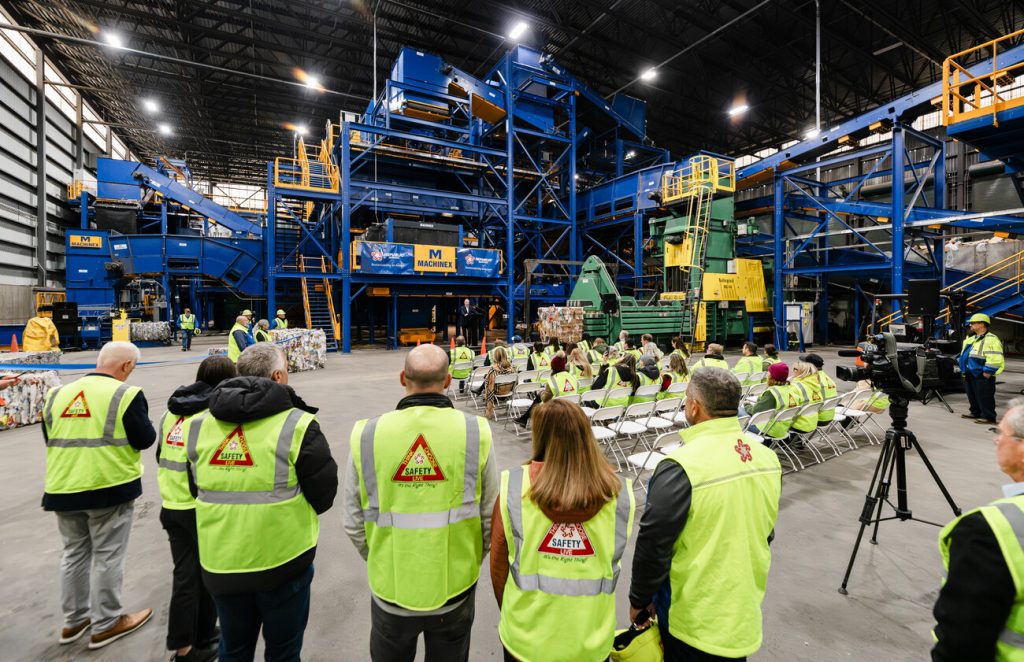
Photo: Spenser Hasak | Purchase this photo

Photo: Spenser Hasak | Purchase this photo

Photo: Spenser Hasak | Purchase this photo
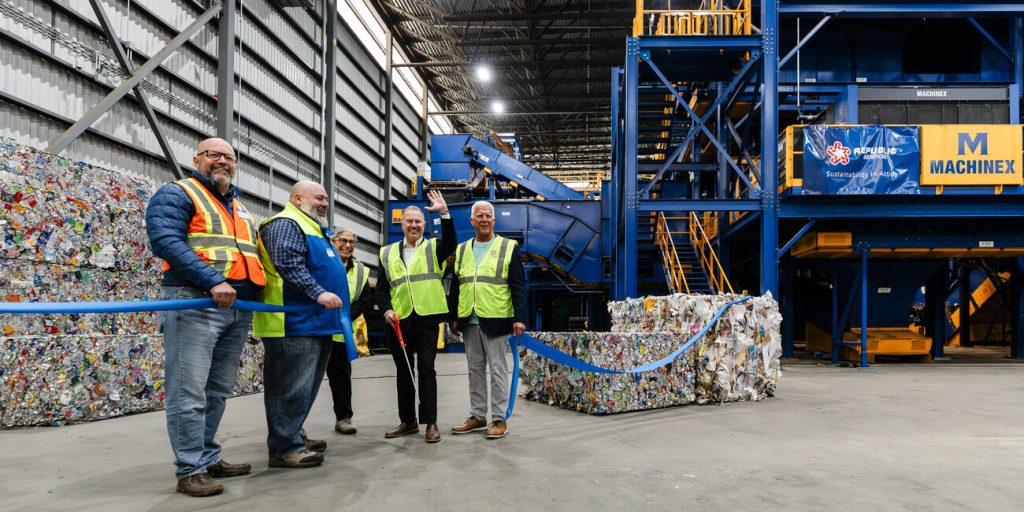
Photo: Spenser Hasak | Purchase this photo

Photo: Spenser Hasak | Purchase this photo

Photo: Spenser Hasak | Purchase this photo

Photo: Spenser Hasak | Purchase this photo

Photo: Spenser Hasak | Purchase this photo

Photo: Spenser Hasak | Purchase this photo

Photo: Spenser Hasak | Purchase this photo

Photo: Spenser Hasak | Purchase this photo

Photo: Spenser Hasak | Purchase this photo

Photo: Spenser Hasak | Purchase this photo

Photo: Spenser Hasak | Purchase this photo

Photo: Spenser Hasak | Purchase this photo

Photo: Spenser Hasak | Purchase this photo

Photo: Spenser Hasak | Purchase this photo

Photo: Spenser Hasak | Purchase this photo