
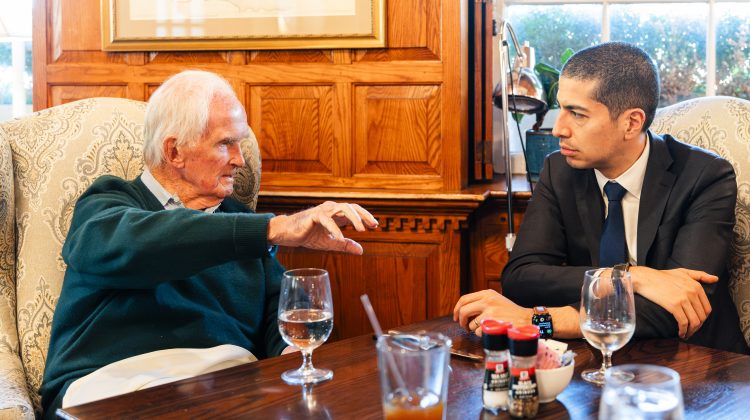
Former Congressman Michael Harrington knows what it means to run because the country is at an inflection point.
In 1969, Harrington won a historic special election by opposing the Vietnam War, becoming the first Democrat elected from the Sixth District in nearly a century. His campaign was animated by a belief that extraordinary times demanded representatives willing to challenge power, even at political risk.
More than five decades later, Harrington says he sees that same impulse in Dan Koh.
In endorsing Koh for Congress, Harrington cast the race in terms larger than a traditional campaign, drawing a line between two generations shaped by political crisis — his by the Vietnam War, Koh’s by the rise of Donald Trump and MAGA politics.
“What elected me was Vietnam,” Harrington said. “Public disapproval of our conduct, along with the impact on hundreds of thousands of troops. That was what was on people’s minds.”
For Harrington, Koh’s candidacy carries echoes of that moment.
“I’m not interested in someone looking for a lifetime tenure,” Harrington said. “This country is at a stage where it needs more than the status quo approach.”
Koh has made opposition to Trump-era politics central to his campaign. The son of immigrant families from Korea and Lebanon who settled in Andover, Koh often speaks of public service as both duty and inheritance. After senior roles in the Biden-Harris administration, the U.S. Department of Labor, and Boston City Hall, he launched his campaign, arguing this is a moment that calls for confrontation, not caution.
He connected that directly to Harrington’s own political origin story.
“One of the reasons he was elected in the first place was that people admired that he was willing to challenge authority,” Koh said. “Right now, with everyday assaults on our democracy, we need people who aren’t afraid to do that.”
For Harrington, opposition to the war was not simply a policy stance. It was a rejection of complacency in government. For Koh, he argues the challenge now is resisting what he views as Democratic backsliding and a Republican Party overtaken by extremism.
“There’s a very big difference between conservatism and MAGA,” Koh said. “We need to call out every day that this is not normal.”
Harrington appeared to respond as much to that posture as to Koh’s résumé.
Though Koh has held senior positions in Washington, helped implement major Biden Administration priorities, and built a record in state, local, and private-sector leadership, Harrington focused less on credentials than temperament.
“What stands out is what he has said — and whether he’ll be prepared to put that title on the line and take on the tough ones,” Harrington said.
For many longtime observers of Massachusetts politics, the endorsement carries symbolic weight.
Harrington built his reputation by taking on entrenched power, from his antiwar insurgency to exposing CIA covert actions abroad. His endorsement suggests he sees in Koh not simply a successor, but someone entering politics for reasons he recognizes.
That sense of political inheritance was not lost on Koh. “The issues may be different,” Koh said, “but the fire and the perspective should not be.”
Harrington entered public life amid protests over a distant war. Koh entered politics amid fights over democratic norms at home. Both, in their telling, were drawn in by opposition — not as an end in itself, but as the beginning of public service.
One challenged the Vietnam consensus. The other says he is running to confront the Trump era.
For Harrington, that resemblance mattered. “This is not a time for the typical member of Congress,” he said.