
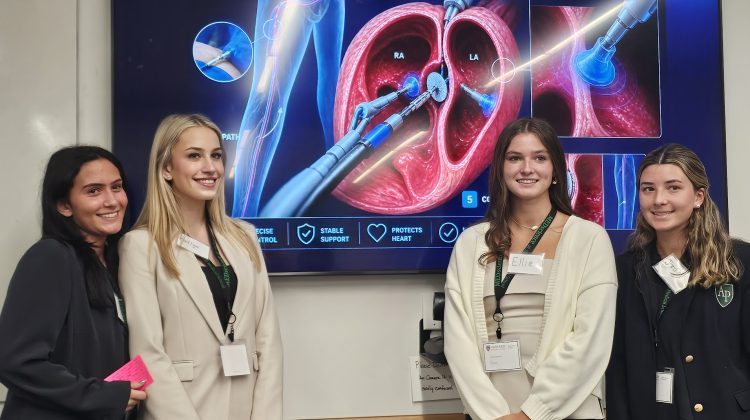
For high school students, learning science inside Harvard Medical School is an extraordinary opportunity. This year, 19 Austin Prep students in the Harvard Medical School MEDscienceTECH program did just that, diagnosing simulated patients, working with surgical robots, applying artificial intelligence to medical problems, and pitching original innovations to judges.
The yearlong STEM immersion concluded this spring with the MEDscienceTECH Surgical Innovation Showcase. Five teams presented original surgical innovations, demonstrated robotic prototypes, and made their case for mock investment before judges from Boston University and Austin Prep.
Throughout the year, students worked in Harvard Medical School’s MEDscience simulation suites, practiced clinical communication, explored anatomy and surgical techniques, and applied physics principles through hands-on engineering challenges. The final event brought that work into a professional setting that felt part operating room, part robotics lab, and part “Shark Tank.”
The Pitch: Three Minutes to Change the Medical Landscape
Each team opened with a three-minute pitch introducing a patient case, explaining the medical problem, and presenting a robotic surgical solution.
The projects included kidney tumor removal surgery, brain aneurysm surgery, aortic aneurysm repair, and MIRCRS, a minimally invasive robotic coronary revascularization system intended to reduce the need for open-heart surgery.
HeartBridge, made up of Ellie Underwood ’27 of Lynnfield, Jordyn Petitjean ’27 of Peabody, Ava Pazzia ’26 of Burlington, and Kaitlyn Riordan ’26 of Georgetown, proposed a robotic system to treat a patent foramen ovale, or PFO, a small hole in the heart that can increase the risk of blood clots and stroke.
“What we did is design a robot to complete patent foramen ovale surgery, also known as a PFO,” said Kaitlyn of the HeartBridge team. “What that is, is a small hole in the heart that fails to close after birth.”
The team centered its pitch on a simulated patient who came in with migraines with aura and shortness of breath before being diagnosed with a PFO. HeartBridge students explained that their robot would guide a catheter through a vein in the leg and up to the heart, using imaging to locate the hole and position a closing device with greater precision.
“Currently, the surgery is not done robotically, which can be risky,” said Kaitlyn. “You have to deal with the heart beating and the muscles of the patient, so you have to make really precise and steady movements.”
The students also proposed a long flexible arm adaptation, a grabber tool to insert the mesh closure device, and a stabilization system to help control movement inside the heart.
“One very important addition we think we need for the robot is a stabilization system,” said Jordyn of the HeartBridge team. “We need to make sure that nothing that isn’t supposed to be touched is getting touched.”
After the pitches, judges moved through demonstration stations, where students showed how their robotic systems worked and answered questions about design, function, limitations, and future improvements.
Teams demonstrated movement controls, camera systems, surgical tools, grabber mechanisms, and potential upgrades. Judges asked how the devices would be used by surgeons, what improvements were needed, and how the concepts could move from classroom prototype to real-world application.
The Awards: Investment Dollars, Diplomas, and a HeartBridge Win
At the end of the showcase, judges awarded mock investment dollars and recognized standout performances. Each judge received an allocation of mock funding to award to the teams. The totals reflected the amount of support each project earned from the judging panel.
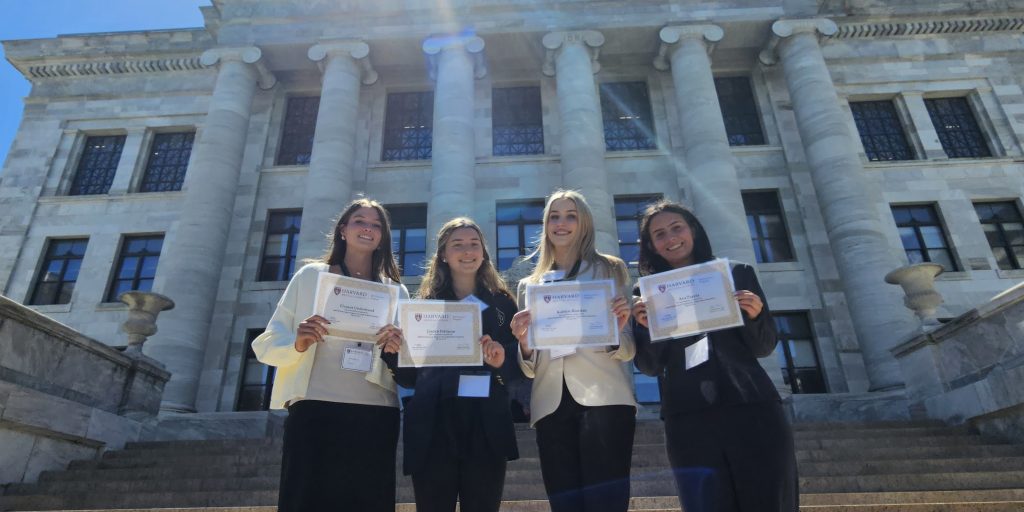
HeartBridge earned Best Pitch and was named the overall winner after receiving the most investment dollars from the judges. The team received $20,000 for its PFO robotic surgery concept. Judges praised the group for clearly connecting the patient’s story, medical problem, and proposed solution, and for presenting with confidence and command of the material.
The program concluded with a graduation ceremony, where students received diplomas recognizing their completion of the prestigious yearlong Harvard Medical School MEDscienceTECH program.
For the HeartBridge team, the day brought a year of medical simulation, robotics, teamwork, and innovation to a fitting close, with a winning pitch and a glimpse of what high school students can do when given access to extraordinary learning opportunities.