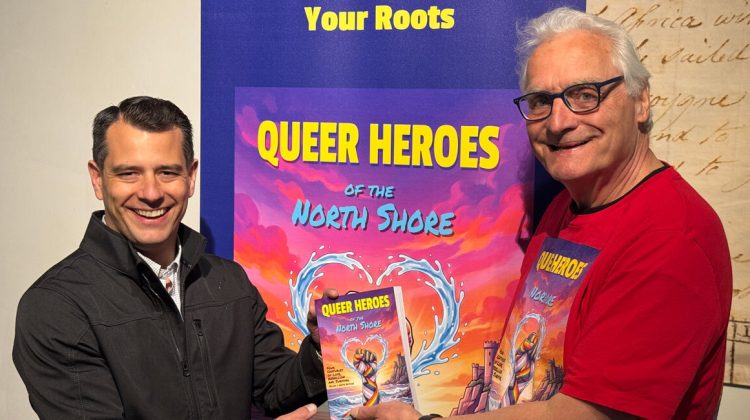
LYNN — Four centuries of erased, marginalized, and forgotten history were brought into the light on Saturday morning, as local author and historian Jim Moser launched his new book, “Queer Heroes of the North Shore: Four Centuries of Love, Rebellion and Survival,” to a packed house at the Lynn Museum and Arts Center.
The highly anticipated presentation drew an overflow crowd of more than 75 attendees, culminating in a standing ovation. Among those gathered to honor this history and show their support were Lynn Mayor Jared Nicholson, State Rep. Sean Reid, and School Committee member Brenda Ortiz-McGrath.
Moser took the audience on a sweeping, deeply emotional journey. He traced a lineage of survival and joy spanning from 1606 — honoring the sacred Two-Spirit traditions of Native American people long before the Puritan arrival — all the way to the vibrant, unapologetic visibility of today’s modern Pride celebrations.
“Queer people have always been here on the North Shore,” Moser said. “We have been more numerous, more resilient, and more extraordinary than the history books have ever allowed us to know. For centuries, our stories have been erased, sanitized, or locked in the closet.”
Acknowledging that applying the word “queer” to historical figures can be complicated since the specific language did not exist in their time, Moser offered a profound reframe: “If the historical figures we are celebrating today were alive right now, and if they deeply understood our modern, expansive concepts of gender identity, sexual orientation, and queerness… I firmly believe they would proudly identify as queer.”
Unfurling a rich tapestry of local lore, Moser captivated the room with stories of extraordinary connection. He spoke of the deep romantic friendship between poet Henry Wadsworth Longfellow and abolitionist Charles Sumner in Nahant; the tragic early love of Henry Davis Sleeper and Guy Wetmore Carryl in Swampscott; and the fiercely independent “Boston Marriage” of Sarah Orne Jewett and Annie Adams Fields, who built a life together overlooking Singing Beach in Manchester-by-the-Sea.
The morning was a shared experience of laughter and tears. A wave of joy rippled through the crowd when Moser recounted the birth of Gov. Maura Healey, noting how her grandmother smuggled a bag of soil from Byfield into a Maryland naval hospital so the future governor could technically be born “on North Shore soil.” Moments later, a reverent silence fell over the room as Moser read a poignant 1915 love letter written by famed Gloucester inventor John Hays Hammond Jr. to his lover, Leslie Buswell, who was bravely driving ambulances in France during World War I — a relationship that blossomed within a hidden, high-society Gloucester enclave that served as a sanctuary for queer inventors, artists, and politicians.
The presentation also touched on haunting historical mysteries, such as the 1966 disappearance of filmmaker Danny Williams — a former lover of Andy Warhol — who vanished off the rocky coast of Rockport, leaving an unresolved legacy.
Bringing the history fiercely close to home, Moser highlighted the vital, life-saving importance of Lynn’s historic gay bars. He recounted the harrowing night of the Great Lynn Fire in 1981, when Tony the Tiger, the manager of Fran’s Place, heroically locked the doors and refused to evacuate. His absolute defiance forced firefighters to protect the building, ultimately saving the sanctuary and the lives of the displaced seniors sheltering inside.
Pivoting from survival to triumph, Moser celebrated the modern era of unapologetic visibility, highlighting the North Shore’s claim to famous queer figures who now shine openly across sports, politics, Broadway, symphonies, and pop music.
The historical weight of Moser’s work has already garnered state-wide attention. In a statement recently published in The Daily News of Newburyport, Healey praised the book’s impact: “Books like Jim’s highlight the importance of representation… I hope this serves as inspiration for young LGBTQ people that you can be and do anything you put your mind to.”
During the Q&A session, when asked about his own roots, Moser shared a deeply personal connection to the region. He noted that he grew up in a conservative, rural town in Pennsylvania before attending MIT, ultimately finding his true home in Lynn 27 years ago after falling in love with his husband, Lynn native Billy Mulcahy.
But the most profoundly touching moment of the morning came when a young girl in the audience stood up to ask Moser why he had written the book. Moser replied that he wrote it so young people could finally connect with their queer ancestors, see their own reflections in the historical record, and know without a doubt that they belong here. To cement that mission, Moser announced he will be donating copies of the book to NAGLY (North Shore Alliance of Gay, Lesbian, Bisexual and Transgender Youth).
In closing, Moser invited the community to keep this vital momentum alive by contributing their own histories to the newly launched “Queer History North Shore” Facebook group (https://www.facebook.com/