PEABODY — Banana-scented lead detectors, glowing bacteria, and student-engineered plasmids took center stage Thursday morning at Peabody Veterans Memorial High School.
Students in the school’s Honors Biotechnology Applications class, taught by Ryan Slater, presented biotechnology-based solutions to environmental pollutants affecting Peabody, turning classroom science into practical environmental problem-solving.
Throughout the morning, students proposed biosensors engineered to detect pollutants including arsenic, chloride, copper, lead, mercury, nitrate, and phosphorus.
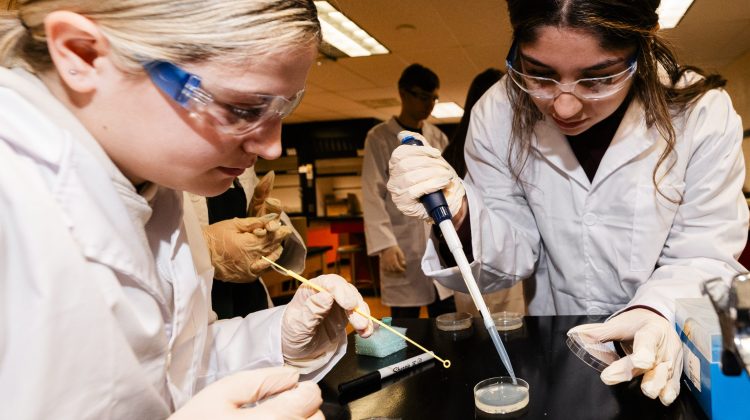
Before presentations began, Slater explained how students genetically engineered plasmids — small circles of DNA — to alter bacterial behavior and create visible signals when pollutants are present.
“We are bending these bacteria to basically work for us,” he said. “We are telling them how to behave, what to make, as they read these plasmids.”
The first group, “Salty Water is Faulty Water,” focused on chloride pollution by road salt runoff entering local waterways and private wells. Their proposed biosensor would glow bright yellow in the presence of elevated chloride levels, potentially helping residents test well water and identify contamination.
Another team, “Abolish arsenic,” later presented solutions targeting arsenic contamination, methylmercury pollution near Salem Harbor, and nutrient pollution in waterways like Proctor Brook. Their proposed biosensor was similar to the first group’s, except it would glow bright red.
Also opting for a color clue, team “Quick Silver Pollution” focused on mercury contamination and proposed a blue chromoprotein biosensor to visually detect mercury levels in water, helping communities identify contaminated areas and monitor toxic exposure in local ecosystems.
The “Our Solution to Copper” team tackled copper contamination caused by aging water pipes. Their biosensor used ice nucleation proteins that react to polluted water by freezing at higher temperatures.
“When you see a pipe that is made with copper, you often think, ‘Oh, it’s not an issue,’ but that pipe may break down over time,” student Jack Smith said. “And the water that is flowing through it is the water that you end up drinking.”
Meanwhile, team “Double Kill” studied phosphorus and nitrate pollution contributing to algal blooms and oxygen-depleted “dead zones” in local waterways. The group’s biosensor would show changes through shifts in pH levels.
“The idea isn’t to remove nitrogen and phosphorus from the water,” student Raphaela Fernandes said during audience questions. “The problem becomes when there’s an over-concentration of these two nutrients.”
The final presentation, “A Lead Free Future,” drew some of the loudest reactions from the audience after students revealed their biosensor would detect lead contamination through the smell of bananas.
“We wanted something that was very distinct,” student Alana Rosa said. “No one’s going to have banana perfume on.”
The presentations also sparked discussion about the future of the Honors Biotechnology Applications program, sponsored by Springpoint and the Barr Foundation.
Several students suggested expanding the course into a longer or two-year program that would allow future classes to conduct more field testing and environmental data collection.
By the end of the presentations, audience members praised both the students’ scientific understanding and their ability to communicate difficult concepts clearly.
Krystyna Hincman, of Cell Signaling Technology, commended students for tackling advanced material while presenting in front of a crowd.
“I’m very impressed with the presentations… You guys all did a really great job on a really hard topic, so congratulations to all of you,” she said.