
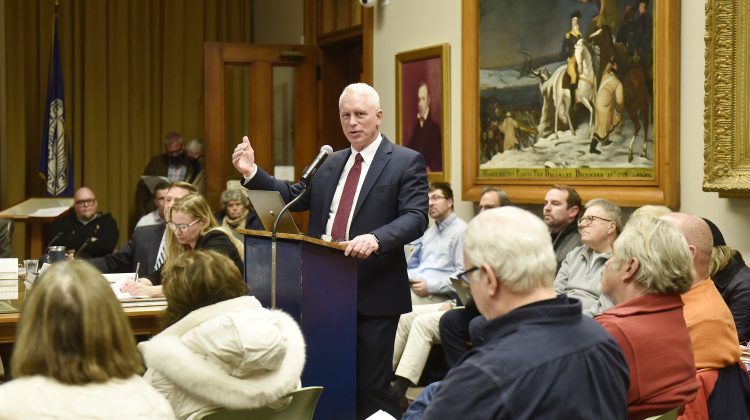
MARBLEHEAD — Town officials warned residents this week that Marblehead faces a projected $7.7 million budget deficit for fiscal year 2027, forcing leaders to weigh service cuts or new fees and spending reductions to balance the budget.
During a Select Board budget review meeting, Town Administrator Thatcher Kezer presented two scenarios outlining how the town could close the gap: one relying largely on eliminating municipal services and jobs, and another combining new revenue with smaller cuts.
Under Scenario A, the town would balance the budget strictly through reductions to municipal departments. That approach would eliminate 56 positions out of roughly 185 to 190 town employees and shut down several services entirely, Kezer said.
Departments that would lose funding include Community Development and Planning, the Cemetery Department, most of the Health Department, the Council on Aging, Abbot Public Library, and Recreation and Parks.
“These decisions prioritize core services such as public safety,” Kezer told the board, explaining that other departments would still face reductions even if they remain open.
Kezer described the cuts as necessary if the town relies solely on current revenue sources.
“Scenario A assumes no significant changes in our current revenue trends,” he said, adding that officials had to reduce spending by $7.7 million to match projected revenues.
A second proposal, Scenario B, would attempt to maintain most town services by shifting some costs to residents and making smaller budget cuts.
The largest change would be the creation of a curbside trash collection fee, expected to generate roughly $2 million annually. Under the proposal, the town would remove trash and recycling costs from the general fund and instead charge households directly.
Based on early estimates, the fee would cost residents about $254 per household per year, or roughly $21 per month, depending on how the program is structured.
The plan would also ask the Marblehead Public Schools to reduce their proposed budget by an additional $1.5 million, on top of roughly $1.9 million in cuts already identified, officials said.
Kezer said the request reflects the town’s effort to balance financial pressures between municipal services and education spending.
Another major cost driver in the budget is health insurance, which town officials estimate could rise by about 11% next year, though final rates had not yet been set at the time of the meeting.
Select Board members acknowledged that the choices are difficult.
“This has been the hardest budget season that I’ve seen,” member Erin Noonan said during the discussion, noting that even the smaller-cut scenario would still eliminate roughly 20 positions across town departments.
Residents who spoke at the meeting raised concerns about the proposed trash fee, potential layoffs, and the possibility of closing public services such as the library.
Others urged the town to consider broader financial reforms or larger tax overrides to stabilize funding in the long term.
Town officials said the scenarios are meant to illustrate the scale of the problem rather than represent final decisions. The Select Board is expected to continue refining the budget and discussing potential override proposals before presenting a final plan to voters.
“If we’re going to solve this structurally,” one resident told the board, “we need to talk about how to fund the services the town actually wants for the long term.”