
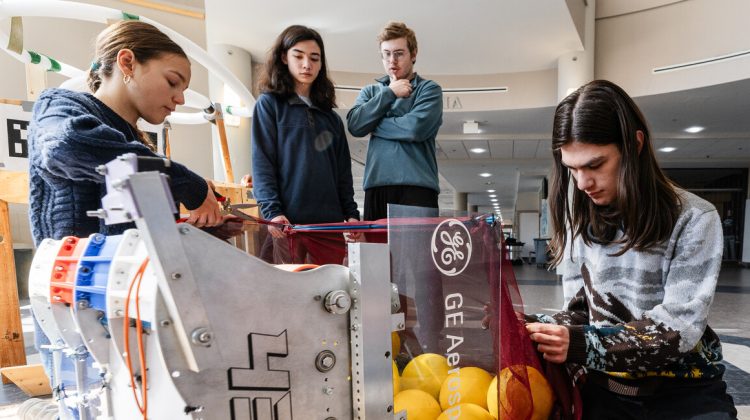
SWAMPSCOTT — When the robotics team is practicing in the atrium after school, it’s anything but quiet.
The steady hum of the robot’s motor cuts through the open space, followed by the sharp whir of spinning wheels. The scattered chatter stops as groups of students track the game pieces through the air, then there’s the thud of a dozen foam balls hitting the ground around the goal posts.
“This is probably one of the most complicated robots we’ve built so far,” said Aiden Tat, a senior and one of the team’s captains, watching the machine cycle through another test. “So seeing it actually work is pretty cool.”
The team — known as the Swampscott Currents, Team 4311 — has spent months designing, building, programming, and refining the robot, which is built to collect game pieces and launch them into the goal — this year’s annual project for the FIRST Robotics Competition.
Unlike a typical classroom project, nearly every part of the process is student-led.
“The students are doing all the design work and the manufacturing, for the most part,” said Swampscott High School physics teacher and mentor Chris Crocker. “Any of the creative decisions, like the actual physical building (of) things, is done by students. We’re mostly just there for supervising the safety aspect of it.”
That means everything from computer-aided design models to the wiring and assembly is handled in-house. Students cut parts from metal and polycarbonate, reuse components from past robots, and troubleshoot problems in real time.
There are a lot of different components that go into making a competition-ready robot. Within the team, students split into different groups that each focus on a particular aspect. While Tat is the team’s overall captain, he also leads the mechanical and electrical subgroups.
“I do mostly the computer design aspect of things, where we design the parts,” he said. “And then when we go into the manufacturing side, that’s where we’re cutting the parts and doing the assembly.”
Around him, that process plays out in layers. Some students gather by the laptop that holds the code that programs the robot. Others cluster around the robot itself, ready to troubleshoot or reset after each test. Across the room, a separate group watches on, talking strategy and getting ready for the next competition.
While the team, especially throughout the build process, is organized into those subgroups — including design, build, electrical, coding, and administrative roles — students often move between them depending on what needs to get done.
“There’s a lot of movement,” said sophomore Fiore Finocchiaro, who decided to join the team this year after taking an engineering class with Mr. Crocker. “We have different departments … but there’s a lot of collaboration between them.”
During build season, students meet multiple days a week after school, often staying for hours. As competitions approach, that ramps up to daily sessions. Noah Oubala says that seeing that hard work amounts to something is part of what keeps him coming back. “It’s 100% reflective of the work you put in,” he said.
In his second year with the team, Oubala said he’s taken on a larger role, and that’s changed how he experiences the work.
“It’s a lot more fun when you get involved more,” he said. “It’s really great to step up and do more and learn a lot more about the robot. Especially the smaller details and things.”
Those small details have paid off in the Currents’ two district competitions. This past weekend, Swampscott went 7-3-1 in qualifying matches, finishing ninth out of 37 teams. The Currents served as the seventh-seed alliance captain in the playoff rounds before being eliminated, and currently sit 83rd in the Northeast standings, with the top 100 advancing to the district championship.
20 teams are still to compete before those standings are finalized, but the Currents are well-positioned to make their return to the District Competition for the third year in a row.
But building and competing in robotics is expensive, and that cost is felt at every level of the program.
“The admission fee just to go to the events is over $6,000,” Crocker said. “That’s not for building the robot — that’s just for admission.”
Crocker and the students were happy to report that the program had received increased school support this year — noting that this is the first year they have been fully funded by the school. The team has also benefited from community donations from North Shore organizations like GE Aerospace and JD Software.
Along with that increased financial support, the team has grown both in size and in experience. What was once a small group of about eight students has expanded to roughly two dozen active members, with more cycling in and out throughout the season.
And for many of those students, the draw goes beyond the robot itself.
“I like when I see everybody being productive in the room,” Oubala said. “Everybody working on a certain task — that’s great.”
For others, the robotics team has brought a sense of community and belonging.
“It’s nice to have a STEM-focused community where you can bounce ideas off people,” Tat said.
Finocchiaro agreed, saying that the environment has been especially meaningful as she’s gotten more involved throughout the year.
“It’s really nice to be in a community where there is a smaller group. It keeps it more tight-knit,” she said. “It’s definitely a more male-dominated area … and when we’re at competitions, I get to meet other girls who are interested in STEM.”
Senior Boris Evdokimov is the captain of the code team and the driver of this year’s robot. He’s worked across multiple areas throughout his four years on the team, but that focus on programming has helped him shape what comes next — studying cybersecurity at Northeastern University.
“Programming-wise, it’s definitely helped for me,” he said. “You also get to see the real-world applications of what you’re doing.”
That exposure is shaping what comes next for the team’s younger students, too. Oubala said being on the team through his first two years of high school has helped him start to see a path forward.
“It’s definitely something that interests me,” he said. “Maybe I could go into the engineering part … it gives you the right exposure to see what you want to do after high school.”
For newer members of the team, that learning curve is part of the appeal.
Freshman Lauren Gladstein said joining the team has given her a chance to pick up new skills while working alongside more experienced students.
“I get to learn a lot from the seniors and everybody else,” she said. “I like the teamwork … I like learning how to build the robot.”
In the atrium, the robot continues firing off rounds one after another, as students talk through adjustments, chase foam balls down the hallway, and admire a season’s worth of hard work between attempts.
With two strong qualifying performances now behind them, the team is hopeful for another appearance at district championship, and the possibility of competing on the robotics stage beyond even that.