MARBLEHEAD — Marblehead officials are asking voters to confront what they describe as a structural fiscal crisis, warning that without an operating override, the town faces layoffs, reduced municipal services, school cuts, and dwindling financial reserves.
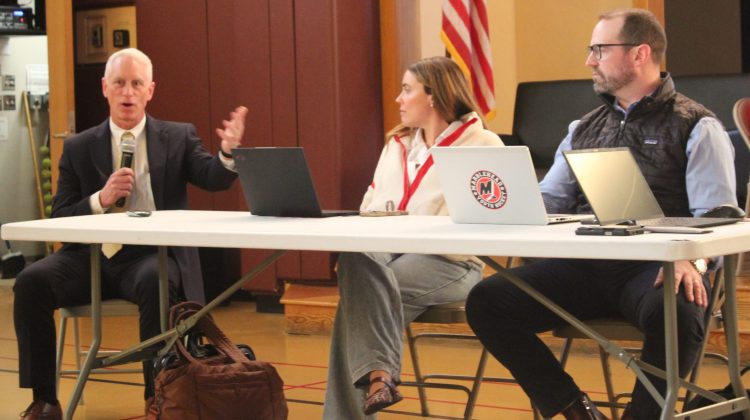
At a Monday evening public forum ahead of Town Meeting, Town Administrator Thatcher Kezer, Finance Director Aleesha Benjamin, Finance Committee Chair Alec Goolsby, and School Committee member Melissa Clucas laid out a proposed three-tier override plan while detailing a projected $7.7 million budget deficit.
Officials said the shortfall is being driven not by expanded government or new programs, but by surging fixed costs — including pensions, health insurance, special education obligations, and a sharply higher trash contract — colliding with revenue growth constrained under Proposition 2½.
“We’ve made cuts. We’ve never made $7.7 million in cuts,” Goolsby said. “Maybe $1 million, maybe $1.5 million in a hard year, but $7.7 million is a lot.”
Town officials said available operating revenue for fiscal 2027 is projected at $96.5 million, about $600,000 less than last year, even with growth in property taxes and state aid.
That decline, Goolsby said, stems largely from reduced local receipts and shrinking “free cash,” the surplus revenues and unspent appropriations the town has long used to help support budgets.
“Right away, we have less revenue than last year,” he said. “And costs are rising dramatically.”
Among the largest pressures, officials said, health insurance costs alone are rising by $1.7 million, part of what they described as a sharp multi-year escalation.
“Five years ago, health insurance costs were going up around 2% a year,” Goolsby said. “Then 6%, 7%, 10%, 16% last year, and now somewhere between 10 and 12%.”
Kezer said many of the most significant budget pressures are largely outside local control.
“The GIC dictates to us how much health insurance is going to increase,” Kezer said, referring to the state Group Insurance Commission. “We have very little control over pensions. A lot of the biggest cost drivers, we don’t even have a say in.”
Benjamin said those pressures are affecting communities statewide.
“Living within 2.5% is nearly impossible for most municipalities across the state,” she said.
Officials stressed the fiscal 2027 budget headed to Town Meeting is already balanced — but only after major reductions.
Municipal departments have cut 22 full-time equivalent positions, including reductions in the library, public works, planning and development, finance, and public buildings. Schools have reduced another 22 positions, including layoffs and unfilled vacancies.
If no override passes, officials said residents should expect reduced library operations that could jeopardize state certification; elimination of the school resource officer position; reduced road maintenance and parks staffing; cuts to senior services and community development; and no capital funding or reserve contributions.
“The cuts to this budget risk the library being decertified by the state,” Goolsby said, calling that possibility “devastating.”
He added, “We have real layoffs coming.”
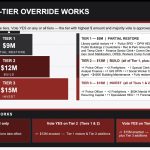
Officials are proposing a three-tier override structure beginning with Tier 1, the lowest financial commitment, a $9 million override over three years, described as a partial restoration of cuts already made.
That proposal would restore some municipal and school positions, preserve the possibility of library accreditation, return a school resource officer, and help address longer-term structural deficits.
Benjamin emphasized that the first tier is not a full return to prior service levels.
“It is not a full restore,” she said. “There are many cuts that are not being brought back.”
Tier 2 and Tier 3 build from there, adding further restorations, public safety staffing, school technology, and capital investments.
Benjamin defended those higher tiers as investments in long-term town services.
“I think adding back and building on investing in communities is the way to go,” she said.
Officials said the three-year structure is designed to avoid repeated annual override battles.
“Don’t make us do this every year,” Kezer said. “Let’s project out three years and get the best handle on this.”
Officials repeatedly pushed back on suggestions that the override reflects overspending in schools.
“The override is not about bloated school spending,” Benjamin said. “It is about the cost drivers districts can’t control.”
She said one-time use of $1.5 million in prepaid special education costs helped soften cuts this year, but increases pressure in future years.
Goolsby said that, absent additional funding, he warned, schools could face even deeper reductions.
“I’m talking 40 to 60 positions,” he said.
Some residents pressed whether schools should receive an even larger share of funding, citing Marblehead’s strong academic reputation and concern about protecting property values.
Kezer said the town is trying to balance competing needs.
“There are 20,000 different opinions as to which is the most important service,” he said. “We can’t optimize one area over other areas. We have to balance it all.”
Officials also raised concerns about shrinking reserves.
Kezer disclosed the town’s free cash had been certified, Monday, a week before town meeting, at about $6.1 million, lower than the roughly $6.3 million officials had hoped for and, he said, likely the lowest level since he arrived.
“I think that’s the lowest since I’ve been here,” Kezer said. “It was like $10 million when I walked in the door.”
He said the town plans to use $5 million of that to support the operating budget and about $1 million for lease payments, leaving a much smaller cushion than hoped.
“We can live with it,” Kezer said. “But free cash is declining over time.”
Goolsby said total reserves now sit around $3 million, below levels often recommended by the state.
“It’s not recommended by the state,” he said of relying on free cash to support operations. “We need to get off that.”
The override proposal now heads toward a two-step public vote that officials acknowledged has caused confusion.
At Town Meeting, voters will first consider voting in favor of or against the balanced fiscal 2027 budget that includes the cuts officials have outlined if no override passes.
They will then vote on the override. This would authorize the Select Board to place override questions on the June ballot and approve contingent appropriations tied to those options.
The community would vote on the override based on the highest tier, Tier 3, which would be a $15M override.
Kezer emphasized that Town Meeting is not the override vote itself.
“Town Meeting is the trigger,” he said. It authorizes the Select Board to put the override on the budget.
If the override vote fails, no override goes before voters in June, and the town operates under the cuts-only budget.
If Town Meeting authorizes the questions, voters would decide at the June ballot among three override tiers.
Under the proposed system, voters may vote yes or no on each tier, with the highest tier receiving majority support prevailing, even if lower tiers receive larger margins.
Officials said a separate ballot question is also expected on whether to replace the new trash and recycling fee with tax support.
Residents repeatedly pressed officials on how the voting mechanics would work, prompting lengthy explanations that even Kezer acknowledged were difficult.
“It is more complex than in the past,” he said.
Officials framed the proposal as an effort to stabilize town and school finances for three years while also pushing the state for relief from escalating mandated costs.
“We are doing everything we can locally,” Kezer said, “and we’re working with our colleagues around the state to get relief for the things we don’t control.”
For now, he said, the override is the principal tool available.
“If town meeting votes no,” he warned, “there will not be an override — and you will be living with the balanced budget and all the cuts.”