
MARBLEHEAD — The Marblehead Select Board voted to advance a three-tier override plan on Wednesday afternoon aimed at closing a multimillion-dollar budget gap, setting up a complex ballot question that will ask voters to choose among three funding levels.
The Board approved the tiered override approach in a 3-0 vote. Member Jim Zission recused himself due to a potential perceived conflict of interest involving a family member employed by the school district, and member Alexa Singer was not present for the vote. The Board separately approved a Memorandum of Understanding between the town and schools in a 4-0 vote.
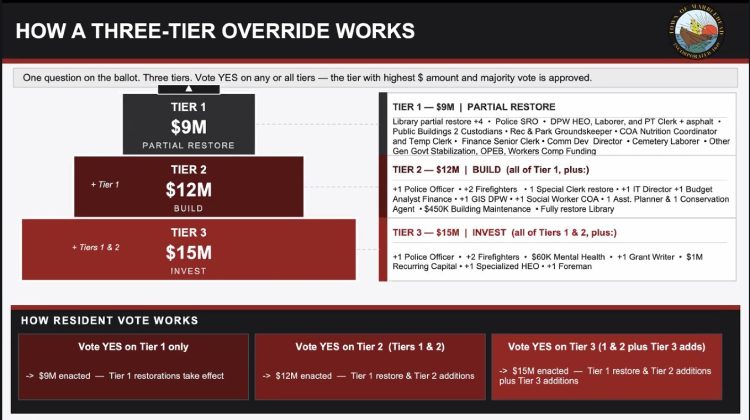
The proposal introduces a new format for Marblehead: a single ballot question featuring three override options — $9 million, $12 million, and $15 million — with each tier building on the previous one.
Under the plan, voters may support one or more tiers, and the highest tier receiving majority support would determine the final override amount. The structure is designed to give residents flexibility while ensuring a single outcome.
Members emphasized that the vote at the Town Meeting differs from the ballot vote. Town Meeting will be asked to approve a contingent appropriation tied to the highest tier, while voters ultimately decide the level of funding at the ballot box.
“All you’re doing is allowing us to appropriate that money,” Chair Dan Fox said, noting that actual spending is still controlled annually through the budget process.
The three tiers are structured as follows:
- Tier 1 ($9 million) focuses on partial restorations, including library services, public safety staffing, and basic municipal functions.
- Tier 2 ($12 million) builds on Tier 1 with additional staffing, including police, firefighters, and administrative roles, as well as full library restoration and facility maintenance.
- Tier 3 ($15 million) represents a broader investment level, adding positions, mental health funding, capital spending, and expanded services.
The override would be implemented over three years rather than all at once, an approach members said is intended to reduce the immediate impact on taxpayers.
The Memorandum of Understanding approved by the board outlines how the town and Marblehead Public Schools are intended to guide how new revenue from a potential override would be managed over the next three years. While not legally binding, the agreement establishes a shared financial framework between municipal and school leaders and is designed to provide voters with greater transparency about how funds would be allocated.
Under the MOU, future revenue is expected to be split roughly 62% for schools and 38% for town services, based on current cost structures.
The agreement also includes a commitment not to entertain another override request until at least 2030, along with provisions for annual financial reviews between town and school officials. Members said the goal is to reduce reliance on one-time funding sources, rebuild stabilization reserves, and ensure a more sustainable long-term budget, though all spending decisions will still require approval through the annual Town Meeting process.
The override proposal is expected to go before voters in June, following the Town Meeting, where officials plan to present a more detailed breakdown of costs, impacts, and long-term projections.