
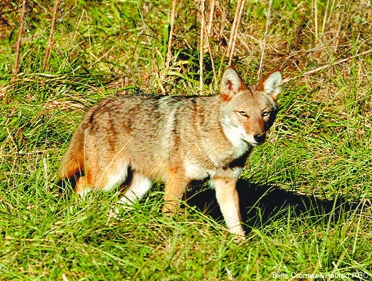
NAHANT ― As residents across the commonwealth would attest, the coyote population has been making itself known to an especially intense degree this year.
An Arlington family told NBC10 Boston that on October 3rd their 5-year-old labradoodle, Layla, was bitten by a coyote after being let out before bed in Arlington Massachusetts.
Issues like these have sparked panic in Cambridge, Provincetown, and Lynnfield in 2021 alone ― and Nahant has not been spared.
Residents were invited to a virtual event held by the police department on Thursday to discuss living with coyotes and the danger that comes with it.
Back in February of this year, a 12-year-old black lab in Nahant, Buddy, suffered injuries after being attacked by a coyote.
“We remind you to keep an eye on all pets while outside,” the presentation stated. “And please know that coyotes can scale fences up to eight feet high. If you observe an overly aggressive coyote in Nahant, call 911 in the event of an emergency.”
During the presentation, former Belmont Animal Control Officer John Maguranis showed citizens how to live with coyotes. He gave general information about coyotes and their behaviors. Maguranis also showed examples of how people can coexist with coyotes and provided safety tips for people and their pets.
According to the coyote expert, there have been roughly 22 recorded coyote bites on humans in the past 65 years in Massachusetts; 4 of those bites were confirmed to be rabid and one person was believed to have contracted rabies.
Lastly, Maguranis showed viewers how to haze and scare a coyote off the correct way. Coyotes can be extremely active leading up to the winter months, the presentation cautioned.
“Hazing,” a term for scaring away coyotes, is very effective and humane ― but only if done correctly. Scaring a coyote away is only successful if you scare them completely away, Maguranis said. Waving your arms and banging pots and pans is not effective in permanently warding them away.
“You should be able to open your back door, the coyote looks up, sees you, and runs away. That is a natural behavior of a coyote,” he said.
Marguranis’ portion of the presentation was also dedicated to teaching communities how to coexist with coyotes, rather than resorting to unnecessary measures.
“The fact is these animals are not going away; it’s impossible and we just need to learn how to live with them,” said Marguranis.
Hannah Chadwick can be reached at [email protected].