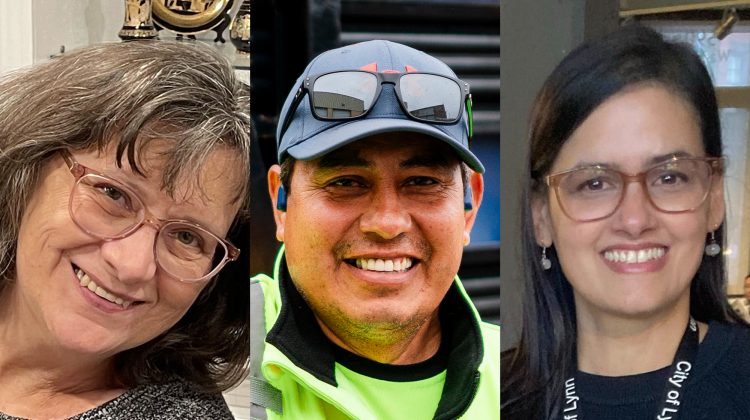
LYNN — Whether answering calls in Spanish, clearing sidewalks in the snow, or cutting paper waste with the dawn of computers, these three public servants quietly helped Lynn run more smoothly over the past decade and beyond. They are not department heads or elected officials, but their work has left a lasting mark.
Jose Menvijar, a Department of Public Works employee for nearly 10 years, said his favorite part of the job was connecting with residents.
“I like to engage with the public,” he said through interpreter Faustina Cuevas. “I’m a sociable person. It brings me joy.”
A native of El Salvador, Menvijar has lived in Lynn for 24 years. On the job, he’s learned snow removal, landscaping, and — most recently — taken the lead on trash bin repairs. He often visits residents’ homes to fix their barrels and appreciates the diversity of people he meets.
“I’ve built relationships with people from all backgrounds,” he said. “It doesn’t matter what language you speak or what you look like. I’m here to serve.”
Over the years, Menvijar said Lynn has become cleaner and more vibrant, with new buildings and fewer reports of violence. He has especially noticed the growth of the Spanish-speaking community, a change that brings him pride.
“Thank you to the public for supporting our work,” he added. “But please don’t litter or push snow into the street. This city belongs to all of us, and we all share the responsibility to keep it beautiful.”
Dorothy “Dottie” LeBlanc, who retired last week after 35 years in the Treasurer/Collector’s Office, echoed that spirit of dedication. A lifelong Lynn resident, LeBlanc grew up around the corner from City Hall on Henry Avenue and began working there in the early 1980s.
“There were no computers when I started,” she said. “Everything was manual. We used floppy disks, then thumb drives, then servers. The technology changed, but we adjusted.”
Though she took five years off to raise her children, LeBlanc spent more than three decades in the same office — eventually processing payroll for the entire city workforce. She described her co-workers as a second family.
“You’re here more than you are at home sometimes,” she said. “You’ve got to treat it like a family.”
She recalled light-hearted pranks between department heads in the early days and the leadership of her first boss, Robert McManus, former chief financial officer, who helped foster camaraderie. Though the job could be demanding, she said it was never dull.
“I worked through COVID,” LeBlanc added. “Even when City Hall was closed, I was working from home — sometimes late into the night — to make sure everyone still got paid.”
Now retired, she plans to enjoy more of the auditorium performances at City Hall, which she says have helped reshape public perception of the building.
“People used to think of City Hall as a gray building, but it’s really beautiful inside,” she said. “They’ve done a great job turning it around.”
Berta Tavares, Lynn’s language access coordinator, is one of the newer faces among the group. She moved to the city in 2012 from Santiago, Dominican Republic, and began working in City Hall three years ago. Trained as an educator and fluent in Spanish, French, and English, she transitioned into language access after the COVID-19 pandemic.
“I usually prefer to stay in the background,” Tavares said. “But this is a good opportunity to talk about the work we do and to thank the community.”
Tavares helps ensure residents can communicate effectively with city departments, providing interpretation at public events, translating documents, and coordinating multilingual outreach. But the job often goes beyond translation.
“Sometimes people come looking for food, housing, or even clothing,” she said. “I don’t just point them in the right direction — I’ll call ahead or even go with them to make sure they get the help they need.”
Tavares also provides real-time interpretation using wireless headsets during public meetings and city events. And to better engage Spanish-speaking residents, she recently launched a WhatsApp channel that delivers city updates in audio, text, and flyer form.
“WhatsApp is something most of our community already uses,” she said. “It’s one more way to connect.”
She hopes the city will one day adopt a formal language access ordinance, as other municipalities have, to provide long-term structural support.
“It’s more than translation,” she said. “Language justice means building community and making sure everyone feels like they belong.”
Whether sweeping streets, processing payroll, or bridging language gaps, these city workers embody Lynn’s quiet, often-overlooked spirit of service.
“As long as we do it together,” Menvijar said, “we can accomplish great things.”