
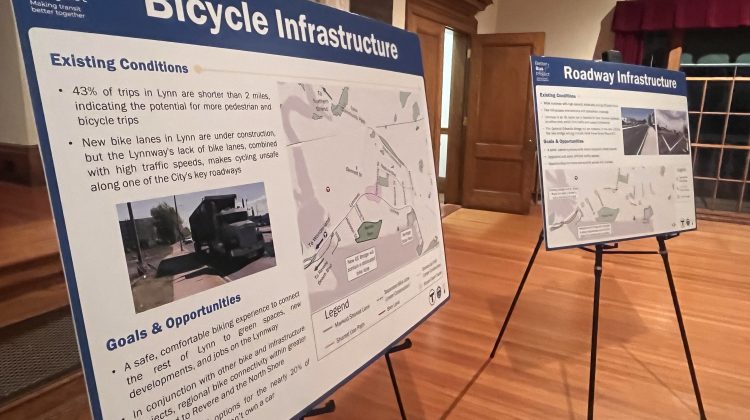
NAHANT — Community members gathered at Town Hall Thursday evening for an “open house” style forum on the Lynnway Multimodal Corridor Project run by the Massachusetts Bay Transit Authority (MBTA), where residents raised concerns that the development could worsen traffic for drivers using the route.
Officials from the MBTA were present to answer questions and receive feedback, along with the director of green transportation, Dan Driscoll, from the Department of Conservation and Recreation (DCR). Representatives from the Massachusetts Department of Transportation (MassDOT) were not in attendance.
The MBTA is collaborating with the two entities and the city of Lynn for the development. All the construction work, with the project slated to start in 2027, will take place in Lynn. In 2022, the MBTA received a $20 million federal grant for the project.
Currently, the Lynnway is a multi-lane thoroughfare and is mainly a route for motor vehicles to travel. The goal of the project is to create a multimodal corridor — a route designed to accommodate multiple modes of transportation — to create a safer environment for bicyclists and pedestrians.
The project will also include dedicated and protected bike lanes connecting Nahant Beach and progress toward connecting the Northern Strand Trail, according to the MBTA’s website.
MBTA Senior Project Manager Phillip Cherry noted that while it’s the last public meeting regarding the existing conditions of the project, there is no concept developed for the final outcome yet.
“It’s really important that you have information on the existing conditions, and then you take a lot of the public feedback that we’re getting and combine that with survey information, as well as engineering and analysis… So, tonight is really important to continue to get the public’s feedback,” Cherry said.
Several attendees at the event voiced the opinion that the development would make traffic worse for those using the route, rather than the project mitigating traffic congestion in the area.
“It seems that someone or some people have deemed one type of commuting citizen to be good, and the other bad. That good citizen should be entitled to a faster form of travel than the other, it seems,” Moira Pellegrino said. “Both types of commuters pay state taxes. The poor businesses — whose trucks and workers use this road — will be paying employees for longer commutes in the company… This plan will punish the majority, instead of supporting them.”
Another participant, John Nardizzi, said that “some of us have a concern about the size of the bike lane”, citing how a potential lane reduction could worsen traffic, which he said looks “completely disproportionate to the infrastructure.”
Attendee Addie Flynn cited a 2015 report from the Metropolitan Planning Organization, noting that between 41,000 and 44,000 cars travel on the Lynnway every day.
“While the MBTA reports (on its website) that there are 3,000 bus riders, and this will save them five to seven minutes. So, we’re unsure of how that’s going to affect the 41-44,000 cars,” Flynn said.
Select Board member Pat O’Reilly shared his perspective on the project.
“I came here tonight to hear the concerns, but it has become clear that the results of any proposed Lynnway lane reduction will be to slash vital transportation capacity for Lynn and the surrounding communities,” O’Reilly said. “MassDOT, Gov. Maura Healey, and state and local leaders must work to avoid lane reductions of the Lynnway in favor of solutions that keep us moving forward.”
Driscoll explained that the DCR conducted a Parkways Master Plan and that “we’ve been going around our entire system looking at roads that in some cases are either overrun by automobiles or over appropriated in a cross section by automobiles.”
“We did a feasibility study on the Lynnway before this initiative took place, and the priority for us was to make it a more humane landscape,” Driscoll said. “To have it feel safe for pedestrians and safe for bicyclists, while preserving the need to move a lot of cars through here.”
Driscoll continued, “It’s really a balancing act of how much space do the cars really need to function, and how much can we take for the bike lanes or separate facility for bikes?”
“The most important thing for us is going to be to see how the design team can balance that and meet the objectives of the public, the community of Lynn, and the DCR,” he said.
Cherry reiterated that nothing is finalized, and that “these meetings are here to gather feedback,” and added that the community’s input on the matter will be taken into consideration going forward as the project continues.
He also noted that the MBTA hopes to have a concept released to the public this Fall. Construction on the project is not slated to begin until 2027.
MassDOT could not be reached for comment.