
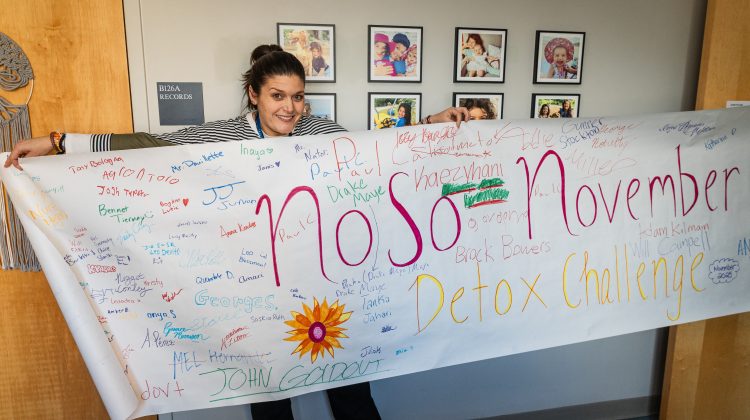
SWAMPSCOTT — Students at Swampscott High School underwent a month-long social media detox as part of the “NoSo November” initiative, led by School Nurse Megan Ramirez.
Ramirez explained that the inspiration for the initiative came from Maddie Freeman, a student from Colorado who founded NoSo November. The nonprofit organization seeks to relieve teens of the various issues they face in the digital world by empowering participants to foster a healthy balance between life and technology, according to its mission statement.
“She was from a small community and lost friends to suicide. She went to college, and then COVID-19 happened. She had to move home, and she was like, ‘What am I going to do?’ She started the company when she was 18, and I think it’s pretty incredible,” Ramirez said.
Ramirez said that Freeman and other peer leaders spoke to students at a school-wide assembly, where they discussed the benefits of stepping away from social media. Ultimately, over 100 students participated in the initiative.
Some of the big social media platforms that kids deleted from their phones included TikTok, Snapchat, Instagram, and Facebook.
“It’s a lot for someone to swallow, but the reason for the month-long detox is that it actually takes that long for your dopamine levels to go back to normal after being removed from social media,” Ramirez said. “Our lead nurse was able to secure the funding from a grant last year, and she set the money aside for us… It’s just about getting kids to be more mindful of how much they’re using their phones.”
She continued that it’s hard for the kids to admit how frequently they use their phones because they think it connects them with others. She added that during the assembly, some students noted they had accrued an average of five and a half hours a day on their devices.
“If their average was 5 and a half hours every day, they are spending 15 years literally on their phone, doing nothing. When you add it all up, it’s a lot of time that you are just throwing down the drain,” she said.
The school also had students fill out activity sheets that asked them to reflect on how much they use their phones, as well as generate various ideas on how else they could spend their time.
Ramirez said that overall, she noticed a positive impact in the day-to-day lives of students who took on the challenge. She cited more connections between students in real-time, and said some kids have mentioned they’re sleeping better at night without social media.
“I think they were actually more connected after stepping away from social media, which surprised some of them. They actually hung out with their friends instead of just talking to them, or they were actually talking to their friends and not sitting around a table on social media. A lot of kids were surprised by how much extra time they had.
“Whereas before they would be like, ‘I’m going to do this and earn my break where I can scroll online.’ And when that was cut out, they were like, ‘I guess I’m going to go outside.’ I think the biggest takeaway was that they realized they were wasting a lot of their time,” she said.
Another observation she made was that detoxing from social media got more students interested in reading books.
“I have these books that I keep on my table, and not a single kid touches those books. And then, when their phones were gone, they sat there for not even 30 seconds with nothing to do with their hands. All of a sudden, they’re like, ‘Oh, look at this in front of me,’ and start looking at them,” Ramirez said.
She added that she hopes to bring the initiative back next year to continue making a positive impact on the student body.