
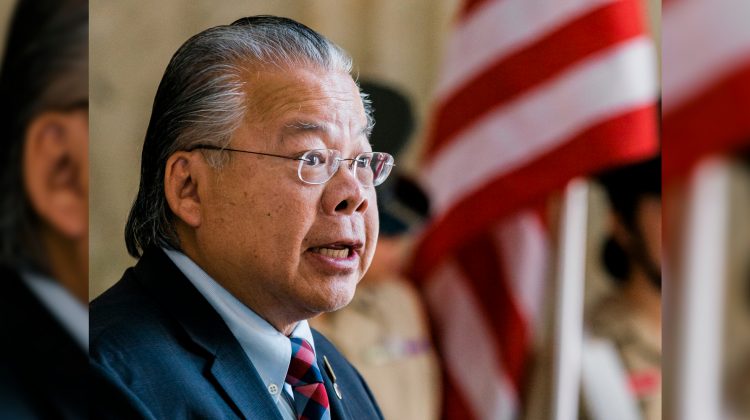
SAUGUS — Rep. Donald H. Wong (R-Saugus) is co-sponsoring comprehensive energy reform legislation put forth by House and Senate Republicans to provide financial relief to Massachusetts ratepayers who are struggling to pay high energy bills.
House Docket 5554, “An Act addressing energy costs, transparency, and sustainability,” was filed Jan. 15 by House Minority Leader Bradley H. Jones, Jr. (R-North Reading), Senate Minority Leader Bruce Tarr (R-Gloucester), Rep. Wong, and 23 of their Republican colleagues. It contains a series of reforms to address rising energy costs, including proposals to restructure the Mass Save program, allow older homeowners and renters to factor in a portion of their utility bills to determine their eligibility for the Senior Circuit Breaker tax credit, and provide more cost transparency for consumers.
“Massachusetts residents are paying some of the highest energy rates in the country, and many are struggling with the cost of heating their homes this winter,” Rep. Jones said. “At the same time, utility costs are also placing a significant financial strain on employers, particularly the small businesses that are the backbone of the state and local economies. Our bill takes a comprehensive approach to this problem that we feel will collectively provide meaningful short-term and long-term relief to the state’s ratepayers.”
Sen. Tarr said, “Unaffordable energy costs in Massachusetts are destabilizing household budgets, compromising our competitiveness, and undermining trust in efforts to reduce greenhouse gas emissions. The comprehensive provisions of this bill come to the rescue of ratepayers who are struggling to pay some of the highest prices for electricity and home heating in the nation, with boundaries to control costs, tools to achieve consumer savings, and powerful and innovative measures to create new sources of energy without carbon emissions. Taken together, these measures will produce the rate relief that is desperately needed now, while putting our state on a path to more affordable and environmentally sound sources of energy for the future.”
To provide immediate short-term relief for Massachusetts ratepayers, House Docket 5554 requires 50% of Alternative Compliance Payments (ACPs) made pursuant to the Renewable Portfolio Standard to be returned to utility customers in each of the next three years. These ACPs are currently deposited in a custodial fund overseen by the Massachusetts Clean Energy Center for use in clean energy projects. This change alone will return approximately $66-$69 million per year to ratepayers, and between $198 million and $207 million over three years.
Additional first-year savings of $78 million will be realized through basic service and energy contract changes contained in the bill, including language giving electric distribution companies the flexibility to procure default service supply through procurements of varying lengths and in combination with other companies, as well as provisions extending the contract period from 1 year to 1.5 years and allowing electric distribution companies to collectively procure its energy supply (gas, electric, transmission, transportation, or any combination thereof) together. Along with the ACP changes, this is expected to produce about $147 million in combined savings for ratepayers in each of the first three years of implementation.
House Docket 5554 also includes several proposed changes to the Mass Save program, which is an energy efficiency initiative funded by Massachusetts ratepayers through a monthly surcharge on their gas and electric bills. The program’s three-year budget for 2025-2027 is currently set at $4.5 billion.
In addition to capping Mass Save administrative spending at 10% of the total funds allocated for the program, House Docket 5554 also limits spending on the program’s next three-year plan (running from 2028-2030) by prohibiting the budget from exceeding the cost of the 2022-2024 plan, plus 6.25%. Because the 2022-2024 plan was funded at $4 billion, the 2028-2030 plan cannot increase by more than $250 million. This means that by 2030, the combined annual savings from the ACP returns, basic service changes, and the Mass Save spending reduction will produce an estimated $396 million in ratepayer savings per year, or approximately $2.38 billion in savings over 10 years.
Under the bill, an oversight commission will be established to examine Mass Save’s structure and the possibility of transferring the administration of the program to an independent agency. It also removes a requirement that the “social value” of greenhouse gas emissions be calculated by DPU to determine the cost-effectiveness of the Mass Save program.
In addition, House Docket 5554 temporarily updates the Senior Circuit Breaker tax credit for homeowners and renters who are 65 or older by allowing 50% of their utility costs to be calculated into their income used to determine their eligibility for the credit. Taking effect for the current tax year, this change would sunset after three years, on Jan. 1, 2029.
House Docket 5554 requires the Department of Public Utilities (DPU) to develop a public-facing dashboard that will provide information on the cost and supply of energy for residential and commercial consumers. It also creates a special commission to study and recommend reforms to utility delivery fee structures, identify the industry’s best practices, and develop cost-reduction measures for consumers in the Commonwealth.
House Docket 5554 also:
- Delays the enforcement of motor vehicle emissions standards in Massachusetts for 5 years, which targets Massachusetts’ adoption of California’s Advanced Clean Cars II standards requiring automakers to sell a growing share of Zero Emission Vehicles beginning with model year 2026;
- Creates a special commission to analyze natural gas costs in the Commonwealth and recommend measures to contain and reduce those costs for residential and commercial consumers;
- Directs the Secretary of Energy and Environmental Affairs, in consultation with the Massachusetts Clean Energy Center, to develop and implement the framework of a regional compact among the states of Massachusetts, New Hampshire, Maine, Vermont, and Connecticut for the purposes of research and development regarding nuclear fusion energy and establishes a Fusion Research Council to provide additional guidance;
- Raises the solar net metering cap from 25MW to 35MW and the municipal net metering hosting capacity limit from 10MW to 20MW;
- Allows municipal light boards to provide services — including the construction, installation, operation, or maintenance of utility poles and conduit, wires, cables, and equipment, and streetlights and traffic signals — to assist utilities, including their own municipal light plant;
- Repeals a provision contained in the 2021 climate policy roadmap law that added biomass to the Municipal Light Plant Greenhouse Gas Emissions Standard (GGES) as of Jan. 1, 2026;
- Prohibits third-party competitive electric suppliers from using predatory practices to enroll customers at an artificially low rate that will increase dramatically in a short period of time and limits automatic contract renewals to those instances where the customer provided expressed written consent at the time of their initial enrollment;
- Allows pre-2019 clean energy generation (primarily hydro-generated electric power) to participate in the Clean Peak Energy Standard and receive full clean peak credits; and
- Repeals a 1982 law that requires the construction of any new nuclear power plant, low-level radioactive waste disposal, or storage facility to first be approved by a majority of voters in a statewide general election;
Rep. Wong will be working with his colleagues to push for the scheduling of a public hearing on the legislation as soon as possible.