
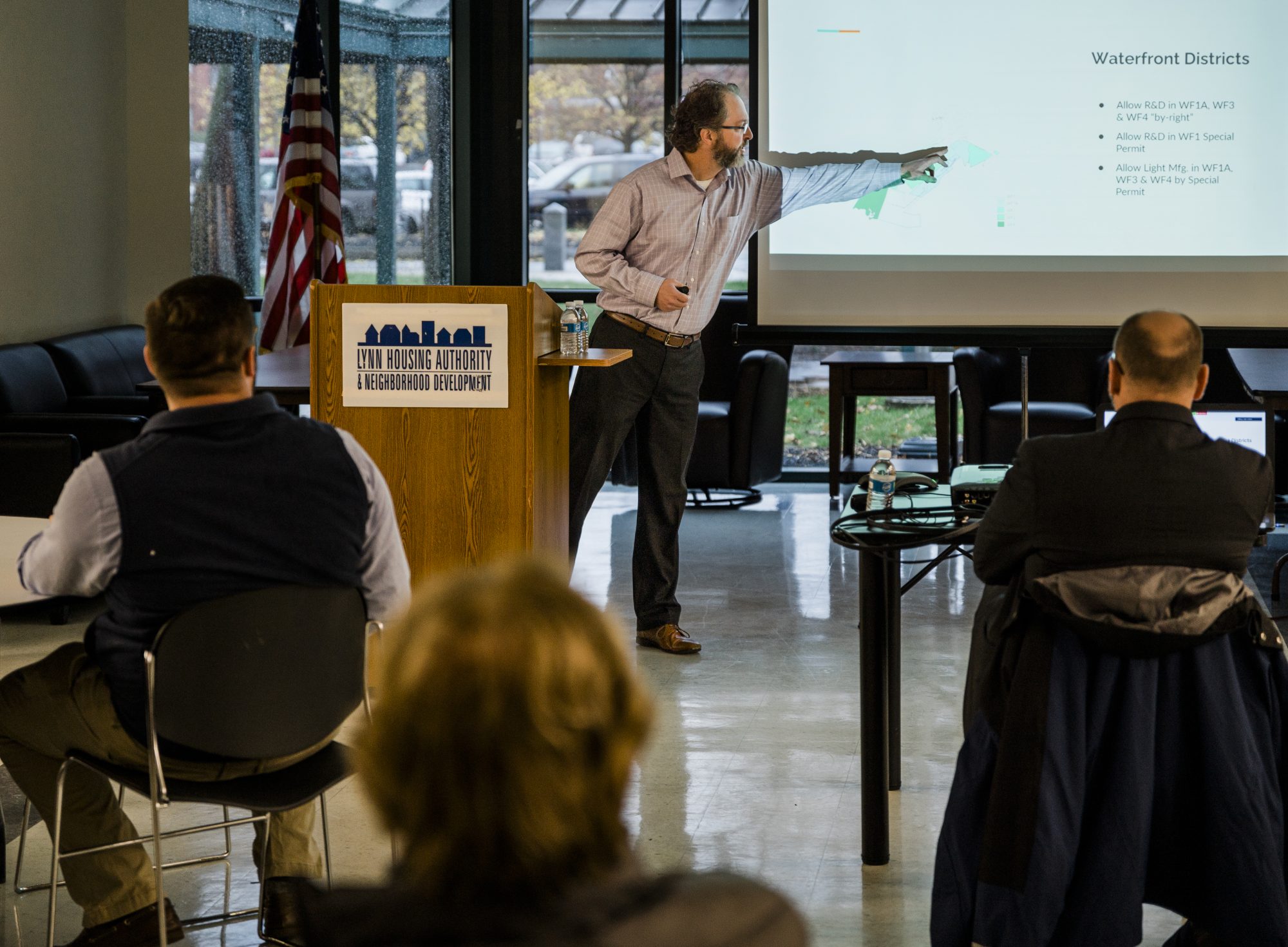
LYNN — The Lynn Affordable Housing Trust Fund Board met recently to discuss key changes to the Inclusionary Zoning Amendment, as well as updates to upcoming housing development projects in Lynn.
The Board announced major updates to the Commonwealth Land Trust project on 21 Oxford St., as well as the 2Life Communities project at the Solimine House.
Both projects closed their financing, and they are anticipating construction to begin soon. The Commonwealth Land Trust is developing a five-story building of 40 studio homes for individuals impacted by homelessness and housing instability, which is expected to be completed in the next 18 months, but could potentially take longer.
As for the 2Life Communities development, which will bring forth 150 new affordable housing apartments to seniors in Lynn, construction has already begun, Principal Planning Director Aaron Clausen said. This could take between 18 and 24 months to complete due to its scale and size.
“Those two [projects] are moving forward,” he added. “I think it’s over 200 units of affordable housing that are under construction right now.”
Lastly, the Lynn Armory Project, which will develop 43 affordable units for veterans, is also moving into financial closing, but a date has not been set yet.
The Board has voted to adopt the Inclusionary Zoning Proposal, which was submitted for approval in October, and is now in effect.
There were no changes to levels of affordability, according to Clausen.
He said that 10% of new housing projects still need to meet 60% of the Area Median Income, which is determined by the U.S. Department of Housing and Urban Development (HUD). While the previous zoning ordinance had a “premium for in-lieu fees of 20% in the downtown or the waterfront,” Clausen said.
They have found that market revenues across districts are beginning to normalize based on a study done by economic development firm, RKG Associates.
“They’re getting closer to each other, and so therefore the premium for the fee no longer applies, so that was removed,” Clausen said. “That doesn’t mean that there’s a different fee for different districts; they’re still based on the market conditions, so in-lieu fee is more in the downtown, it’s a little bit more in the waterfront than the rest of the city, but that premium is no longer applied.”
They have also discovered that “smaller multifamily projects don’t benefit from economies of scale in the way that a larger project would,” adds Clausen. A sliding scale of a fee discount has now been implemented for projects below 20 multifamily housing units.
There were also changes to the number of units that are applicable for the in lieu fee, increasing from one unit to two.
“We did that for two reasons,” Clausen explains. “This came out of sort of our practice over the last couple of years. We were seeing projects that were adding just one unit. Many times, they were adding the unit for multi-generational housing, or in essence, an accessory dwelling unit. And that’s not something we really wanted to sort of create a barrier for creation, particularly multi-generational housing.”
He added, “It is a great way to help provide affordability, both to seniors and professionals in the family. It also aligns with the recent legislative changes that the state passed around accessory dwelling units, whereby an ADU that communities are required to allow by right cannot be subject to inclusionary zoning. So, just made that consistent across the board.”
The timing for the payment in lieu has been adopted and changed, as it will now be due at the time of the certificate of occupancy instead of half of the in lieu fee due at the building print application and then the other at the certificate of occupancy.
“Many, particularly the smaller projects, don’t finance construction the same way a larger multifamily project might,” Clausen explained.
He added, “Whereby they come up with construction financing to pay for the building permit fee, the construction, etcetera. So, many of the smaller projects, multifamily projects, were finding it difficult to make that payment at the building permit. Also, it is a bit of an administrative headache, to be frank.”