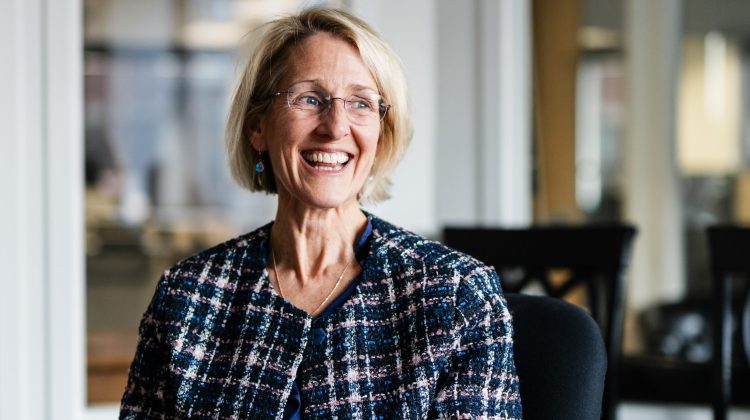
LYNN– Molly Cohen has completed her first 100 days as Lynn Public Schools superintendent.
With 20 years of experience in Lynn Public Schools, Cohen has held a wide range of roles, including teacher, counselor, assistant principal, principal, and executive director of curriculum and instruction. Proficient in Spanish, she spent three years teaching in Chile and another three years in Salem.
“Molly Cohen is a proven leader with experience at all levels in our school district,” said Mayor and School Committee Chair Jared C. Nicholson. “She is highly respected by students, teachers, and administrators and well-positioned to lead the district forward.”
The superintendent doesn’t look backward but thinks forward, so when she recalls her biggest accomplishments thus far, it’s the program that has been run at Lynn English for more than a decade called “Living in Two Worlds.”
When Cohen was the bilingual guidance counselor at Lynn English, the peer mediator at the time, Ginny Keenan came to her and informed her of a grant from the Cummings Foundation.
“What does it mean to be bicultural and to have students express that?” Cohen said. “To have this big funding to be able to create a video and edit it and learn all of those skills, I think, is what I’m most proud of.”
The people of Lynn are a strength that Cohen sees and wants to continue building on. “I love Lynn because it’s a city that feels like a town…and it’s true for Lynn Public Schools.”
One of Cohen’s biggest goals for her time as superintendent is engagement with the families in Lynn. In fact, when Cohen first began, she had a four-pillar entry plan: stability, belonging, instruction, and relationship.
Since her first day as superintendent, Cohen has continuously visited all of the Lynn schools to speak with the principals, teachers, and spend time in classrooms.
“To get a feel for what the morale is, what the culture and climate in the buildings is, and just being approachable.”
That approachability is not accidental. “I think what is most important is that our families understand that we are inviting them to have a voice and a choice — to participate in decision-making and to hold some power,” she said.
That approachability also comes with transparency: “We have to be very clear about what growth is, what it looks like, what’s realistic so that people are motivated by learning,” Cohen said. “When you’re discouraged, it;s really hard to open a book and study.”
In terms of instruction, her four-pillar plan is actively being shown with their heavily focused learning walks, “Which is when you walk through classrooms and collect data when given a rubric on how students are performing and how we can support teachers better,” Cohen explained.
She also said one of the biggest challenges facing student success is access to high-quality instruction following the disruptions of the COVID-19 pandemic. “ I think what is hard right now for student success would be access to tier one instruction.”
Cohen noted that while remote learning accelerated technical skills, it also made it harder for students with varying language and content proficiencies to fully access grade-level, rigorous instructional materials.
To address this, the superintendent shared that the district, along with the Department of Elementary and Secondary Education (DESE), is prioritizing inclusive instructional practices.
“Our strategy right now is really investing in inclusive practices for students with disabilities. And with our multilingual learners, how do we scaffold and differentiate the content so that students are able to demonstrate their knowledge at the grade level standards?”
She added that a professional development council will be formed this spring, and that “by the end of this year, we’ll be able to share with the teachers what the professional development framework will look like in the next two years.”
What does Superintendent Cohen want to accomplish a year from now? “Student scores, better attendance, and families engaged,” she said, “and that morale piece, that the staff feel the efficiency in teaching their students.”
“Do I believe that we have the potential in our students, in our staff, in our families, in our communities?” Cohen said. “Yes.”