
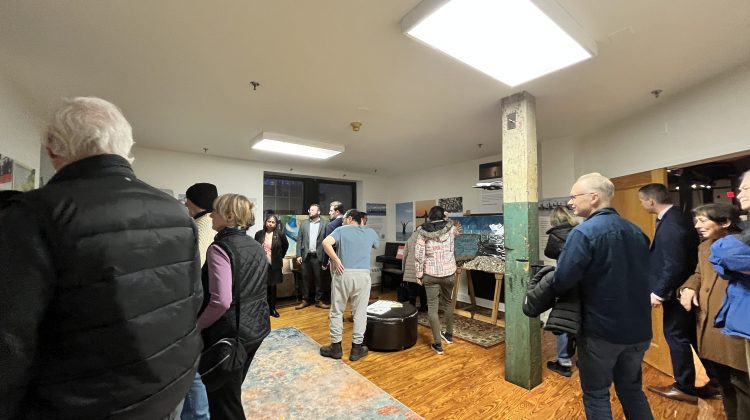
LYNN — Save the Harbor/Save the Bay opened its multimedia exhibit, “Bay State Without Beaches,” at the Lynn Museum and Arts Center this week, marking the final stop of a North and South Shore tour highlighting how coastal climate change is affecting communities across Massachusetts.
Supported by a grant from Mass Humanities’ Expand Massachusetts Stories Program, the exhibit features personal interviews, portraits, and multimedia artwork exploring how rising seas, intensifying storms, and environmental degradation are reshaping life along the shoreline. The show will remain on view for two months.
Executive Director Chris Mancini thanked the museum for hosting what he called “the kind of culmination of this project,” noting the exhibit previously appeared in downtown Boston and at the Hull Lifesaving Museum before arriving on the North Shore.
The project grew out of community meetings held in partnership with the Metropolitan Beaches Commission. Those sessions initially focused on beach maintenance, infrastructure upgrades, and breaking down barriers to access, including racial, disability, and language barriers. Organizers later issued a 2023 report and say 71% of its recommendations have been implemented.
But during those meetings, another concern repeatedly surfaced.
“One thing we weren’t asking about, but we kept hearing was, well, what about climate? What about sea level rise? What about resiliency on the recreational beaches?” he said. “And so we simply couldn’t ignore that.”
Save the Harbor followed up with additional meetings, including one in Lynn, to gather firsthand accounts from fish processors, DCR rangers, and residents from Lynn to Nantasket. Rather than focus solely on “policy and data and measurements and flood maps,” Mancini said the goal was to understand “what was the lived experience?”
“We spend so much time … trying to prove that something’s happening, and then we can address it,” he said. “And it almost felt like we were flooded with that type of information. So I wanted to really balance it out with the stories that will kind of characterize it or will convey more of an emotional stake in how these things affect us here in Massachusetts on a day-to-day basis.”
Opening remarks were delivered by Metropolitan Beaches Commissioner and State Sen. Brendan Crighton, who reflected on his two decades working with the commission.
“You weren’t telling people what you were gonna do. You were asking them what they wanted to see happen on their beaches,” he said, describing the organization’s community-centered approach.
He also pointed to improvements in water quality, calling them accessibility issues. “For the first time in my life, I swam on King’s Beach with my kids this past summer,” he said, describing it as “a big, big moment.”
State Rep. Sean Reid also said the exhibit demonstrates the importance of pairing research with storytelling.
“We have a lot of data, we have a lot of information, but nothing moves people as much as stories, as much as expression,” he said. “Initiatives like this really help to break through to that next level.”
Among the featured voices is Lynn resident Carmen Maria Osuna, a sustainability consultant, surfer, and environmental advocate. In her story, she describes witnessing instability in the ocean firsthand.
“As a surfer, I move with the ocean’s rhythms, and I have felt its instability deepen,” she said. “Storms grow fiercer, and waves are less predictable. But the most haunting change is what the sea returns to us. Plastic, debris, and microplastics scattered across the shore after every storm.”
“The ocean has become a mirror, reflecting the waste of our linear consumption back to us,” she continued, “and demanding that we confront the consequences of our neglect.”
Ozuna emphasized that “Resilience is not optional. Coastal resilience is an urgent mandate,” calling for composting, wetland restoration, and circular product design as ways to strengthen natural defenses against flooding and erosion.
For Save the Harbor, the exhibit represents a new direction. While the organization has conducted public hearings and issued policy reports for 20 years through the Metropolitan Beaches Commission, this marks its first full museum exhibition of this scale.
Asked whether the show was designed for residents or policymakers, Mancini said it is primarily about community connection.
“I think it was more to speak to people, to make people feel seen and heard,” he said. “Maybe your story isn’t in here, literally, but if you come and see it, you (say) oh gosh, this person is experiencing what I’m experiencing. I’m not alone.”
Despite the scale of climate change, he described an evolving sense of hope.
“A lot of the models and the reports say we can’t stop it at this point, but we can slow it down and eventually reverse it if we do everything right. But stuff’s gotta change,” he said. “So as long as we are prepared for that, emotionally and mentally, then we can kind of free ourselves up to change with it.”