
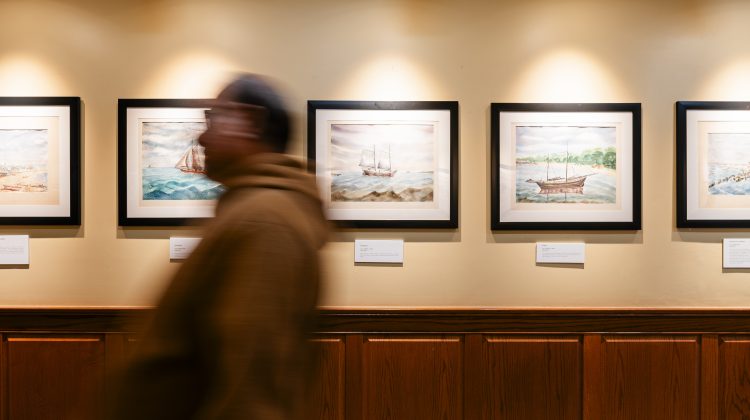
SWAMPSCOTT — A new exhibit at Swampscott Town Hall is bringing a piece of the town’s past back into public view: eight watercolor paintings that have been largely unseen for more than 70 years.
The paintings, created by historian and amateur artist Ira J. Haskell, were originally produced for Swampscott’s 100th anniversary celebration in 1952. After that event, the works were placed in storage, where they remained for decades before recently being rediscovered and prepared for display.
Jonathan Leamon, vice chair of the Swampscott Historical Commission, said the paintings were uncovered during a recent effort to sort through the town’s historic materials.
“They’d been in storage since 1952 in the library, in a garbage bag,” Leamon said. “But they were very well kept.”
The collection includes eight watercolors depicting scenes tied to the town’s coastal history. They include scenes of fishing boats built in Essex that would have operated along the North Shore, as well as local landmarks and maritime stories that helped shape Swampscott’s early identity.
While the paintings themselves date to the early 1950s, the scenes they depict stretch much further back in time. One painting references the wreck of the Tedesco, a Spanish ship that crashed into the rocky shores of Swampscott during a winter storm in 1857. All members of the crew were lost and later buried in Swampscott Cemetery, where a memorial still stands.
Other works illustrate locations such as Fisherman’s Beach and historic buildings by the shore, offering glimpses of how the waterfront once looked when fishing was central to the town’s economy. They depict scenes of today’s busiest streets, like the intersection of Humphrey Street and Puritan Road, when they were yet unpaved, and its biggest attraction was a hay scale.
Leamon said part of the intrigue behind the exhibit came from researching the artist himself. Haskell, born in 1883, authored “Chronicles of the Haskell Family”, a detailed genealogical history tracing generations of his family’s New England roots – dating all the way back to a descendant on the Mayflower. According to historical records, the Haskell family’s ties to the North Shore stretch back to the early colonial period, predating the Salem witch trials.
“When I looked him up, he’s not known as a painter — he’s known as a historian,” Leamon said. “But I think he’s very talented.”
Despite his scholarly focus, Haskell’s artistic work appears to have been more than a casual hobby. Some of his paintings are held in the Thomas J. Watson Library at the Metropolitan Museum of Art, and the watercolor series created for Swampscott’s centennial shows careful attention to historical detail.
The works were originally donated to the town in 1952 by a local florist, creating an unusual connection between the artist and the community. Leamon said that detail was one of the first clues that helped piece together the story behind the collection.
“I was wondering why a florist would be selling watercolors,” Leamon said. “And it turns out that the florist was married to Ann Haskell Carlson, the painter’s daughter.”
Leamon also noted that at the time of the centennial, the paintings were displayed informally. A tribute to Haskell’s artistic modesty, he mounted them to the wall using thumbtacks.
Today, the paintings have been newly framed and arranged in a display case at Town Hall, where residents can see them up close. Because they are watercolors — a medium that can fade when exposed to light — the Historical Commission plans to keep them on display for about six months before returning them to storage.
For Leamon, the exhibit is part of a broader effort to connect residents with pieces of Swampscott’s history that might otherwise remain tucked away in archives.
“Our primary responsibility is the preservation of historic buildings,” he said. “But we also keep the archives, and we hope that by displaying stuff like this, it gives people an appreciation for the history of the town.”
Each of Haskell’s eight paintings tells its own story, much like the stories that can be found on a walk through Vinnin Square or along Humphrey Street. The hay scales and old fishing shacks may be gone, but through the preservation and display of works like Haskell’s, the town’s history is never too far away.