
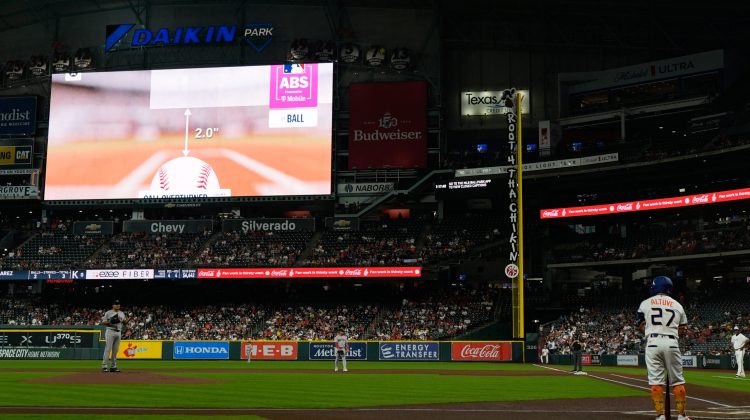
Rants are so much fun. You can just rip right into whatever it is that’s bothering you, right?
Well, I have a rant. It’s called the Automatic Ball-Strike Challenge System. I hate it.
This will run counter to most people’s opinion on this, I’m sure. After all, in the major leagues, these days, balls cross the plate at somewhere just south of 100 miles per hour, even out of rag-armed pitchers. If you cannot, as they say, bring it, then that puny little 90 mph offering either has to curve, dart across the plate at the last minute, or nibble at some obscure part of the strike zone.
If you’re the umpire and don’t have perfect 20/20 vision, or you’re developing a floater, or a speck of dust blows into your eyes, you could miss the big moment and call a ball on the batter. Or vice versa.
The human element is what makes sports so much fun, and so entertaining, and at the same time, so ulcer-inducing. You just don’t know. As a participant, it’s something you have to absorb and overcome. It’s part of the challenge. You can either simply shrug it off and keep pitching or go to pieces and go completely off your game. Your call. And there’s no ABS computer to bail your keyster out if you get it wrong.
This is more than just a “get off my lawn” argument. This goes to the heart of a game that was created and perfected in the late 19th-early 20th century, when people actually had concentration spans and, presumably, more tolerance for human error. It allowed for the odd rhubarb or two, which added to the entertainment value to a sport often short on it from the point of view of the spectator.
The ABS system is just another attempt to use technology to purify games that do not need purifying. So what if the umpire misses a ball/strike call? Wait 30 seconds and there’s another pitch, and another call. Maybe Blue gets that one right.
Sure. Maybe once or twice a game, the umpire will miss one and issue a walk when it should have been strike three. It happens. So do errors with the bases loaded. We don’t get to replay those, and most of the time they’re worse than missed ball/strike calls. I’m sure Billy Buckner would have wanted a do-over in 1986.
Actually, I never understood this obsession we have in sports with correcting the record when, in truth, letting it stand is the better option. The action hinges on split-second decisions.
Human beings are asked to take mental pictures of pitched balls crossing home plate either at 100 mph or accompanied by dips, curves and other crazy movements that make them almost impossible to judge with the naked eye. They’re often just as impossible to see while you’re standing there, zealously protecting your bodies from being hit by said 100 mph projectiles. Yet, batters don’t get mulligans if they swing and miss.
If you’re going to try to legislate perfection into sports where human beings are making critical decisions, you’re going to end up losing. It’s either all or none. And since “all” is just not possible, or even practical, then why start picking and choosing what you’re going to challenge and what you’re going to leave alone?
Even though there are definite parameters in the rule book for determining the strike zone, the truth is that no two strike zones are exactly alike. Consistency is more valued. If you’re on the plate, and you’ve established — by virtue of what you’ve already called — balls a couple of eyelashes off the outside corner are strikes, then keep it that way. Nobody’s going to complain if you make that call with two outs and two strikes on the batter in the ninth because it’s been a consistent strike. That actually happened to me once. I was behind the plate and rang up a kid on a pitch that was brutally outside. The batter was justifiably angry as he walked back to the bench.
But bless him. The coach said to him, “Kid, that’s been a strike all day.”