On Easter weekend, this is a story about a guy named Jesus.
Not that one.
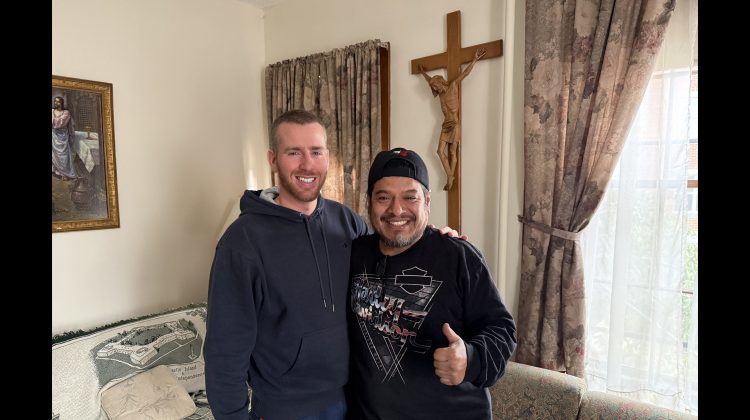
Although Jesus Viveros knows something about suffering and triumph, albeit on a markedly smaller scale.
For almost three decades, Viveros — who came to the United States from Mexico — has lived a life here without incident, first in New Jersey and in Lynn for the last 25 years. That all changed on May 27, 2025, when a routine ride to work turned into a 1,600-mile detour that kept him away for 43 days.
And it could have been much worse.
As he was driving his wife to her job just before 5:30 a.m., Viveros noticed he was being followed by two cars, which became four after he took a turn. He was pulled over by U.S. Immigration and Customs Enforcement (ICE) agents, yet he wasn’t really worried because he knew he had done nothing wrong in the eyes of the law.
Well, almost nothing.
There was the matter of illegal entry into the country, when he went under a fence in Tijuana and ended up in San Diego, but 29 years of being an upstanding, tax-paying resident should count for something, right? He was also driving without a license.
As it turned out, the ICE officers were looking for someone else who happened to live in the same building as Viveros. That led to questions about his immigration status and he told them the truth about how he came to the U.S. Driving without a license gave them another reason to detain him and before long he was in a van with about 20 other men parked in Pine Grove Cemetery.
Viveros was ready to sign a form that would have pretty much guaranteed his deportation, but he said one of the ICE agents talked him out of it, saying that between his longevity in the U.S. and his family situation, including one son with DACA (Deferred Action for Childhood Arrivals) status, he might have a chance to stay.
When his phone rang at that hour of the day, Father Daniel Zinger, who had just taken over as pastor of St. Mary of the Sacred Heart Parish, figured it was bad news. One of Viveros’ sons was calling to let him know that his father had been detained. Father Zinger immediately headed for the family’s apartment.
“When I got there they were praying the Rosary,” Father Zinger said. “They said they were scared and they knew they needed faith to get them through, and so they prayed the Rosary.”
Faith plays a leading role in this saga, especially for the protagonist, although his conviction would be tested over the next six weeks.
Viveros was taken to an ICE field office in Burlington. That facility has frequently been in the news for its horrible conditions, which Viveros can confirm. There were about 50 people in one room, he said, with one bathroom. What little food they were given was bad. He was able to make a 3-minute phone call to his family, who tried to reassure him that everything would be OK, though that was based on hope rather than solid information.
After about 11 hours in Burlington, Viveros was transferred to the Plymouth County Correctional Facility, which is used by ICE to house detainees. By that point, the family, with the help of Father Zinger, had connected with immigration attorney Zoraya Grossman, who agreed to take the case.
It was not good news when they learned about a week later that Viveros would be transferred to an ICE facility in Louisiana, which literally and figuratively placed him closer to being returned to Mexico. As the lawyer went about the task of trying to prevent that, Father Zinger made plans to travel to Louisiana to visit his parishioner. He would take two of Viveros’ sons with him.
“So we flew down to New Orleans and we had to drive about five hours north, literally in the middle of nowhere, to this prison way out in the countryside,” Father Zinger said. “And they let us come in and we had a visit and he shared with us the story. They were funneling them through the process to see what kind of legal arrangement could be made. And if none could be made, then they ultimately send them back to their own countries.”
Thrust into a situation like that, it would be easy to lose hope, if not faith. Viveros would not allow himself either. He maintained an attitude that was disproportionate to his predicament, and that could be a reason that he does not have any real ICE horror stories. A diabetic, Viveros was given his medication and provided meals appropriate for his condition.
“Very good,” he said, when asked how he was treated in Louisiana. “It all depends how you react. I don’t win anything if I fight. You fight, you don’t make anything different. I know I make a problem (for myself) when I jump under the fence, but I don’t do anything wrong … they never treated me bad, because I responded very nicely.”
As the days passed, Grossman was trying to make the case that Viveros is not the person ICE had in mind when they stepped up immigration enforcement efforts. In fact, the driving without a license notwithstanding, he could be the poster child for someone who should not be deported.
“So we came back to Boston and every day we were working with the lawyer really hard, making sure that she was on top of everything,” Father Zinger said. “The judge received all the paperwork. We had all kinds of people here in our church write a letter for him. A dozen priests wrote a letter for him, too. He’s well-known in the area, in the Catholic community, a man of very good character, no criminal record, just a good upstanding man. He loves his family, he loves his church.”
Right around July 4 – you can determine whether that is appropriate, ironic, symbolic, or all of the above – a judge ruled that Viveros would be released. It took five days for a bond payment to be processed and he was outfitted with a GPS ankle bracelet, for which he has never been given a real explanation, but on July 9 he was on a plane headed back to Lynn, reunited with his wife, sons and priest.
“Nunca dudé,” he said, Spanish for he never doubted that his family would get him back.
He has returned to his job at an auto shop where he has worked for more than 20 years, and to his Bible study class at St. Mary’s, the church that is central to his life.
“St. Mary’s is everything to me,” Viveros said, “because they’re always telling me to get up, to not be discouraged.”
And it is a parish being run by a priest who takes the charge of ministering to his people very seriously.
“As a priest, I love my people, and I’m here to be their father. That’s why they call us ‘Father.’ This is what I’m here to do,” said Father Zinger, who has had nine other parishioners detained by ICE and all but one, who is being held in Washington state, released. “If I’m not doing this, I’m not doing my job, and I’m not doing what God wants me to do. It’s what I’m here to do. I’m here to preach the gospel to them. The gospel is the good news that they’re supposed to be here and enjoy their life and the good things that they have.”
Amen to that.