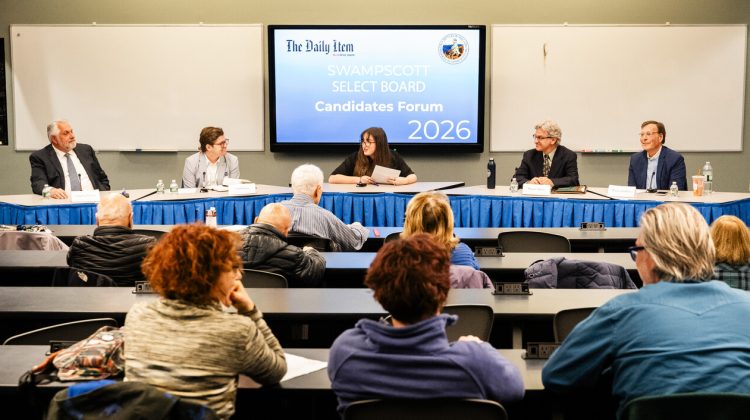
SWAMPSCOTT — Voters got a preview of this year’s town election Tuesday night as candidates for Select Board and School Committee took the stage at Swampscott High School for a public forum.
The forum was moderated by the Item’s Editorial Director Sophia Harris, and comes ahead of the April 28 town election, where four candidates are competing for two open Select Board seats, while three School Committee candidates are running unopposed for seats that will still shape the district’s direction.
About fifty residents turned up to hear the candidates speak. The forum was also broadcast by Swampscott TV, and a recording is available on the town’s YouTube page.
The School Committee portion of the forum featured Martha Driscoll Cesarz, a former teacher and principal at Stanley Elementary School, and John Giantis, a finance and legal professional who has served on the Committee for six years. Katie Arrington, who is also running, could not attend the forum.
Giantis and Cesarz both said they were looking ahead to the work of the Committee and the role they could play in it.
Giantis, who is seeking a third term, pointed to the balance he has tried to bring to the role. “The focus has to remain on serving students, not just now, but over time,” he said. “Over the past six years, I feel like I’ve developed a clear understanding of that balance between listening and deciding, between supporting people and staying accountable, between immediate needs and long-term sustainability.”
Cesarz, drawing on her background in education, said she hopes to bring a more open and communicative approach to the Committee.
“My responsibility on the School Committee is to actively seek things, listen carefully to all viewpoints, and paint a broad understanding of the important issues confronting the schools and town,” she said.
All four Select Board candidates — Wayne Spritz, Charlie Patsios, Ted Dooley, and Wayne Godfrey — attended, setting up the night’s only contested race.
Dooley, who chairs both the Planning Board and Harbor & Waterfront Advisory Committee, framed the town’s financial challenges as requiring new approaches beyond cuts or tax increases.
“We can’t cut any more. I don’t think we can increase taxes anymore. We need to rely on more economic development in this town, and I have the experience to do that,” Dooley said, referencing his involvement in the Vinnin Square rezoning. “Those investments are going to bring in hundreds of thousands of dollars in new growth to our community.”
Godfrey, a Town Meeting member and outreach coordinator for the Swampscott Democratic Town Committee, pointed to the town’s structural financial pressures, particularly around school funding.
“We have billion-dollar problems in this town that we can’t tax our way out of,” Godfrey said. “I intend to use my advocacy skills and my connections to state and federal partners to place pressure … and hopefully open up those lock boxes.”
Patsios, who chairs the Housing Authority and serves on multiple town committees, emphasized the need to better leverage revenue sources and infrastructure planning.
“Our building department brings in roughly $800,000 of revenue. We’re limiting the number of hours that they can work,” Patsios said. “We need to take that back to 40-plus hours. That’s a profit center for the town.”
Spritz, an engineer and longtime member of several committees, most recently as the Chair of the Solid Waste Advisory Board, said his approach would focus on process, data, and consensus-building.
“Facts matter. Details matter. Process matters,” Spritz said. “And most of all, teamwork and alignment matters. That means listening carefully before you make choices, and trusting your team.”
Much of the discussion centered on how the town should manage growing financial pressures, with candidates broadly agreeing on the need for new revenue.
Dooley repeatedly pointed to commercial growth and development as key to easing the burden on taxpayers, while Patsios focused on restructuring town systems and identifying underused revenue opportunities. Godfrey emphasized advocacy and potential partnerships beyond the local level, and Spritz stressed long-term planning and decision-making grounded in data.
The town’s financial situation was also brought up as candidates discussed several major projects currently facing the town, including the rail trail and the future of the General John Glover farmhouse, both of which have drawn significant public attention.
On the rail trail, candidates broadly supported completing the project, though they differed in how to move it forward.
Dooley pointed to the gap between the town’s approval of the project and its execution.
“It’s a great idea … but what we haven’t been able to do is have an honest conversation about how we are going to complete it,” he said. “We need to do better at executing on our public policy. When we set a policy like this, we need to do it right.”
Spritz echoed that support while emphasizing the need to resolve ongoing logistical and financial challenges.
“I do think the rail trail should be completed … I think it could be a community gem,” Spritz said. “What I’m frustrated with is that since 2017 — Town Meeting allotted about $850,000 to move the project along. … My goal will be to bring the groups together to find a way through this.”
On the Glover House, candidates also agreed on the importance of preservation, while also stressing important questions to be answered on cost and long-term viability.
Patsios said that he believes the farmhouse should be saved, and the town should explore available funding tools to support its restoration.
“It’s a national treasure that’s located in Swampscott, Massachusetts,” he said, mentioning that he himself is a monthly donor to the preservation efforts. “ I believe that CPA funds can be used for a project like that. If we know where we can look … I know we can do better.”
Godfrey, meanwhile, emphasized the scale of the challenge and the need for broader support beyond the local level.
“I do in fact support preserving the Glover … there’s an opportunity to preserve an absolutely beautiful piece of history,” he said. “There has to be a private-public partnership that is sustainable over the years … and that needs to be generational … we really do need to ask for help from the Commonwealth and our federal partners.”
Throughout the discussion, candidates repeatedly stressed that strong communication and connections, both among Select Board members and between the Board and the public, would be key to navigating those challenges and building trust around major decisions.
Voters will now weigh their options in the weeks leading up to the April 28 election.