
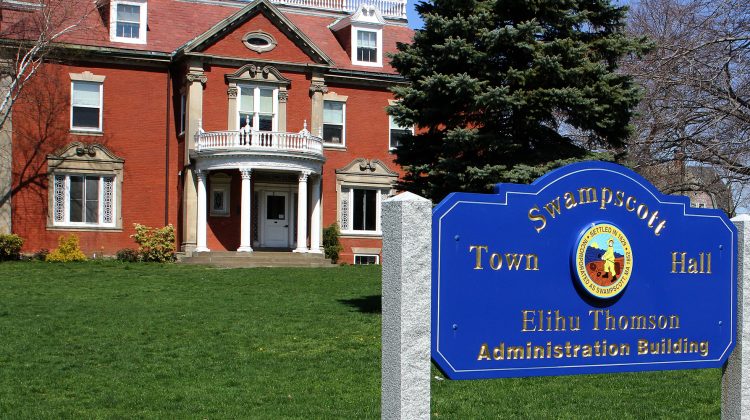
SWAMPSCOTT — After more than a month of discussion, revisions, and legal review, the Select Board on Wednesday unanimously approved a formal proclamation outlining how the town will approach federal immigration enforcement on town-owned property.
The measure affirms that “the enforcement of the nation’s federal civil immigration laws is solely the responsibility of the federal government,” not local officials, while also responding to what it describes as “fear and concern in Swampscott” tied to current federal policies.
The vote was the culmination of a process that began in mid-February, when resident Keiko Zoll read a separate proclamation urging the town to take a stronger stance on civil liberties and immigration enforcement. That earlier document, which board members signed, was largely symbolic — but it set off a weeks-long effort to craft something more formal and legally grounded.
What emerged Wednesday was a new proclamation adopted by the Board itself, one that repeatedly balances a statement of values with clear legal boundaries.
Central to the measure is a restriction on how town property can be used. Select Board member Doug Thompson read the proclamation aloud at the meeting. It states that Swampscott “should not use the property within its custody and control, including parking lots, garages, parks or buildings … for staging areas, processing locations or operations basis for federal immigration enforcement actions.”
The proclamation also limits access to municipal buildings, stating that town officials “shall not provide access to nonpublic areas of town buildings unless required by a valid judicial warrant … or other applicable law.”
At previous meetings, Town Administrator Nick Connors and Swampscott Police Chief Ruben Quesada have told members of the Select Board that the legal basis of this type of proclamation, which has been issued by other North Shore towns like Lynn and Salem, is “uncharted territory.”
Taking note of this, the proclamation language was carefully reviewed to ensure the town had minimal risk of legal or financial consequences.
“This proclamation has been heavily vetted through counsel to ensure that we are not … jeopardizing Swampscott in any way for maintaining this viewpoint from a federal or state perspective,” Chair Katie Phelan said. “Obviously there are no guarantees, but we have all the right language that we’re meant to have so that we’re not putting ourselves in harm’s way.”
The proclamation itself said that it should not be used to restrict or interfere with the execution of lawful judicial warrants or enforcement of criminal law. It reaffirmed existing police practices, noting that officers will continue to act in compliance with state or federal legal requirements in situations involving warrants and court orders.
The final document also includes a broader statement of principles, saying the Select Board “strives to ensure that all persons living and working in or visiting” Swampscott are treated fairly “regardless of their national origin, race, gender, sexual orientation, religion, disability, immigration status, ethnicity, or political viewpoint.”
It further frames the action as part of the town’s responsibility to maintain public safety while encouraging residents to express their views “in peaceful and nonviolent ways.”
The path to Wednesday’s vote stretched longer than initially expected, with multiple drafts circulating over several weeks as officials worked to translate the earlier resident-led proclamation into a policy that could withstand legal scrutiny.
In doing so, the Board moved from a symbolic statement of concern to a more specific — though still limited — framework defining the town’s role.
While the proclamation cannot alter federal enforcement practices, it sets clearer boundaries for how those efforts intersect with local government, and signals how Swampscott officials intend to navigate that line going forward.