
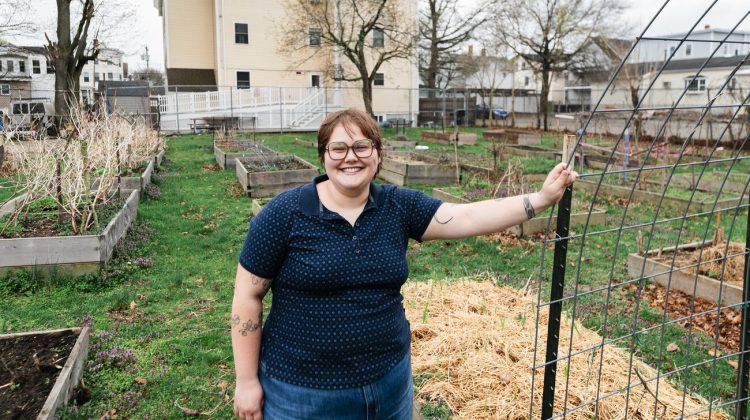
LYNN — The Food Project has launched the Lynn Community Garden Network, where they are collaborating with 15 community gardens across the city.
What initially began as ‘Lynn Grows’ has transitioned to this network.
“It was fine, but it wasn’t super accessible to everyone in the city, so we discontinued that,” Gray Lawson, food access and education manager, said. “And now we are restarting it, but in a very different way and calling it the Lynn Community Garden Network.”
Lawson shared that the city has 15 gardens, and each one has its own coordinator.
“What we were running into in the past year is that everyone’s kind of in their own bubble doing their own things,” they stated, “But a lot of us are repeating the same work, and it’s not the intended outreach.”
“So we’re kind of trying to centralize it in one kind of way where all the community gardeners know each other,” Lawson added. “The coordinators can talk with one another and… what that looks like in practice is we’re gonna host one workshop a month in a community garden.”
The first workshop will take place next month after The Food Project’s annual plant sale on Ingalls Farm. At the sale, seedlings are sold at a lower cost than most other plants that could be found in other places.
With the sale, community coordinators will have obtained the discounted seedlings, the workshop will be a basic teaching on how to properly plant them.
“It’s just gonna be garden basics. You have your seedling. How do you plant it? How can you take care of it?” Lawson stated. “What if it gets really cold again and starts snowing randomly like it did last week?”
With this new project, the idea of ‘resident driven’ is important.
“We’re centralizing the efforts… since they are throughout the city, in different wards,” Associate Director of Youth Programs and Community Partnerships Adesuwa Usuanlele said. “Definitely this being a space for like resident collective action.”
The network has also expanded how The Food Project evaluates its impact.
Lawson described a mix of quantitative and qualitative data collection, including surveys distributed at farmers’ markets in multiple languages such as Spanish, Russian, Khmer, and English, as well as surveys tied to community garden applications.
Participants are asked about their food consumption at the start of the season and again later, allowing coordinators to compare whether access to fresh produce has increased.
In addition to survey data, The Food Project gathers qualitative insights through conversations with gardeners, tracking how much food they are able to grow and consume.
Lawson also monitors participation metrics such as the number of garden beds in use and waitlists, emphasizing that this kind of data is “really, really important when it comes to grant reporting.”
The network has also given The Food Project a new perspective on the city’s garden needs.
“One of the main challenges that was brought up by most of the community gardener members was their access to water. When you’re growing food, you need water,” Usuanlele explained. “And right now, a lot of the gardens don’t necessarily have the infrastructure to have easy access to water.”
They offer a level of support and connection to the city regarding the water issue that the garden coordinators may not have themselves.
The Food Project wants to “Be that connection of ‘You’re a resident, you don’t have a direct line to City Hall as well as we do,’” Lawson said.
Those connections also include the Latino Support Network and the Public Health office.
Beyond logistics and infrastructure, organizers emphasized that community awareness and inclusivity remain key goals. Lawson noted, “I feel like people currently don’t super know how to get involved and don’t wanna bother us,” adding that some residents assume others are more in need of garden space or resources.
They stressed that gardening is meant to be accessible to everyone: “Growing your own food is and can be for everyone. And we want everyone to be growing their own food.”
Lawson also hopes residents understand that the gardens are not just for those with plots, but serve as broader community spaces.
They described them as “like a third space, like a free open space where the community can come together,” encouraging people to visit even if they are not growing food,
“Come see the bees; come see the flowers,” Lawson said.
Ultimately, the goal is to ensure that Lynn residents know these spaces are open and welcoming.
“This is for everyone, and everyone can grow their own food…And we want to help give the resources to make that accessible to everybody,” Lawson stated.