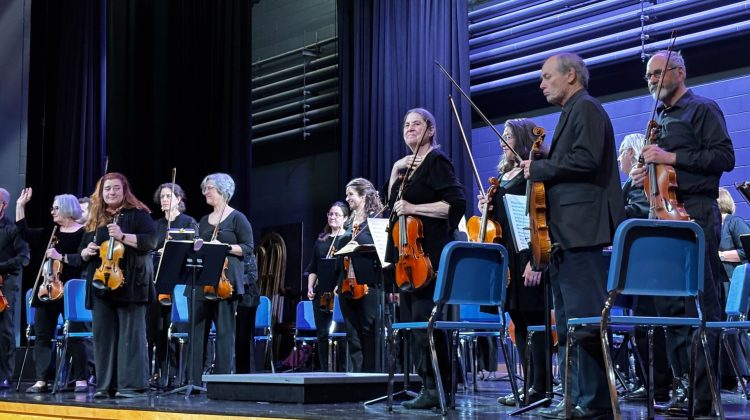
SWAMPSCOTT — The North Shore Philharmonic Orchestra’s spring concert at Swampscott High School on Sunday brought together a mix of well-known and lesser played works, ranging from early Baroque to contemporary music before closing with Beethoven’s most underrated symphony.
Under the direction of Robert Lehmann, the winds opened the concert with Richard Strauss’ “Serenade,” a young work of the late Romantic composer that set the mood with a flowing and pensive tone. Lehmann noted ahead of the concert that Strauss, like Beethoven, “paid respect to the Classical traditions in this charming piece that evokes the elegance of a bygone era.”
The concert also featured contralto Emily Marvosh, who performed Johann Christoph Bach’s “Lamento” and Caroline Shaw’s “Is a Rose” alongside the string orchestra.
Lehmann said he was excited to welcome Marvosh to the NSPO stage. Marvosh, a member of the Grammy nominated Lorelai Ensemble, has appeared with other groups, including the Boston Symphony Orchestra, the Rhode Island Philharmonic, and the Handel and Haydn Society.
Marvosh performed two pieces that reflected very different points in music history. The “Lamento,” written in the Baroque period by the older cousin of the famous Johann Sebastian Bach, is rooted in early chamber music traditions, while Shaw’s “Is a Rose” is a modern work that draws on a mix of historical influences.
The ensemble’s performance reflected that journey through time in their playing. During the Bach, performers were quick and short with their bows — a style of playing that reflects differences in how instruments were made in that time.
The Shaw performance was long and languid, featuring a dream-like harpsichord. “Is a Rose” is a trilogy of songs with lyrics that feature poetry by Robert Burns, Jacob Polley, and Shaw herself.
“(‘Is a Rose’) explores themes of nature, love, and fragility,” Lehmann said. “The cycle revolves around the rose as a symbol of beauty, transience, and memory.”
The piece’s blend of neo-Baroque and contemporary idioms and lyrics, Lehmann told the audience, is reflective of the entire program’s connection of older and newer styles.
After a brief intermission, the program closed with Beethoven’s “Symphony No. 2,” which Lehmann described as one of the composer’s “sunniest works,” and “very much in the style of the great masters Haydn and Mozart.”
Beethoven’s second symphony is a four-part movement. It begins one of Beethoven’s longest openings, stretching from a slow adagio to dynamically surprising (though not uncharacteristic of Beethoven) allegro con brio — literally “fast with spirit.” The second section, the “Larghetto,” is gentle in a way that was reminiscent of the earlier lyrical pieces, and is followed again by a dynamic shifting “Scherzo,” which acts as a fun burst of energy before the full-hearted finale.
Ironically, the mostly light-hearted symphony was composed during Beethoven’s stay in Heiligenstadt, famous for his “Heiligenstadt Testament” — a letter written by Beethoven to his brother as he despaired over his hearing loss and contemplated suicide.
Lehmann said, despite Beethoven’s inner turmoil, the second symphony marked a turning point for him, calling it a “springboard into (his) own future compositional style, one that would break established molds of the Classical-era style and pave the way for the new Romantic period.”
The performance closed the program on a lighter note, bringing the concert back to the same sense of balance between tradition and change that ran throughout the afternoon.
Founded in 1947, the North Shore Philharmonic Orchestra is made up largely of volunteer musicians and aims to provide accessible performances to communities along the North Shore. They are funded in part by the Mass Cultural Council, the Swampscott Cultural Council, and other North Shore community organizations.
The orchestra’s next performance is a youth-focused concert at First Baptist Church in Beverly on Saturday, June 7, featuring music by Danvers resident Charles Turner along with student performers and an instrument petting zoo.