
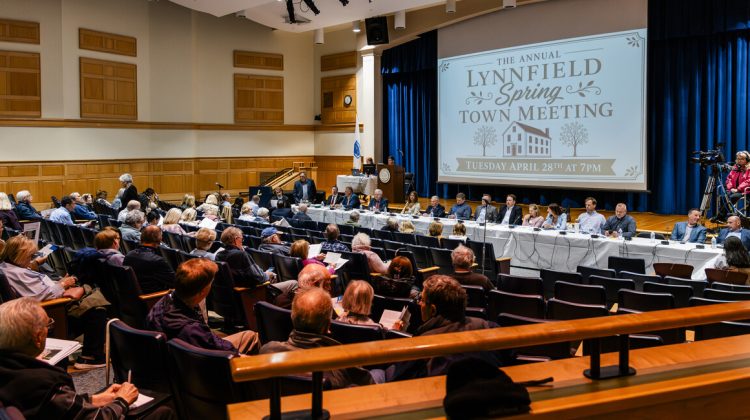
LYNNFIELD — After just making a quorum at Tuesday night’s Town Meeting, voting began on the 19 articles on the 2026 warrant.
Articles 1 through 4 passed quickly by voice vote and required no further discussion.
Article 5, “To see if the Town will vote to transfer $2,607.62 from available funds or otherwise provide a sum of money to pay for services rendered or goods received in previous fiscal years… or take any other action in connection therewith,” had minimal discussion with resident Pat Campbell asking why there were paid bills back to 2022.
Campbell was referencing the money owed to West Marine Inv# 195679, which was an amount of $593.98. It was explained that invoices had been sent to former employees, but it was found that the invoices had been sent to the wrong emails, and this was to correct that issue.
The clicker vote for Article 5 passed with 154 yes votes and 14 no votes.
Article 6 was gone through page by page “To see if the town will vote to raise and appropriate, or appropriate by transfer of available funds, or otherwise, $80,565,960 for the necessary Town charges and expenses for the town’s fiscal year 2027 operating budget.”
Campbell again stood to point out the amount of money being taken by the school department from various other sections, like the DPW.
“Two years ago… I called attention to the fact that the School Committee was giving huge increases in salaries of, let’s say… 21%, 7%, 6%. Now, people in regular businesses aren’t getting increases like that,” she said.
Campbell made a motion that the employees of the school department not be given more than the 3% raise that the teachers receive. However, due to technicalities in the school budget being a fixed budget, the motion was not allowed.
In the end, Article 6 passed by a clicker vote with 140 voting yes and 36 voting no.
Article 7, which had to do with the vote to appropriate $1,049,926 from the Emergency Medical Service Enterprise receipts to pay expenses and contractual services required to operate the medical services in town, passed by a voice vote.
Article 8, which focused on the appropriation of funds from the Golf Enterprise receipts and/or Gold Enterprise Retained Earnings to pay expenses and contractual services, also passed by voice vote.
Article 9 passed via clicker vote with 142 yes votes and 24 no votes.
“This is our annual capital budget, which covers capital expenditures, anything from school technology, to fire trucks, to new floors at the Senior Center. It is paid by using our free cash,” Town Administrator Rob Dolan explained.
Article 10 was to vote to appropriate the sum of $1,431,00 for the purchase of various DPW related equipment and to fund DPW capital expenditures as set forth in Appendix B. It would also authorize the treasurer, with approval from the Select Board, to borrow said sum pursuant to G.L. c.55 sections 7 or 8, or any other enabling authority, and to issue bonds and notes of the town.
“This is the second half of our capital investment,” Dolan said. “Most capital investment is through CIP, which is cash, as I said earlier. This is a borrowing request for the town to reinvest in DPW equipment, predominantly snow removal equipment… We have learned that bringing the snow removal in more in house is far more advantageous fiscally, than it is to hire contractors.”
The article passed by a clicker vote with 146 yes votes and 24 no votes.
Article 11 passed quickly via voice vote.
Article 12, “To see if the town will vote to authorize the Select Board to petition the General Court for special legislation to authorize the town to appropriate funds from the Gold Enterprise Fund to the Recreation Capital Trust Stabilization Fund for the purpose of funding large and/or long-term capital projects, improvements, and turf replacement,” passed by a voice vote.
Dolan explained that investments were made to build athletic fields at Lynnfield High School. Those fields are now in need of improvements.
Article 13 would be a vote to authorize the Select Board to petition the General Court for special legislation to authorize the town to impose a local sales tax upon the sale of restaurant meals originating within the town by a vendor at a rate of 1.5% of the gross receipts of the vendor from the sale of restaurant meals.
Dolan noted that this tax could bring in an estimated $500,000 a year to go to the operations of the town. However, he did explain that the state had yet to allow this to pass from multiple governors, so this was a way for the town to try to pass it through special legislation.
Article 13 passed with a clicker vote of 139 yes votes and 29 no votes.
Articles 14 and 15 both passed quickly.
Article 16 ended up being withdrawn in a large agreement by all in the crowd, as a mistake was found in the warrant regarding how the building fees were written out. While a recess was taken to try to fix the issue, it was decided that withdrawing was the better idea.
Article 17, regarding an amendment to Article III of Chapter 7 of the Town’s General Bylaws, Traffic Safety Advisory Committee, was deferred after discussion with 132 voting yes on the deferral and 36 voting no.
It was voiced that the article should first be brought to a public meeting so residents could share their thoughts before it could be voted on by Town Meeting.
Article 18, which would “amend the Town’s General Bylaws to insert a new chapter, Cryptocurrency Machines, as follows, and further, to authorize the town clerk to assign appropriate Chapter and section numbers for said bylaw,” passed by a voice vote. It will prohibit the installation and use of cryptocurrency machines in the town.
Article 19 was a citizen’s petition that was advisory only to ask the town to establish a local Senior Relief exemption submitted by Allan Dresios. This vote would not establish anything, but was to poll whether the town was interested. The clicker vote read 109 yes votes and 48 no votes.