
SWAMPSCOTT — The Planning Board met Monday evening to discuss potential zoning changes aimed at preserving ground-floor commercial space along Humphrey Street, after town staff said a growing number of residential conversion proposals could gradually erode the corridor’s current economic impact and character.
During the meeting, board members and planning staff discussed possible amendments to the Humphrey Street Overlay District. This could be done, they said, by either requiring special permits for converting commercial storefronts into residential units, by requiring ground-floor commercial uses in future developments, or a combination of both.
Senior Planning Director Christa McGaha said the town has recently seen multiple applications over the past year or so involving proposals to convert existing commercial properties into all-residential buildings.
“The intent of the Humphrey Street Overlay District is to promote mixed-use development, support a walkable, vibrant downtown, and encourage economic activity and small businesses,” McGaha said. “The conversion of existing ground-floor commercial to completely residential doesn’t align with the purpose of the Humphrey Street Overlay District.”
An overlay district is basically a method of zoning that allows municipalities to place an additional layer of regulations on top of the town’s underlying zoning map across a group of different zones. It’s often used to address specific and unique areas, such as historical districts or specialized development goals. In Swampscott, the Humphrey Street Overlay District was created to encourage mixed-use and pedestrian-oriented development along the Humphrey Street corridor.
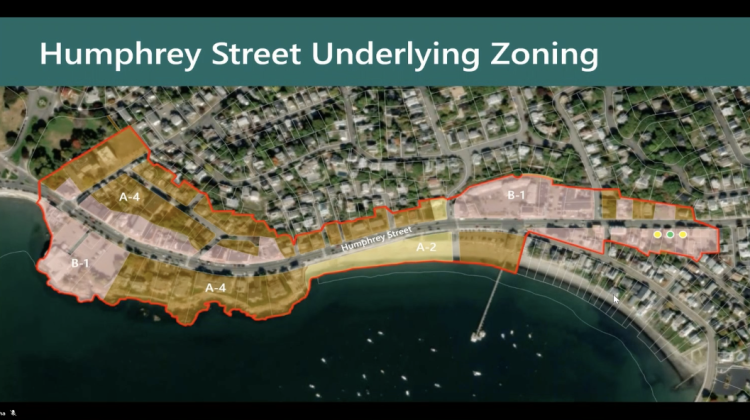
The underlying zoning classifications along the district vary, but most of the conversion discussion focused on parcels zoned B-1 beneath the overlay district. B-1 is a type of business district, which, according to Swampscott bylaws, generally allows neighborhood business and mixed-use activity. However, McGaha noted that according to the current bylaws, developers would not need to go through the town’s Zoning Board of Appeals to convert an existing commercial space to a residential-only building, provided that the building has fewer than six units.
“What we’re seeing now as a trend is the incremental loss of ground-floor commercial over time, so it’s slowly going away and converting to residential,” McGaha said. “It isn’t visible overnight, but it’s something that definitely impacts the mixed-use land use of the corridor.”
Planning Board member Jer Jurma said Humphrey Street has historically struggled to maintain a strong commercial corridor and argued that losing storefronts now could undermine recent momentum.
“I think one of the things that Humphrey Street has suffered from for years is its inability to have a critical mass of retail and restaurants,” Jurma said. “It’s not until like the last few years that the dynamic nature of Humphrey Street has started emerging.”
Planning Board member Angela Ippolito said that the recent commercial success along Humphrey Street isn’t necessarily reflected in the zoning, with parts of the street falling under A-2 and A-4 residential zones and other parts falling in the B-1 classification.
“The underlying zoning … it basically was patterned on the original patterns of development when zoning was first adopted by the town, which was back in like 1952 or something,” Ippolito said. “So whatever was in use, that’s how it got zoned. There was no rhyme or reason.”
McGaha said one of the simplest approaches could be creating “conversion control” regulations throughout the overlay district, which would require developers to obtain a special permit before changing commercial storefronts into residential space. Under that framework, she said applicants could be required to demonstrate prolonged vacancies of over 12 months within the building or other hardship conditions before receiving approval.
Another approach that McGaha mentioned was amending the zoning bylaws to require ground-floor commercial use along the corridor, which she noted did not give an ideal amount of flexibility to either the town or property owners.
Planning Board member Ariane Purdy supported the idea of protecting the existing commercial space, but cautioned against rules that could unintentionally create inactivity in an economically impactful area.
“I think the concern with requiring [first-floor commercial space] is this idea of vacancy, right?” Purdy said. “I mean, we don’t want a bunch of vacant storefronts if economic times dictate that we can’t keep a commercial base in these fronts.”
Planning Board members also mentioned that the Hawthorne property also falls within the overlay district, noting that any potential zoning changes would affect the long-term redevelopment plans for the town-owned property.
“I think there is a lot of passion from the community on how that property is going to be used,” McGaha said. “If that property is going to be included in what we propose, we have to be very intentional about how we say that to the community that just went through this process.”
Board members referenced past public discussions surrounding the town-owned site, including concerns about maintaining public access and ensuring future development aligns with the broader character of Humphrey Street.