SWAMPSCOTT — Residents gathered at the Senior Center on Wednesday evening to learn about and provide feedback on the redesign of the Lynnway corridor, a long-discussed transportation project aimed at improving safety, transit reliability, pedestrian access, and the overall experience of traveling through the area.
The Lynnway Multimodal Corridor Project is a partnership between the Massachusetts Bay Transportation Authority, the Department of Conservation and Recreation, the Massachusetts Department of Transportation, and the City of Lynn, with funding coming from the state of Massachusetts and $20 million from the U.S. Department of Transportation’s RAISE grant program.
The redesign project aims to “create a safer, more connected, and more multimodal corridor,” and is meant to align with the MBTA’s Better Bus Project and Transit Priority Vision. These two projects are part of a broader effort to improve bus service reliability, accessibility, and efficiency across the state, and particularly in heavy public transit corridors like the Lynnway.
While construction is not slated to start until 2028 or later, representatives from the project team said these public meetings are valuable for gathering public input, an important part of the design process.
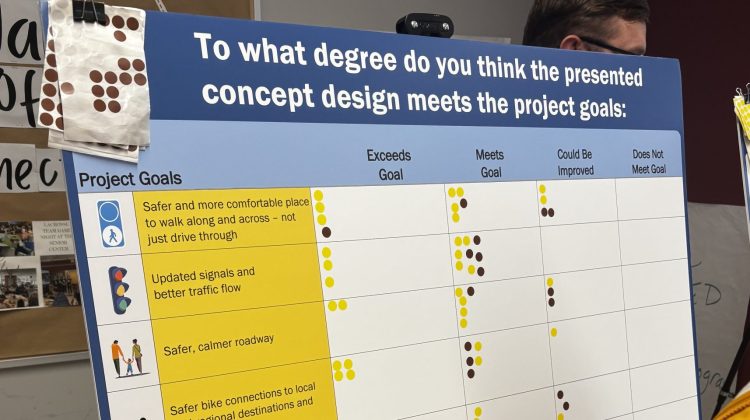
The back room of the senior center featured several posterboards displaying maps, traffic studies, design concepts, and examples of proposed infrastructure upgrades, with project representatives stationed throughout the room to answer residents’ questions.
Project materials described the current Lynnway as carrying roughly 40,000 vehicles per day while also serving MBTA bus routes that account for approximately 3,000 daily boardings and 70,000 weekly transit trips. Officials said the corridor currently suffers from outdated traffic signals, narrow sidewalks, poor pedestrian infrastructure, limited bicycle accommodations, and several high-crash areas.
“There’s been probably a decade worth of studies from at least five different transportation-related agencies … that have all in some way said, ‘Hey, the Lynnway’s got an outdated design,’” Project Manager Phillip Cherry said. “MassDOT has a variety of different data sources that indicate there’s safety issues there.”
Cherry said the current project builds on years of planning efforts related both to transportation improvements and redevelopment along Lynn’s waterfront.
“This project didn’t just sort of happen overnight,” he said. “There’s been several other efforts that have spurred this.”
One major focus of the proposed redesign is improving pedestrian and bicycle infrastructure along the corridor. Plans displayed Wednesday included new 12-foot-wide shared-use paths intended for both cyclists and pedestrians, separated from vehicle traffic by six-foot landscaped buffer zones.
Project representatives said the goal is to create safer and more comfortable conditions for people walking and biking along the Lynnway, where sidewalks currently sit directly adjacent to fast-moving traffic in many locations.
Another major component involves improvements to bus infrastructure and transit reliability. Plans displayed at the meeting included dedicated bus lanes in portions of the corridor — in the right lane on the northbound side, and in the center lane along the median going southbound. Consolidated bus stops, upgraded bus shelters, and raised bus boarding islands and medians are intended to make stops safer and more accessible for riders.
Residents attending the meeting asked frequent questions about how the redesign could affect traffic congestion along a roadway that already experiences heavy backups during rush hour. Some attendees expressed concern about reducing general traffic capacity while introducing dedicated bus lanes, noting that portions of the Lynnway already experience significant congestion despite currently operating with three travel lanes and no separated bus lane infrastructure.
Project materials shown Wednesday included several locations where residents could choose between multiple design options, with tradeoffs involving traffic flow, green space, pedestrian comfort, and future development potential. At the end of the room, there was a station for people to fill out comment sheets with notes on their feelings about the project.
Many residents were concerned about traffic in the area, and asked questions about the timing in which the traffic study was done, noting that it would be important for designers to understand what traffic actually looks like at peak commuting hours. Some residents also shared concerns about pedestrian safety with a center bus lane, particularly in such a busy area where crossing is often difficult. Residents also shared concerns about the timeline of work on the Lynnway, especially with construction work to be done on the General Edwards Bridge within the next couple of years.
Cherry described the current stage of the project as still relatively flexible, comparing it to drawing with a highlighter rather than a permanent marker.
“As this project moves forward on a typical design timeline, you kind of move to a pen and then a fine-point pen,” he said. “There’s still time for elements of this to be adjusted,” he said, although he noted that the project is operating within the constraints of its grant funding.
Project materials also tied the redesign to broader redevelopment plans along Lynn’s waterfront, where officials anticipate thousands of new housing units, additional commercial development, expanded park space, and new connections to the harbor area over the coming decade.
Construction is not expected to begin until at least 2028, with detailed engineering and design work planned through 2027.
Wednesday’s session was the second of five open-house-style public meetings planned for communities along the corridor. The same information will be presented at additional meetings, including a virtual session on Thursday, May 14 at 6 p.m, followed by in-person meetings on Tuesday, May 19 at Nahant Town Hall and Wednesday, May 20 at the Marblehead Senior Center.