
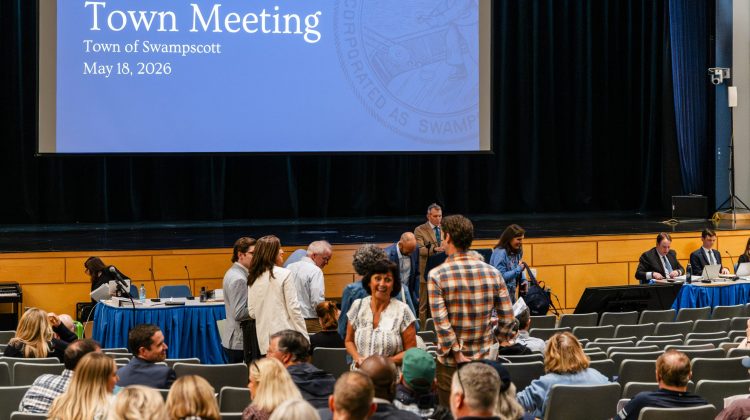
SWAMPSCOTT — Town Meeting members voted Monday night to reject a citizens’ petition that would have restricted the use of wood-burning fires in town after a lengthy and enthusiastic debate over public health and local traditions.
The proposal was brought forward through a citizens’ petition by Dr. Lawrence Block, a former Board of Health member. It was the final article on the warrant and generated some of the evening’s most passionate testimony before ultimately failing in a hand vote.
The discussion also marked Town Moderator Ryan Hale’s first Town Meeting in the role. Before the debate began, Hale acknowledged both the late hour and the strong feelings surrounding the article, while emphasizing the importance of allowing residents to fully discuss the issue.
“I do appreciate the tone in the room, and I would like to make sure that we honor the process that we have in Town Meeting,” Hale said, acknowledging that Block had gathered the necessary number of signatures to bring the article before members.
Block, a cardiologist who has been practicing medicine for over 40 years, gave a presentation on the article in which he framed the proposal as a public health issue, giving reference to growing scientific research surrounding wood smoke exposure.
“This article is not to ban all fires in town,” Block told members during his presentation. “It is to ban wood fires based on the very significant health effects. And we have lots of published data on the ill-effects of wood smoke over the last 5 to 10 years.”
During his presentation, Block cited concerns about fine particles produced by wood smoke known as PM 2.5, which he said can travel deep into the lungs and create health risks, particularly for children and older adults. He also described wood smoke as a carcinogen and pointed to recommendations from organizations including the American Lung Association and the EPA.
He also argued that Swampscott’s population density makes outdoor smoke difficult for neighbors to avoid.
“Swampscott is the fifth most densely populated town in the state of Massachusetts,” Block said. “There is no way that you can possibly have a fire in Swampscott without adversely affecting the health of a neighbor.”
Block pointed to other Massachusetts communities that have already adopted similar restrictions and emphasized that alternatives such as propane fire pits and grills were still available.
“I’m not saying that we shouldn’t be having fires,” he reiterated. “The fact is that there are alternatives to wood smoke.”
After Block’s presentation, a few residents shared their thoughts on the proposed article.
Helen Tieger, a Town Meeting member and an elected member of the Board of Health, said the Board supported the proposal.
“Because of the health and the risks of these fires, we as the Board of Health support this bill,” Tieger said.
Town Meeting member Barrie Atkin also spoke in favor of the article, saying she has experienced ill-effects from exposure to wood smoke.
“I personally know of a number of others because I’ve been exposed to wood fire smoke and have some allergies to it, and get sick every time I’m nearby the fire,” Atkins said.
Opponents, however, argued that the proposal would unnecessarily regulate everyday family activities and weaken community connections.
Joe Simons, a Town Meeting member from Precinct 5, urged members to reject the article, arguing that outdoor fires create opportunities for families and neighbors to spend time together in person.
“At a time when so many of our children are spending time in their rooms on tablets, and there’s an epidemic of isolation in Swampscott and the country at large, having a responsible cooking fire — the ability to do that strengthens families,” Simons said. “It binds together families and neighbors and friends alike.”
Simons also criticized language in the proposal that he said encouraged residents to act as enforcers of the restriction, taking photos and document violations to the Board of Health.
“I worry that it divides neighbors,” he said. “It does the exact opposite of what we want to do in building community.”
Other residents speaking against the proposal raised concerns about what they viewed as threats to longstanding family and neighborhood traditions. Several speakers argued backyard and beach fires help bring neighbors together and questioned the consistency of restricting outdoor wood fires while still allowing wood-burning fireplaces and stoves inside homes during the winter months.
Following the debate, Hale called for a vote to end discussion before members voted on the article itself. The motion did not pass.