
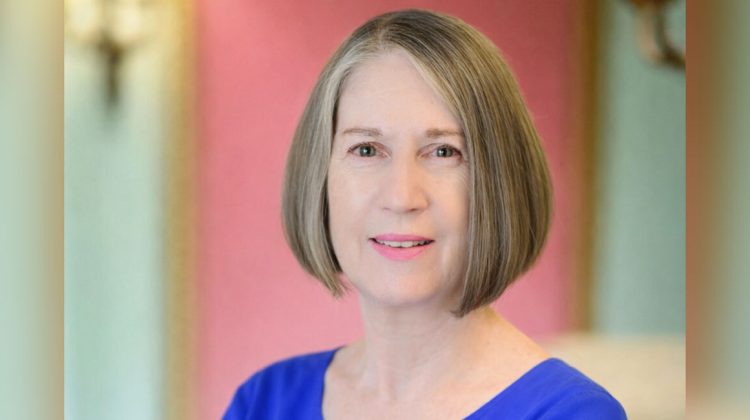
SWAMPSCOTT — In 2003, Elisa Speranza first heard the story that would become her debut novel, and she knew she couldn’t let it go.
The Lynn native, who moved to Swampscott when she was 10 years old, had built her career in government, housing, transportation, and the private sector, and would eventually return to her childhood dream of becoming a writer. But that idea for her first novel lingered in the back of her head for nearly two decades before she finally sat down to write in earnest.
“When I was doing a purge of scrapbooks and things like that during COVID … I found a note that I had written that somehow my mother had saved that said: ‘When I grow up, I want to be a writer or a veterinarian,’” Speranza said. “I think I was about eight years old.”
While she would quickly discover that a veterinary career involved science — “not one of my strengths” — Speranza had quietly spent years developing her lifelong love for writing into something bigger.
“Thinking you want to write a book and learning how to actually write a book that anyone would want to read — that was the learning curve for me. I had to get some help with that.”
Speranza said she would “secretly sneak off” to go to writing workshops in different cities, including GrubStreet in Boston. There, she found the mentorship she needed to start working on her novel in earnest.
Her debut novel, “The Italian Prisoner,” was ultimately published in 2022, after nearly 20 years of research and development throughout various stages of her life and career. The book, based on a true story and inspired by the little-known history of Italian prisoners of war held in Louisiana during World War II, grew out of a story Speranza first heard shortly after moving to New Orleans.
That fascination with overlooked corners of history would eventually carry into her second novel, “Triage,” released on May 12. The historical fiction novel follows Laura Marino, a former Army nurse living in 1951 New Orleans, as she struggles with grief, trauma, and memories from her service in North Africa and the European theater during World War II.
For Speranza, the book started as an opportunity to tell the stories of women whose experiences and service during the war often go overlooked.
“I really am motivated to write because I think that good stories, well told, can illuminate the human condition,” Speranza said. “And I’m drawn especially to characters who’ve been kept in the shadows and deserve their due. So stories that are little-known.”
The novel draws in part from the story of Ellen Ainsworth, a 24-year-old Army nurse who died after saving dozens of wounded soldiers during the Battle of Anzio. During a research trip in Italy, Speranza visited the cemetery where Ainsworth is buried, an experience she said stayed with her long after she returned home.
“They called it a half acre of hell,” Speranza said of the battlefield at Anzio. “I visited [Ainsworth’s] grave. She was one of six nurses who died … and she saved 42 patients. She moved them to safety.”
What struck Speranza even more was the wording engraved on a plaque commemorating the American Cemetery in Nettuno, Italy, where Ainsworth and other fallen American heroes are buried.
“On the memorial, it says ‘In remembrance of the achievements of her sons,” she said. “And it just set me off. So what about the daughters?”
That frustration — and the desire to shine a light on the women who served their country in those difficult times, whose stories are not as well-known, sits at the heart of “Triage.” But while the novel centers on wartime and grief, Speranza said that the message she hopes readers will take away goes beyond those traumas.
One repeated phrase in the novel, “fix your worst problem first,” became particularly important to Speranza as she was finding that message.
“That is the essence of triage,” she said. “I think we all get overwhelmed on a daily basis with things that we have to deal with in our lives and in the world these days. I think focusing on what we can control and what we can fix first is a helpful reminder.”
While the storylines throughout the novel can be heavy, Speranza emphasized that the story is not one without hope.
“There’s a lot of darkness in the book because there’s people dealing with trauma and grief,” she said. “But there’s also a lot of lighthearted moments and humor. For me, the importance of the bonds of female friendship, in particular to get us through dark times — that’s really important.”
Speranza, who said her North Shore roots have really made their way into both her novels, will return to a familiar place to discuss the new novel — the Swampscott Public Library, where she once worked while in high school.
“I wanted to make sure to be back with this book because I’m so grateful for the time I spent there,” she said. “With those librarians and with all those books around me, it was a really formative time for me … I’m looking forward to reconnecting with folks when I’m up there.”
Speranza will appear in conversation with Salem author Len Cawley during a book launch event on June 11 at 6 p.m. at the Swampscott Public Library.