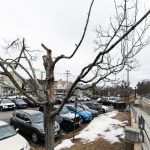
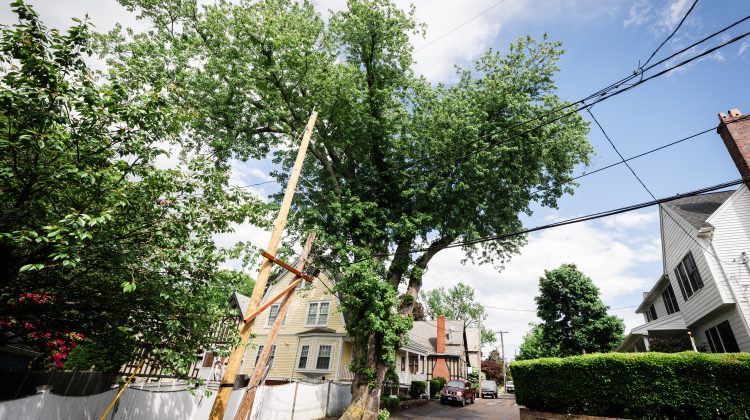
SWAMPSCOTT — Concerns about falling branches, aging trees, and maintaining a healthy shade canopy dominated discussions on Thursday afternoon during the town’s public shade tree hearing, where officials reviewed 40 trees across town for possible removal or maintenance.
Public tree hearings are a process required under Massachusetts General Laws before public shade trees can be removed. Residents must file a formal request with the town, including their name, address, the tree’s location, and the reason for its removal. Members of the public are allowed to voice support or opposition during the hearing, while the town’s tree warden ultimately determines whether a tree meets the qualifications for a justified removal.
The hearing was led by DPW Director and Tree Warden Gino Cresta, alongside Assistant Tree Warden Steve Kent and members of the town’s Tree Committee. Cresta began the meeting by emphasizing the criteria for removal, which is guided by Swampscott’s bylaws.
“The misconception is just because there’s a notice on the tree doesn’t mean the tree’s coming down,” Cresta said. “If one or more persons oppose the removal of a shade tree and the shade tree is not deemed an immediate risk, then the tree will stand.”
One of the afternoon’s most extensive discussions centered around a large Silver Maple tree on Hardy Road, measuring 50 inches in diameter at breast height (DPH). Residents of the street attended the meeting and said that the tree had become dangerous due to repeatedly falling branches and its proximity to homes and utility wires.
Robert Doucette, who lives on the street, said large limbs measuring up to 10 inches have been falling from the tree for years, especially during strong winds or rainstorms. His wife, Tara Doucette, said she called into the meeting because this issue was so important to her, and that she was especially worried about children playing on the street, who could be in danger from falling limbs.
“We love that tree. We love it dearly,” Tara said. “But it’s time for the tree to go.”
Another resident, Evan Katz, agreed that he would be sad to see the tree go, but ultimately the damage that the branches of the behemoth tree could cause were too risky.
“You know, you read all the time about where to locate trees on your property,” Katz said. “If you were building a house … you would never plant a tree and put it there. This tree is probably an example of one where catastrophic damage is probably not that far away.”
Cresta acknowledged those residents’ fears, but said the tree did not appear to show major signs of disease or structural failure, and wondered if any pruning or cutting from the DPW could assuage some of the residents’ concerns.
“We obviously never want to see anybody get hurt,” he said, noting the recent fatal incident involving a fallen tree at a school playground in Melrose.
Rather than making an immediate decision on Thursday, several Tree Committee members said they would prefer an additional evaluation before recommending the removal of a significant mature tree. Committee member Suzanne Hale suggested the town bring in an independent arborist to review the tree, and officials agreed the best course of action was to get an arborist to the street within the next week, in addition to some branch maintenance from the DPW.
The Hardy Road discussion was one of several during the two-hour hearing in which residents raised concerns about branches falling near homes, sidewalks, and utility wires.
At another property, a resident described repeated problems with roots from a town tree interfering with sewer lines and lifting sections of the sidewalk. Other residents asked officials to inspect aging Ornamental Cherry trees after large limbs fell during recent storms.
Kent and Cresta repeatedly explained that healthy trees are often maintained through pruning and monitoring rather than immediate removal, especially when there is disagreement among neighbors and other residents. Discussions focused on balancing those concerns with preserving mature trees and maintaining the town’s canopy coverage, which Tree Committee members have said provides multiple environmental and neighborhood benefits.
“As a committee, we try to preserve those whenever humanly possible,” Hale said. “The preservation of older trees is a significant priority for the Tree Committee.”
At the end of the hearing, officials reviewed the overall results of the afternoon’s discussions. 40 trees were considered for removal during the session. Tree Committee member Brian Drummond capped off the meeting with a tally of 13 trees ultimately recommended for removal, mostly due to declining tree health, while the remaining 27 trees were expected to remain standing pending additional pruning, monitoring, or future review hearings.