
MARBLEHEAD — Americans have more information than ever, but understanding what’s true has become harder.
News arrives instantly through smartphones, social media feeds, podcasts, and artificial intelligence tools. Yet despite unprecedented access to information, Americans remain divided over basic facts, whom to trust, and how to make sense of an increasingly complex world.
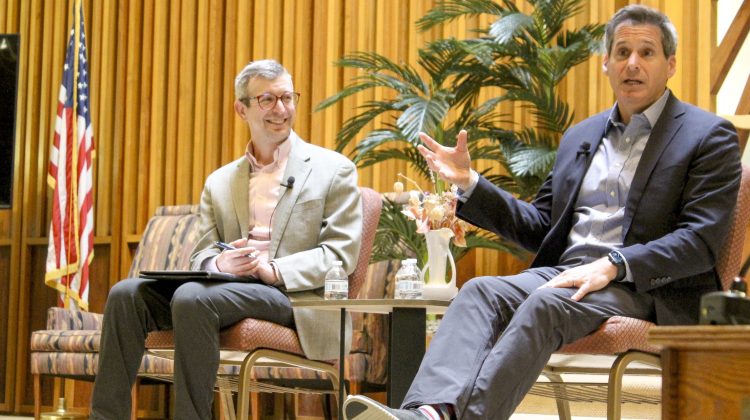
That disconnect was at the center of a conversation Sunday between CNN anchor John Berman and CNN Business senior reporter David Goldman, who argued that journalism’s greatest challenge is no longer delivering information but helping audiences understand it, at Temple Sinai Sunday morning.
“If I’m going to talk about what happened yesterday, I don’t just list the things,” Berman said.
For much of modern journalism, reporters served as gatekeepers of information. Today, most audiences already know the headlines before opening a newspaper, turning on a television, or scrolling through social media.
The challenge now, Berman said, is providing context.
Rather than simply reporting what happened, journalists must explain why it matters, how it connects to larger trends, and what audiences should pay attention to next.
“The biggest challenge now is helping people understand why something matters,” Berman said. “People can find out what happened almost instantly.”
That shift, he said, has made transparency increasingly important.
“I think in CNN what we just have to do every day is to be as clear and as transparent about how we’re reporting the news and about the news itself,” he said.
Berman said audiences no longer automatically trust institutions the way previous generations once did, making it increasingly important for journalists to explain not only what they know, but how they know it.
The conversation repeatedly returned to the issue of trust — both in the media and in the information people consume every day.
Goldman distilled the challenge into a single phrase: “We have to have a truth bias.”
The comment came during a discussion about coverage of Israel and Gaza, one of several topics that prompted questions about objectivity, fairness, and public perception. Goldman acknowledged that it can be challenging “for journalists of all strengths, no matter what news story you’re covering.”
Journalists, as humans, often bring biases or preconceived notions to events, but he stressed that, above all, “we must be biased toward the truth.” He repeatedly emphasized that personal beliefs should not undermine reporting.
Instead, journalists must follow facts, even when those facts challenge their own assumptions or the expectations of their audiences.
Goldman said one consequence of today’s media environment is that people can easily find sources that reinforce what they already believe, making it harder to reach a shared understanding of events.
The pair also addressed criticism that the war in Ukraine receives less attention than conflicts involving Israel, Gaza, and Lebanon.
Berman said newer conflicts naturally attract more coverage, but acknowledged that journalism sometimes struggles to maintain attention on long-running crises.
“Just because something hasn’t changed doesn’t mean we should ignore it,” he said. “If Putin is doing awful things in Ukraine, but he’s been doing them for three straight years, we should still be telling people that it’s happening.”
Coverage decisions are also influenced by the priorities of presidential administrations, he said: “A lot of how we cover the news in American journalism is through the prism of the administration in power, the prism of the White House.”
Berman also noted the practical challenges of reporting from conflict zones.
“One of the challenges we’ve had in Israel is that we’re not in Gaza; we’re not allowed in, and it’s really hard to find out what’s happening on the ground there,” he said.
Artificial intelligence emerged as another example of the growing tension between information and understanding.
While AI can summarize articles, answer questions, and generate content in seconds, both journalists argued that it cannot replace original reporting.
“What can’t AI do? Well, it can’t send a camera to something that shows you what’s happening at that moment; it can’t report out a story; it can’t call sources,” Goldman said.
As technology makes information more accessible, Goldman argued that original reporting becomes even more valuable.
Berman said the rise of AI makes verification more important than ever.
“Anything that we’re getting in, we have to fact-check and check and check again,” he said.
The discussion of perception versus reality extended beyond politics and international affairs.
Following the event, Goldman used gasoline prices as an example of how complicated issues are often reduced to simplistic explanations.
Many consumers assume local gas station owners benefit when prices rise. Goldman said that is often not the case.
“When gas prices go higher, it’s unintuitive, but they make less money,” he said.
Most stations are independently owned businesses operating on thin margins. As fuel prices rise, consumers typically buy less gasoline, reducing sales while operating costs remain largely unchanged.
The result, Goldman said, is that many station owners actually see profits decline during periods of rising prices.
The same economics help explain why prices often decline more slowly than they rise.
“That’s why this phenomenon we call rockets and feathers,” he said. “Gas prices go up like a rocket, and they come down very slowly.”
Goldman said the example illustrates a broader problem in modern public discourse. People are often exposed to conclusions without understanding the forces behind them.
The explanation reflected one of the central themes of the conversation, that many of the issues dominating public debate are far more complicated than they initially appear.
For Goldman, the discussion also served as a return to the congregation where he grew up.
His mother, Debra Goldman, recalled seeing signs of his future career long before he joined CNN.
“David wrote a lot,” she said. “I have books that he wrote from first grade; he made little books, and he would make the covers on them, too.”
When asked what it has been like watching her son build a national journalism career, she smiled: “I’m thrilled to see him. He worked hard, and he earned it.”
Despite concerns about misinformation, declining trust, and rapidly evolving technology, Berman said he remains optimistic.
“My kids give me hope because I think they’re smarter than I am and nicer than I am,” he said. “I actually believe in people and humanity. I think that people are basically good and that everything moves, over a very long period of time, in the right direction.”