
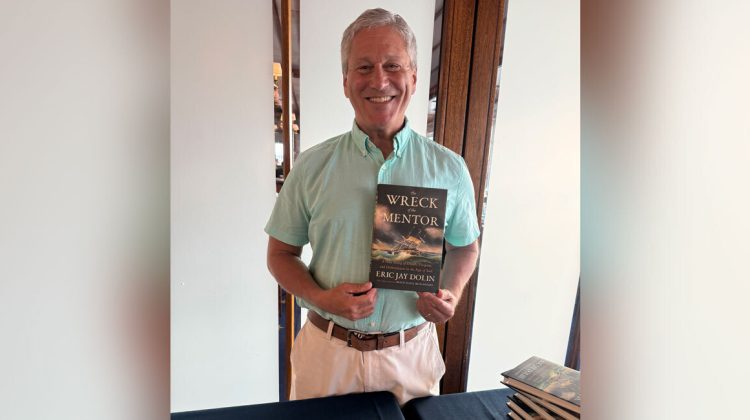
MARBLEHEAD — When Eric Jay Dolin began researching the history of American whaling nearly two decades ago, he stumbled across a story he couldn’t shake.
The tale involved an American whaleship called the “Mentor,” which wrecked on a reef in the Pacific archipelago of Palau in 1832. The surviving crew members endured years of captivity, starvation, uncertainty, and cultural conflict before rescue.
The story never made it into the book he was writing at the time, but it stayed with him.
“It was sort of in the back of my head,” Dolin said. “Then I wrote a book called ‘Left for Dead,’ which is about five men who were intentionally marooned on the Falkland Islands during the War of 1812. Since that book had a story about a shipwreck and people surviving on an island for many years, it brought back memories of the wreck of the ‘Mentor.'”
That memory eventually became “The Wreck of the Mentor: A True Story of Death, Despair, and Deliverance in the Age of Sail,” which was released on June 2.
The book has already generated significant attention. It was named by The New York Times as one of the nonfiction books “everyone will be reading this summer.” Following that mention, Times reviewer Blair Braverman called the book “a work of serious research and clean prose” that contains “plenty of interesting illustrations that keep the pages turning fast.”
While this publication might mark Dolin’s 17th book, it is the first time this story has ever been told.
“There haven’t been any books on the wreck of the ‘Mentor’ until mine,” he said. “This is a story that nobody will have heard of.”
This book also represents the latest chapter in a writing career that almost never happened. In the late 1990s, while working full-time and writing books on the side, Dolin told his wife, Jennifer, that he wanted to become a full-time author.
“She said, ‘Fine, but you have to put aside a year’s worth of your salary before you can quit,'” he recalled. “So I worked for about six years writing books on the side and saving money.”
Then one evening, Jennifer surprised him.
“We were watching TV, and Jennifer said to me, ‘You can quit your job,'” he said. “I said, ‘What?’ She’d kept a bank account for me and put aside a year’s worth of my salary.”
That same year, his book “Leviathan: The History of Whaling in America” was published and performed well enough to secure a two-book contract with W.W. Norton & Company publishing.
“I couldn’t have done it without Jennifer’s support,” he said. “She has always been very supportive of my writing.”
Nearly two decades later, Dolin still speaks about writing with the enthusiasm of someone who has found exactly where he belongs.
“It’s the best job I’ve ever had,” he said. “It’s the hardest job I’ve ever had. And I’m just glad I can do it.”
Much of “The Wreck of the Mentor” was researched from the third floor of his Marblehead home, where digitized archives, historical newspapers, and online collections allowed him to reconstruct a story that had largely been forgotten.
“Researching and writing a book is just a lot of time sitting in front of a computer,” he said. “Writing, saying, ‘Oh, that stinks,’ writing something else, and then you get to the point that you like it.”
He also credited the Abbot Public Library for the creation of this book and many others.
“The Abbot Public Library was very important to me because I ordered a ton of books through interlibrary loan,” he said.
The release of the book has already taken Dolin on a five-state tour and will keep him busy throughout the summer with roughly 30 talks. Local appearances include the Swampscott Public Library on June 18 at 6:30 p.m. and the Marblehead Museum on June 25 at 7 p.m.
“I’m naturally an introvert, so I’ve had to teach myself to get up in front of people and give talks,” he said.
Despite publishing 17 books, Dolin said the arrival of a new title never feels routine.
“It’s sort of like having a kid,” he said. “Your book comes out, and you hope it does well in the world.”
Whether readers pick up “The Wreck of the Mentor” on a beach, on vacation, or at home, Dolin hopes it offers a brief reprieve.
“I like to think this book, especially in the summer, will provide an escape,” he said. “I think it’ll transport you to a different era, a different time, and for the time that you’re reading the book, you’ll be able to forget about the current woes in the world.
“I hope when they finish it,” he said, “they say, ‘That was time well spent.'”