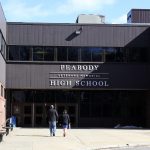
PEABODY — With a vote of 3-2, the School Committee voted against advancing a policy that would make the state’s recommended MassCore curriculum a graduation requirement, citing concerns over funding, student support, and the potential for higher dropout rates.
MassCore is a state-recommended sequence of high school courses designed to prepare students for college and careers. It includes four years of English and math, three years of history and lab-based science, two years of the same world language, one year of the arts, and additional electives. While Peabody already offers the MassCore pathway, students are not currently required to complete it to graduate.
Superintendent Dr. Josh Vadala explained that the state expects each district to adopt MassCore beginning with students entering ninth grade in 2027.
According to the 2024-25 MassCore Completion Report, 75.8% of Peabody students are already completing MassCore requirements.
School Committee members Pamela Milman and Dr. Suzanne Cox voted in favor of the graduation policy’s first reading, while Beverley Griffin Dunne, Joe Amico, and John Olimpio voted against it. Member Brandi Carpenter was absent.
Milman argued that the district is already close to meeting the requirements and that adopting them would expand opportunities rather than limit them.
“We’re not watering anything down; we’re rising up to offer more for more kids,” Milman said, adding that MassCore has existed for decades and has helped improve outcomes in districts that adopted it. She stressed that Peabody’s Advanced Placement and elective courses could remain intact while still meeting the state’s expectations.
Vadala agreed that the district could implement MassCore without sacrificing Peabody’s broad course offerings. He said administrators are already working to ensure existing electives, such as forensic science and computer science, can satisfy MassCore requirements.
“We do think we can do both,” he said. “We can have our cake and eat it, too.”
Opponents, however, repeatedly described the proposal as an “unfunded mandate” that could place additional burdens on taxpayers and students alike.
“I want to give the kids the best, but this country has not proven that education is as important as we all think it is. … My concerns are on the monetary end,” Amico said, questioning how the district would pay for the changes without additional state funding.
Vadala agreed that funding remains a major question, saying the proposal “may be an unfunded mandate” and expressing concern that one-time grants would not cover long-term costs. The Healey administration stated that $500,000 in statewide grants will become available this summer to help districts implement MassCore.
Dunne said her biggest concern was how the district would support struggling students under more rigorous graduation requirements.
“We are a safety net for many children, and we currently are unable to provide the supports that they need. How are we going to pay for more supports to help everyone excel?” Dunne asked, warning that without additional staffing and resources, the district’s dropout rate could increase.
Amico also questioned the state’s assurances that the proposal would not become financially burdensome, comparing it to the rollout of MCAS decades ago.
“If teachers over the last 35 years knew then what they knew now, they would have shown up at the State House with pitchforks when MCAS was established,” he said, arguing that the state’s proposed end-of-course assessments could evolve into another costly statewide testing system.
Dunne added, “I will fight against cutting our courses to realign our staff to be able to accommodate these more rigorous standards, which are currently available in our program and are there for people who want them … This is an unfunded mandate with huge consequences and ramifications down the road.”
The committee’s 3-2 vote means the graduation policy did not advance to a second reading, leaving Peabody’s existing graduation requirements in place.