

NAHANT — More than 20 students trekked down to Doggie Beach on Wednesday morning to survey local species as part of the Coastal Ocean Science Academy Program.
The program, hosted by Northeastern University’s Marine Science Center in Nahant, was established in 2007 to connect students of all ages to local coastal ecology, which has kick-started an early love for nature in many.
By using nature as a classroom, students entering sixth, seventh, and eighth grade from Nahant, Swampscott, Marblehead, Lynn, Revere, Boston, Melrose, and even New York, receive a week-long hands-on experience in what it is like to be a scientist in the Littorina program, said Sierra Muñoz, the Outreach Program coordinator and lecturer for Northeastern’s Department of Marine and Environmental Sciences.
At Doggie Beach, the 21 middle schoolers broke into groups of five to eight, cycling through three survey stations. The first was an epifauna and infauna survey where they identified different bivalves like clams and mussels on the surface of the sand (epifauna) and beneath the surface of the sand (infauna). This was done at the three different tidal exposures: the high tide zone, the intertidal zone, and the low tide shoreline zone to decipher differences in biodiversity.
The second survey focused on testing how much light can pass through the water (water turbidity); wind decibels; how salty the water is; the water temperature; and hypothesizing how it all impacts the health of the environment.
For the third survey, students dressed in chest-high waders, went a couple of feet into the ocean, and threw out a seine net, which is a large fishing net that lies on the surface of the water. Here, students researched what species thrived off the shore. What they found were tiny silverside fish and a variety of shrimp.
One of the most lasting lessons from the program, however, has been understanding how to make the environment better than how the students left it, Muñoz added.
“These beaches and rocky shores are classrooms, and the concepts teach themselves,” Muñoz said.
The program also offers an experience for students entering ninth through twelfth grade called the Chondrus program, where the participants go more in depth about weather conditions, water quality, specific species biodiversity, and relating them to potential local threats along the marshy, sandy, and rocky locations around the North Shore.
As a professor of the science communication course at Northeastern for undergraduates in the College of Science, the most rewarding element has been working with undergraduate students who then become trained in leading lessons for middle and high schoolers in the programs.
Incoming senior Northeastern Undergraduate Emily Stangel has a double major in environmental sciences and journalism, with a minor in marine biology.
“I absolutely love science communication, and you know every kid says they want to be a marine biologist when they’re little, and I just never grew out of that phase,” Stangel said. Writing about the science she has had a lifelong passion for, she gets to “convey complex science ecosystems and biodiversity,” making it digestible for everyone to understand so they know how to play a part in conserving the Earth, she added.
One of the younger leaders of the program, Mia Bianchini, is a soon-to-be Swampscott High School ninth grader. She shared that her favorite part of being in the program for two years has been seeing the curiosity for science and nature as a whole inspire other youth.
“One of the main things for me is just being able to see the love for the ocean from other people, and I think that’s really important, especially with the state of the environment now,” Bianchini said. “Getting the newer generation to appreciate nature is really, really important.”
Bianchini expanded on her love for the environment and how she hopes for it to open the minds of others: “I think that everyone should at least try to take some course, some experience that teaches them about nature because you really get a deeper appreciation of what goes on.”
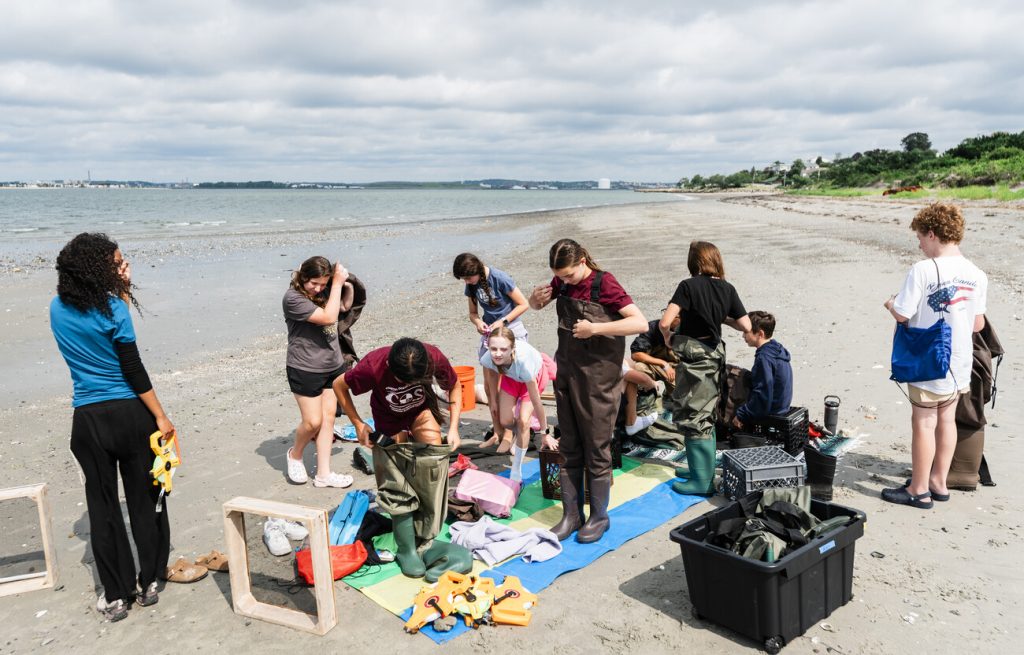
Photo: Spenser Hasak | Purchase this photo

Photo: Spenser Hasak | Purchase this photo

Photo: Spenser Hasak | Purchase this photo

Photo: Spenser Hasak | Purchase this photo

Photo: Spenser Hasak | Purchase this photo

Photo: Spenser Hasak | Purchase this photo

Photo: Spenser Hasak | Purchase this photo

Photo: Spenser Hasak | Purchase this photo

Photo: Spenser Hasak | Purchase this photo

Photo: Spenser Hasak | Purchase this photo

Photo: Spenser Hasak | Purchase this photo

Photo: Spenser Hasak | Purchase this photo

Photo: Spenser Hasak | Purchase this photo

Photo: Spenser Hasak | Purchase this photo

Photo: Spenser Hasak | Purchase this photo

Photo: Spenser Hasak | Purchase this photo

Photo: Spenser Hasak | Purchase this photo