
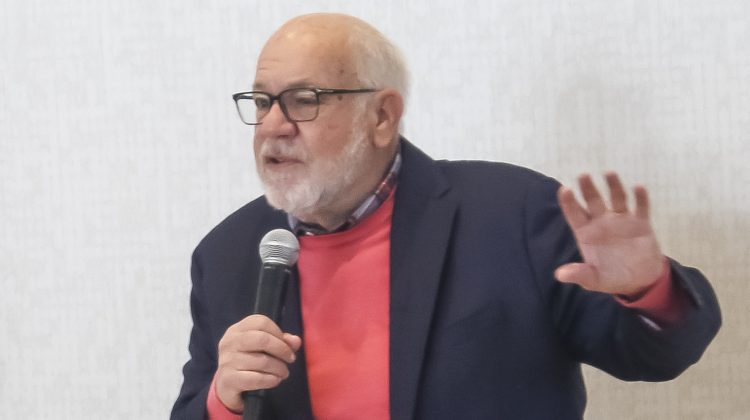
MARBLEHEAD — Michael Goldman began his talk Sunday morning the way only a lifelong political operative might: by asking a room full of Marblehead residents if anyone had been following a state legislative race in Louisiana.
Almost no one had.
That, Goldman said with a smile, was exactly his point.
People in his profession, he told the crowd gathered at Temple Emanu-El’s Sisterhood community breakfast, spend their time watching elections most Americans never hear about because those quiet contests often reveal where the country is heading.
He cited a recent Louisiana State House election in which a Democrat defeated a Republican in a district that had previously voted strongly Republican, describing the result as one example of how early contests can signal shifts in voter sentiment.
Such off-cycle races, he explained, “can give us an understanding of what may very well happen” in future elections because they reveal changes in voter behavior before national campaigns begin in earnest.
“These individual races pop up,” Goldman said, “and they can give us an understanding of what may very well happen down the road.”
Goldman, a Malden native and longtime Marblehead resident, delivered the Feb. 8 talk titled “Where will the 2026 elections take us?” drawing on more than 60 years in political campaigns, government, and consulting.
The president of Goldman Associates told the audience that while today’s political climate can feel uniquely volatile, American history tells a different story.
He also described historic waves of nativism and immigration backlash — from the Chinese Exclusion era to earlier discrimination against Irish and Jewish communities — suggesting today’s debates reflect longstanding patterns rather than entirely new dynamics.
“Many Americans think that this is a unique time,” he said early in his remarks. “It’s not as strange, where we are today.”
Introduced as a veteran consultant who has worked on more than 150 campaigns and taught political history and media at Tufts University, Goldman spoke conversationally — often moving between humor, history, and blunt political analysis.
He described a career that began during the turbulent 1960s, when he volunteered for Robert Kennedy’s campaign, and later included roles in the administrations of former Boston Mayor Kevin White, former Massachusetts Gov. Michael Dukakis, and former President Jimmy Carter.
His client list has included some of Massachusetts’ most prominent political figures — from former U.S. House Speaker Thomas P. “Tip” O’Neill Jr. to former Boston Mayor Martin J. “Marty” Walsh.
Goldman spent much of the morning tracing political conflict across American history, moving from colonial religious disputes to modern polarization.
“We’ve always been a country of fundamental differences,” he said, reminding listeners that disagreement is not a new phenomenon but part of the nation’s DNA.
He argued that periods of fear surrounding immigration, culture, and political power have surfaced repeatedly over generations.
“Nothing that we’re going through is what we’ve gone through before,” he said, suggesting that earlier eras of division eventually gave way to broader consensus.
At several points, Goldman shifted from lecturer to teacher, weaving in anecdotes from classrooms where, he said, many younger Americans lack a basic understanding of how government works.
He said that, depending on the era, young people’s engagement fluctuates, and many remain disconnected from how decisions are made or how government operates.
At the same time, audience members noted that younger generations have become more active in recent political movements: a development the speaker acknowledged while emphasizing that activism often spans age groups.
While Goldman declined to predict specific election outcomes, he said political leaders ultimately respond to voters — not the other way around.
“Politicians look for a parade, see what direction it’s going in, and then jump at the front,” he said during the question-and-answer portion.
That dynamic, he suggested, will shape how parties approach the 2026 cycle as public opinion continues to shift.
Standing before a room of residents on a cold February morning, Goldman offered what several attendees described as a reassuring message.
Even in periods of conflict, he said, the country’s political center has repeatedly reasserted itself.
The United States, Goldman suggested, is resilient not because it avoids disagreement — but because it has learned, over time, how to live with it.
He concluded the morning with a message of cautious optimism, saying that despite recurring periods of tension, the United States has historically found ways to adapt.
Even amid disagreement, he said, the nation’s “great center” has repeatedly reasserted itself and moved the country forward.