SWAMPSCOTT — When Maureen McKinnon talks about sailing, she doesn’t start with medals or podiums. She starts with a feeling.
“I just really like the wind in my face and the salt in the air,” she said. “There’s hardly any stress when I’m on the water.”
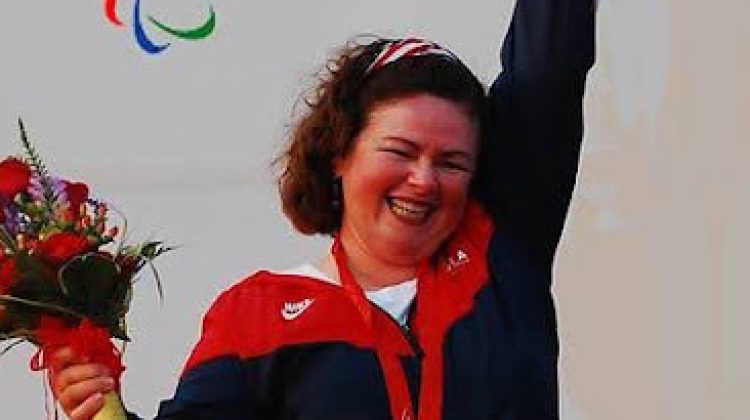
That love of the ocean (and a lot of hard work) carried McKinnon from the North Shore to Beijing, China in 2008, where she made history as the first woman to represent the United States in Paralympic sailing and helped win the country’s first gold medal in the sport.
She shared that experience with her sailing partner, Nick Scandone.
“It was a hell of a year,” McKinnon said. “My teammate and I were both going through a tremendous amount of challenges.”
McKinnon’s 2-year-old had been diagnosed with cancer. Scandone was living with Lou Gehrig’s Disease, or ALS, and throughout the training year the disease was affecting his physical abilities and his voice. They kept going. They were able to adapt their boat to Scandone’s declining health, using systems that amplified his voice and allowed some sailing maneuvers to be done electronically.
“The thing about Lou Gehrig’s is you don’t lose your intelligence,” McKinnon said. “And he was an incredibly smart sailor.”
After a small mistake that left the pair tense in their first practice run, the games were, in all senses, smooth sailing. McKinnon noted that they looked at the scoreboard and saw what is called a “picket fence,” where their first-place finishes lined up in a row.
By the end of the penultimate day of sailing, McKinnon and Scandone had achieved a score so high that no matter what happened the next day, they had already won the gold medal.
So on the last day of racing, the pair took a victory lap up and down the seawall where all the international supporters cheered them on. For McKinnon, this moment is still emotional, nearly twenty years later. She wasn’t thinking about herself or her hardships, but about Scandone.
“It was a really beautiful thing, because everyone knew how disabled [Scandone] had become from his disease, and how he was continuing to sail his very, very best,” McKinnon said. “There was such an incredible international support for our win.”
Standing on the podium while the flag was raised and the U.S. National Anthem played was emotional. “We had overcome so much to get there,” she said. Scandone, a gold medalist, died the following January.
In the years since that victory, McKinnon has built a life that reflects many of the same values that shaped her sailing career — resilience, adaptability, and community. Today, she spends much of her time in Swampscott at The Residence at Vinnin Square, where she works as an engagement assistant helping seniors stay active, connected, and engaged.
McKinnon’s favorite programs involve word games and book clubs, but what she really values most is connecting with the residents. Her own experience navigating life with a disability helps her relate to residents who may be facing their own physical challenges or the changes in their lives.
“It gives me a relatability that you just can’t get any other way,” she said. “Whether they’re facing mobility challenges or sight challenges, arthritis that affects their hand function…they see me rolling around, and they know that I’ve been through something similar and I can relate.”
Adaptability, something that McKinnon knows well, is central to the way of life at The Residence. The building itself is accessible, which is not only important to McKinnon as a wheelchair user, but for promoting an easy sense of belonging for the people that live there.
“Sometimes people move here out of frustration with not having the ability to get around their own home anymore. And they can come here with no barriers,” McKinnon said. “That’s what we try pretty hard here to do is to not have any barriers for participation or getting around.”
Sometimes those solutions are simple — enlarging bingo cards for residents losing their vision or adapting activities so people with arthritis can still participate. The goal, she said, is the same principle that drew her back to sailing years ago: making sure people can still take part.
“So many of these adaptations are so simple,” McKinnon said. “But they’re very meaningful. Because they can participate with their peers. And that’s what sports bring to me.”
McKinnon is also continuing to advocate for adaptive sailing. She is currently working to organize a sailing clinic for blind sailors, using specialized audible markers and signals that allow competitors to navigate a course without sight. To her, sailing remains one of the most adaptable sports in the world.
“The beauty of sailing is that it can be adaptable for anyone,” she said.
McKinnon still races locally and internationally, including in the small single-handed 2.4-meter boats to be accessible for sailors with mobility challenges. And more than a decade after standing on a Paralympic podium, she still feels the same pull toward the water — the wind, the motion and the sense of freedom that first brought her there.
Now, like that victory lap along the seawall in Beijing, McKinnon still has a crowd cheering her on — only this time it’s the community at The Residence at Vinnin Square. When she returns from sailing trips, they greet her with posters, balloons, and even a cake after her most recent World Championships.
“It’s nice to know they’re behind me,” McKinnon said. “And they know, of course, that I’m always behind them.”