SWAMPSCOTT — Members of the Climate Action and Resilience Committee reviewed a preliminary flood mitigation study Tuesday night outlining a range of potential options for reducing flooding along the town’s coast amid concerns of sea level rise.
The preliminary study, prepared by engineering and design firm Kleinfelder using federal ARPA funding, examines potential flood mitigation strategies for Fisherman’s Beach and surrounding waterfront properties.
“The town funded Kleinfelder to go off and investigate mitigation to the flooding events that we have in town that are pretty frequent now,” committee Chair Martha Schmitt said. “So they started over a year ago, and are a little behind schedule basically.”
Schmitt said Tuesday’s presentation was largely intended as a progress update on what consultants have learned so far and what potential strategies remain under consideration.
The study divides the affected area into three primary sections: the Fisherman’s Beach parking lot and beach area, the Fish House, and the privately owned shoreline and seawalls along Puritan Road.
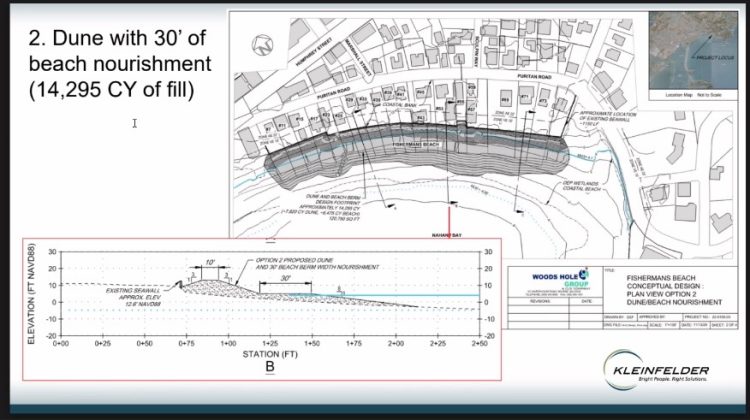
For the beach and parking lot area, consultants examined a range of possibilities, including raising seawalls, elevating portions of the parking lot, installing flood barriers and tide gates, and other beach and dune restoration concepts. Committee members noted that many of those options still need to be modeled to determine whether they would effectively reduce flooding without creating new problems elsewhere along the shoreline.
Committee members expressed skepticism about natural beach nourishment projects, questioning whether additional sand and dune systems would actually provide lasting protection against future storms and regular tides.
“Who knows how quickly that would erode,” committee member Richard Frankel said. “One big storm might just wash it all away.”
Others raised concerns about relying too heavily on seawalls, arguing that large coastal structures can sometimes accelerate erosion and might degrade the quality of the beach.
“Having more of a seawall also makes your beach less,” committee member Geralyn Falco said. “I mean it takes the sand out too.”
Members also discussed the drawbacks of certain seawall designs, including cantilevered seawalls — curved structures designed to push wave energy back toward the ocean. While those designs can reduce overtopping, some committee members argued they can also worsen beach erosion.
“You’re talking about scouring the beach too,” Falco said. “The water comes down and goes straight down. It’s going to take the sand and scour it away with each wave.”
The committee also reviewed several concepts for the Fish House, one of Swampscott’s most historic waterfront landmarks. Among the approaches discussed were wet and dry floodproofing, relocating the structure, and elevating it above projected flood levels. Committee members discussed the advantages and drawbacks of each option, including cost, insurance implications, and the building’s historic status.
Relocation drew particular attention because of what it could mean for the building’s historic designation.
“It would be very costly,” Schmitt said. “Apparently it wouldn’t be considered a national historic site anymore.”
Committee members also discussed elevating the Fish House, similar to projects that have been undertaken in other flood-prone coastal communities. While some questioned how effective such a solution would remain decades into the future as sea levels continue to rise, others noted that elevating vulnerable structures has become a common adaptation strategy along the coast.
The committee noted that the Puritan Road sections would require resident input because much of the shoreline infrastructure there is privately owned. Any future seawall improvements would likely require significant coordination with property owners, who would ultimately be responsible for maintaining those structures.
Preliminary cost estimates were provided by Kleinfelder, though committee members noted that any figures included in the study were only projections, reflecting current construction costs and could change substantially before any project is undertaken.
“These are 2026 costs, so in 10 years when it actually starts getting done … that could be up from that,” Falco said.
According to committee members, the next phase of the project will involve additional modeling by Woods Hole Group, updated schedules from Kleinfelder, and an eventual presentation to the Select Board. The committee also acknowledged that community outreach and education was not included in the original scope of the study and will likely need to be addressed separately as the project moves forward.
“They’re not funded to do any community engagement, so that wasn’t included in the budget,” Schmitt said. “We have to do some of that.”