The best coach the Patriots ever had was not Bill Belichick and it is not Mike Vrabel. It was Chuck Fairbanks.
Sadly, Fairbanks ran afoul of owner Billy Sullivan, who makes everyone else you want to name seem like Amos Alonzo Stagg. Fairbanks left town in 1978, and we had to endure Ron Erhardt and Ron Meyer before Raymond Berry became head coach in the middle of the 1984 season.
Berry, who died last week at 93, was an anomaly among football coaches, especially in this era. He never set out to be the star, or even the most important person in the room. If you didn’t know him, or know his history, you’d think he was some guy from the Foxborough Chamber of Commerce who wandered in to coach.
Let’s backtrack. Fairbanks came on board in 1973, and he was not Sullivan’s first choice. Joe Paterno was. Fairbanks, who made his mark by being one step ahead of the posse, left Oklahoma just as the NCAA was about to slap sanctions on the school for recruiting violations. He came here and swept the place clean. Still one of the shrewdest judges of talent we’ve had here in any sport, Fairbanks’ drafts netted John Hannah, Steve Grogan, Mike Haynes, Darryl Stingley, Julius Adams, Russ Francis, Steve Nelson, Leon Gray, and Stanley Morgan, among others.
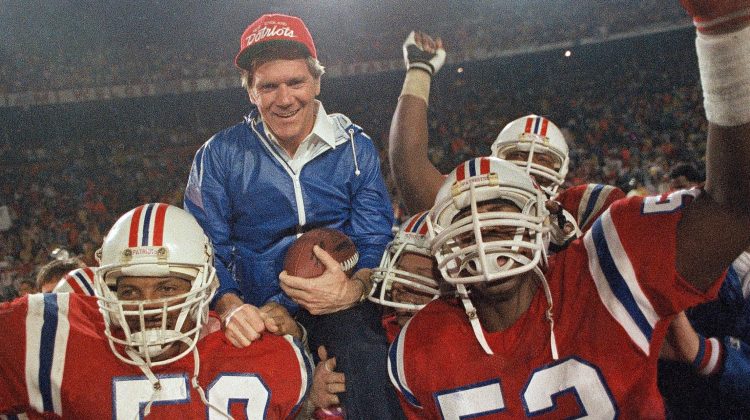
The ones who survived Sullivan’s buffoonery, except for Stingley (who was paralyzed by an exceptionally hard hit by Raider Jack Tatum), all played on the 1985 Super Bowl team — coached by Berry.
Fairbanks was the real deal. Erhardt was a born offensive coordinator (he was Bill Parcells’ OC in New York), and Meyer was simply a fraud.
Berry, one of the best wide receivers in NFL history to that point (a hall-of-fame career with the Baltimore Colts), understood the talent he had inherited and did what all good coaches do: he put his athletes in the best position to win. He didn’t reinvent the game. He didn’t turn the spotlight on himself in any way, either positively or negatively. There were no “we’re onto Cincinnati” comments after tough losses. There’s no known attempt by him to cheat. He just coached. He even managed to make quarterback Tony Eason useful. And he even managed to recognize that for one half-season, in 1988, Doug Flutie had caught lightning in a bottle, and Berry rode him until the fire went out.
And coach he did. For the rest of 1984 and through 1988, the Patriots were finally relevant. At least until that initial burst of talent aged out.
But Berry was not the general manager, and he did not conduct drafts. There’s no way of knowing whether Berry would have done any better than Bucko Kilroy, but it would have been interesting to see. Once that core group of talent retired, Berry was gone by 1989 and Rod Rust, his defensive coordinator, took over. Rust was a bust. So was Dick MacPherson, a real good guy who was sick with diverticulitis during his tenure.
Parcells was hired after MacPherson was let go, and that’s when the team’s culture changed for good.
We tend to judge Berry on his coaching, but we cannot forget how well he played. He was instrumental in the Colts winning the greatest game in NFL history — the 1958 championship victory over the New York Giants, catching 12 passes for 178 yards, including a touchdown.
He knew how to win, and he somehow passed that along to a group of guys itching to do the same.
One Berry vignette stands out. In 1985, the Patriots were at the Orange Bowl — a place where they hadn’t won since 1966 — to play the Dolphins. They were staging a last-minute push that would have won them the game when Eason was intercepted. As he lay on the ground for a long time after the game ended, Berry came out, picked him up, put his arm around him, and walked him off the field. The next time the Pats were in Miami was for the ’85 AFC championship game, in which they “Squished the Fish” and broke that curse. Eason played the whole game.
Did you ever see Belichick do anything like that?