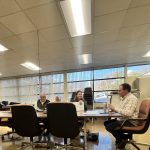
LYNN — The Water & Sewer Commission unanimously approved the FY27 operating budget, capital improvement plan, and rate and fee schedule during Monday’s meeting.
The three separate motions were voted on by Commissioner Vincent Lozzi Jr., Michael Celona, and Thomas O’Shea to allow allocation of funds to current and future proposed plans.
No public statements or requests were sent to the commission’s treasurer, Ryan Boisselle, following the commission’s public hearing on June 2, regarding the increase in water and sewer rates for residents.
The approval of the FY27 operating budget will allow around $32 million for the combined sewer overflow (CSO) sewer separation project that started back in 2017. More allocations to the budget include chemicals for the treatment plant, the electricity for the water treatment plant and wastewater plant, and water pump stations, Boisselle said.
Money allocated to the $200 million proposed plan, including renovations to the current water treatment plant and a potential new water treatment plant, will not be spent just yet, with the approval of the FY27 capital improvement plan.
Apex Senior Principal and city consultant Eric Kelley shared plans to reveal expectations by July 4 for those proposed projects that could raise residents’ bills as a result.
“We went over the siting analysis with staff prior to the start of June, and now we’re waiting on our cost estimator to take the existing kind of concepts and price out both the rehab and replacement of both the main plant and the low service pump station.”
Without firm cost estimates for rehabilitating or replacing the treatment plant and pump stations, the commission faces challenges planning future expenditures, Boisselle said.
“We’re probably talking fiscal 2028, before we start spending any real money on that,” Boisselle said.
The projects within the capital improvement plan are viewed as a wish list to the commission, and some projects that will require cash funds and are not allocated into the budget include the repainting of the Twin Road tank, estimated at around $1.2 million, vehicle replacements, and water meter installations, Boisselle said.
“We want to do it all, but you know, if there’s funds, there’s funds,” Boisselle said. “So that capital improvement plan is not factored into the (operational) budget anywhere, that’s why it’s voted on separately.”
Revenues from residents’ water and sewer taxes and the reserved money in the FY27 capital improvement plan allow the commission a security blanket for emergencies like water main repair.
“God forbid there’s a sinkhole that opens up in the Lynnway that needs attention… if God forbid we get no water and we go through withdrawals in the fall, we’re gonna have to buy water from the MWRA, and that’s all capital improvement,” Boisselle added.
The fall season could be bleak for the commission, with today’s record drop in the Lynn reservoir capacity to 69.8%, a drop of another 3.5% from the already low levels presented on May 30, Water Treatment Superintendent Matt Comeau said.
Comeau suggested a crackdown on residents watering their lawns as a resolution to the consistent drop in reservoir numbers, saying commissioners may need to begin contacting residents directly to remind them to turn off their sprinklers.
The consistent depletion in reservoirs may lead the commission down a similar path they’ve been down before. Comeau referred to an August 1999 record: “They were doing some repairs to some of the dams, and they intentionally let the reservoirs drop, and it got below 50% by the end of August, so you know that’s where we’ll be,” Comeau said. “We don’t want to get to that level.”
Boisselle added how important it was for the FY27 budget to be approved, stating that if it were not, they would need to use the last fiscal budget’s remaining money to get by on necessary costs.
“If they didn’t vote for the operating budget, that’s a problem; if they didn’t approve my new rates, that’s a bigger problem because that means I have to operate FY27 expenses on last year’s rates, which we could squeeze by, but we wouldn’t have any capital funds to be able to fund these other projects,” Boisselle said.